



Musculoskeletal Disorders in France: What Is the Current Situation?
Santé publique France has released new data on the prevalence of musculoskeletal disorders in France, both in the general population and among the working population, broken down by socio-professional category and economic sector.

Musculoskeletal disorders
thematic dossier
Musculoskeletal disorders primarily manifest as pain and functional impairment of varying severity, often occurring on a daily basis and caused or exacerbated by work
In France and around the world, musculoskeletal disorders (MSDs) are the leading cause of work-related morbidity¹ and the leading cause of compensated occupational diseases, accounting for 88% of occupational diseases recognized by the general social security system: 44,492 cases in 2019².
Santé publique France is releasing new data today on the prevalence of MSDs in the general population and by socio-professional categories and sectors of activity, drawn from the 2021 Health Barometer, as well as an update on the annual surveillance indicators for carpal tunnel syndrome and lumbar disc herniation in the general population, also available as open data on Santé publique France’s Géodes mapping observatory.
All of this data, derived from multi-source epidemiological surveillance, provides essential insights for occupational health stakeholders, whether in prevention or research. It confirms the significant burden of MSDs in France, with nearly 60% of women and over 50% of men reporting pain related to MSDs of the back or upper limbs.
Musculoskeletal disorders affect both men and women
3 out of 5 women and 1 out of 2 men report pain related to musculoskeletal disorders
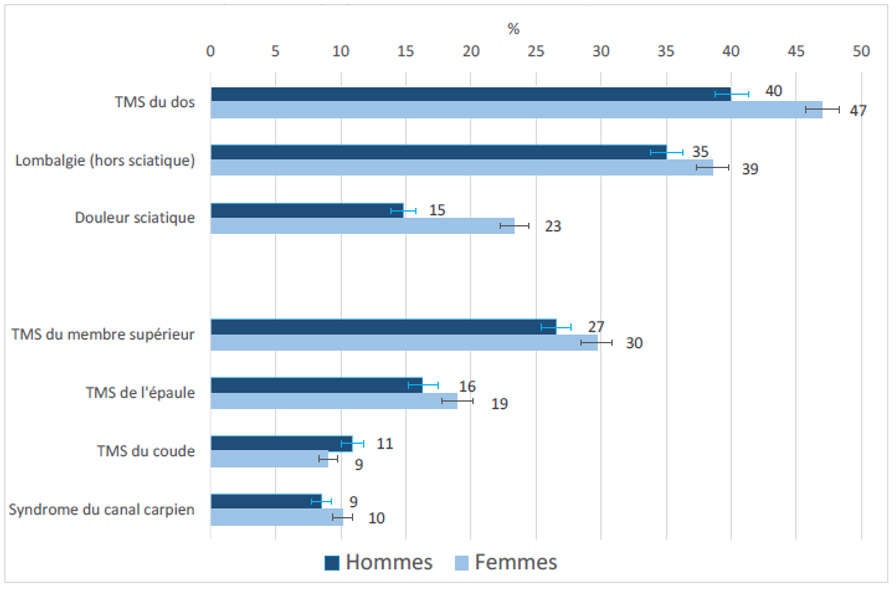
The study shows that the prevalence of all MSDs studied (back and upper limbs) in the general population aged 18 to 64 is 58% among women and 51% among men. The prevalence of back MSDs is 47% among women and 40% among men; the prevalence of upper limb MSDs is lower, at 30% among women and 27% among men. For both body regions, prevalence increases with age for both sexes.
Among employed adults aged 18 to 64, the data are comparable, with 60% of women and 54% of men reporting MSDs of the back and upper limbs. The prevalence of MSDs of the back is 48% among women and 42% among men; that of MSDs of the upper limb is lower: 31% among women and 28% among men.
The most commonly reported MSDs are lower back pain (excluding sciatica) in the back and shoulder MSDs in the upper limbs.
Prevalence of musculoskeletal disorders of the back and upper limbs over the past 12 months (and 95% confidence interval) in the population aged 18–64, overall and by location, by sex
Learn more

enquêtes/études
11 June 2024
Prevalence of musculoskeletal disorders in France, among the general population and the working-age population, by socio-occupational category and economic sector. Results from the 2021 Santé publique France Health Barometer
The number of surgeries for carpal tunnel syndrome and lumbar disc herniation remained stable between 2018 and 2022
In France, in 2022, 124,011 people underwent surgery for carpal tunnel syndrome (CTS) and 20,971 for lumbar disc herniation (LDH). These figures are relatively stable compared to 2018 (125,430 for CTS and 29,627 for LDH).
Women accounted for the majority of patients undergoing surgery for CTS, while men were more likely to have undergone surgery for LDH. Furthermore, regardless of the condition considered, incidence rates were higher in the working-age population (20–64 years) than in the general population.
Over the study period, incidence rates were declining for HDL (an average annual decrease of 3.3% among women and 4.2% among men) as well as for SCC among women (an average decrease of 2.1%). Only the incidence rate of SCC among men showed a positive average annual increase (+0.6%).
Learn more

Musculoskeletal disorders - Data
Certain industries at higher risk for musculoskeletal disorders
This study identified the sectors that should be prioritized for prevention campaigns: manufacturing and construction for men, and the human health and social work sector for women. Additional indicators, in terms of impact on employment or professional careers, could complement the morbidity indicators studied and provide a different perspective on this issue. In the workplace, prevention interventions that address both occupational and personal risk factors must be implemented, such as adapting workstations, reorganizing work processes, or mitigating psychosocial risks.
In daily life, it is also recommended to limit sedentary behavior to promote good musculoskeletal health.
1 Brière J, Fouquet N, Ha C, Imbernon E, Plaine J, Rivière S, et al. Occupational health indicators. Musculoskeletal disorders of the upper limb in France. Saint-Maurice: Institute for Public Health Surveillance; 2015. 51 p.
Ha C, Roquelaure Y. Work-related musculoskeletal disorders in France. Where do we stand today? Bull Epidémiol Hebd. 2010;No. 5-6.35-37.
2 Cnam. 2019 Annual Report [Internet]. Paris: Health Insurance - Occupational Risks; 2020, p. 168.












