



Epilepsy appears to be an indicator of health inequalities in France
Santé publique France has released the results of a study on epilepsy treated in 2020, which show a prevalence similar to that observed in the United States and England, as well as significant social and regional disparities.

Social and Regional Health Inequalities
thematic dossier
Health inequalities affect the entire population across the country and across the social spectrum, and can emerge at a very young age. Measures that promote equal opportunities for...
Epilepsy is defined as the repeated occurrence of seizures not triggered by a specific cause, such as head trauma or a high fever. Epilepsy is a common chronic condition with significant personal and social implications. However, epidemiological knowledge remains incomplete, and social and regional variability has rarely been studied. The study published today by Santé publique France is the first to produce estimates of the prevalence of treated epilepsy at the regional and departmental levels in France over the past 20 years, and one of the few studies worldwide to assess prevalence at the national level. This was made possible by using data from the National Health Data System (SNDS), which compiles all healthcare services reimbursed by the Health Insurance system for all individuals residing in France and enrolled in a health insurance plan (representing approximately 99% of the population). The high prevalence and the social and regional inequalities highlighted in this study justify the implementation of a new epidemiological surveillance system as part of our mission to monitor the health status of the population.
Nearly 700,000 people with epilepsy receiving treatment in France
As of January 1, 2020, 685,122 people with epilepsy receiving treatment were identified in France, of whom 41% had been hospitalized and 29% had long-term illness status.
The prevalence of treated epilepsy estimated from the SNDS was 10.2 per 1,000 inhabitants, identical for men and women. It is similar to that observed in the United States and England. For comparison, the prevalence was 12 per 1,000 in the United States in 2015, 6.0 per 1,000 inhabitants in Japan, and 9.4 per 1,000 inhabitants in the United Kingdom in 2019.
Epilepsy prevalence increases with age
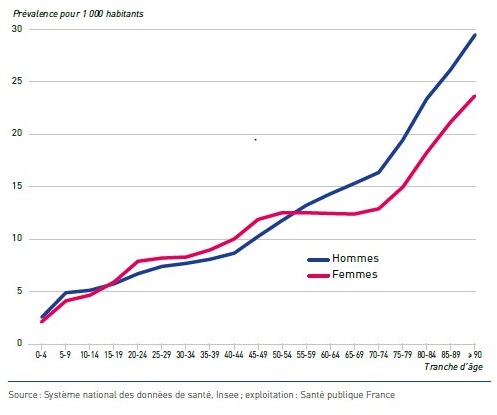
In both men and women, the prevalence of epilepsy increases with age. For men, it rises gradually from 2.6 to 8.7 per 1,000 people between the ages of 40 and 44, then more sharply after age 65, reaching 20 per 1,000 people by age 80. For women, a similar trend is observed, with a slightly higher prevalence of around 12 per 1,000 people between the ages of 45 and 74, followed by a sharp increase thereafter, as seen in men. The increase in the prevalence of epilepsy at an earlier age among men is mainly due to comorbidities, particularly cardiovascular conditions, and especially strokes, which are a cause of epilepsy and occur earlier in men.
Prevalence of epilepsy (per 1,000 people) by sex and age group
Significant social and regional disparities
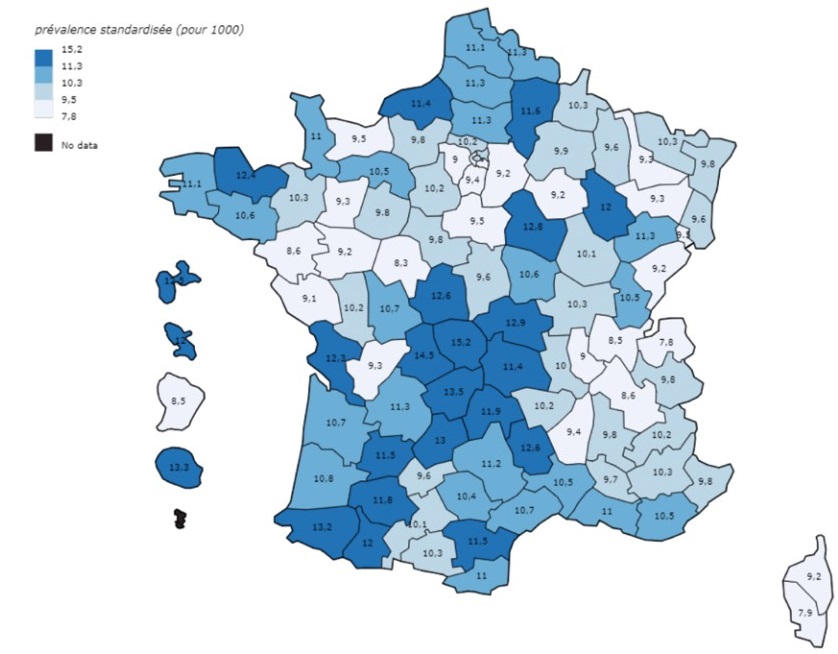
The study reveals significant social and territorial inequalities, with the highest rates concentrated along a northeast-southwest diagonal, in the northern departments, as well as in certain overseas departments and regions such as Réunion.
These territorial inequalities can be partly explained by the frequency of associated cardiovascular comorbidities and the socio-economic vulnerability of these regions.
Standardized prevalence (per 1,000 inhabitants) of epilepsy by department in France as of January 1, 2020
Furthermore, prevalence increases steadily with increasing social disadvantage, with a 42% difference between the most disadvantaged quintile (10.1 cases per 1,000 inhabitants) and the least disadvantaged quintile (7.1 cases per 1,000 inhabitants). The increase in the incidence of first epileptic seizures observed among socially disadvantaged individuals could be partly explained by exposure to toxins in utero and during early childhood, as well as to pollution. Similarly, stigma, the side effects of epilepsy treatment, and associated comorbidities can lead to greater difficulty in finding or retaining employment for people with the condition, or even to a decrease in income.
Download

enquêtes/études
4 April 2024












