
thematic dossier
Work-related illnesses
Dues à des expositions professionnelles, les principales maladies en lien avec le travail sont surveillées par Santé publique France dans l’objectif d’élaborer, avec les partenaires, les...




Santé publique France has published the results of a study on the link between teleworking conditions and the onset of low back pain, taking depressive symptoms into account, and identifies ways to reduce the risk.
thematic dossier
Musculoskeletal disorders primarily manifest as pain and functional impairment of varying severity, often occurring on a daily basis and caused or exacerbated by work
Work organization is known to have both direct and indirect effects on occupational health in general and on musculoskeletal health. Low back pain in the workplace is the leading cause of musculoskeletal morbidity. It is defined as pain localized between the thoracolumbar junction and the lower gluteal fold. According to existing studies, teleworking can lead to increased sedentary behavior, prolonged and uncomfortable trunk postures, or an increase in psychosocial risks, such as social isolation, which influence the onset and progression of low back pain.
Following the three lockdowns implemented to combat the COVID-19 pandemic, the nature and organization of work in France have been profoundly altered, notably with an increased reliance on telework.
As regular teleworking becomes a long-term reality, particularly with the rise of hybrid work, it seemed necessary to better understand the complex links between teleworking conditions, depressive symptoms, and the onset of low back pain. In this context, and based on a panel from the CoviPrev1 survey, Santé publique France conducted a study aimed at identifying effective levers for action to reduce the health impacts of remote work or hybrid work.
The study surveyed nearly 1,500 workers who were free of lower back pain at the start of the third lockdown. To measure the impact of remote work on health, several variables were taken into account, such as the number of days worked remotely, satisfaction with remote work conditions, gender, age, and body mass index.
The results show that:
The proportion of the workweek spent working from home appears to influence the onset of lower back pain: the prevalence of lower back pain drops from 9% for full-time remote work to 5% for hybrid work (part-time remote work).
The physical conditions of remote work and the proportion of remote work influence satisfaction with remote work conditions.
Satisfaction with remote work conditions reduces the risk of depressive symptoms and the onset of low back pain. Furthermore, the presence of depressive symptoms increases the risk of low back pain.
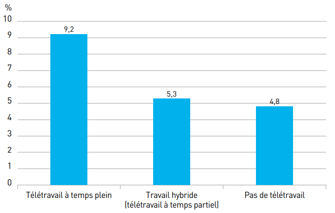
These findings, obtained during the third lockdown, provide a better understanding of the chain of factors contributing to the onset of low back pain in teleworking situations, although further research is needed as teleworking becomes a long-term feature of workplace organization. In particular, they highlight the importance of the physical conditions of remote work (dedicated room, second screen, keyboard, office chair) as well as certain aspects of work organization, such as the proportion of remote work per week, in reducing the impact of remote work on health.
Encourage employers, in collaboration with occupational health services, to take measures to reduce the negative impact of new work arrangements, drawing on the resources of national and regional prevention agencies (Anact-Aract, INRS, Carsat, MSA…).
Provide appropriate equipment for home use (furniture, height-adjustable monitors, etc.).
Disseminate ergonomic recommendations for setting up workstations (e.g., practical presentation sessions via videoconference) to improve workplace ergonomics and satisfaction with working conditions.
Monitor the percentage of telework implemented and encourage regular breaks to facilitate movement and combat prolonged sitting.
Combine these ergonomic and organizational interventions with multidimensional approaches involving all stakeholders.
Download

rapport/synthèse
15 September 2026
1-The CoviPrev survey, conducted in mainland France among people aged 18 and older, aims to track changes in health—particularly mental health—and the adoption of protective measures against COVID-19 during and after lockdown.
thematic dossier
Dues à des expositions professionnelles, les principales maladies en lien avec le travail sont surveillées par Santé publique France dans l’objectif d’élaborer, avec les partenaires, les...












