


Chlordecone and Other Pesticides: Santé publique France Presents New Findings in the French West Indies
Chlordecone, a pesticide that is toxic to humans and causes long-term water and soil contamination, was used in banana plantations in the French West Indies from 1972 to 1993. Since 2004, and particularly through the initiatives of the various chlordecone action plans, Santé publique France and ANSES have been conducting research to improve understanding of the exposure of Caribbean populations to this pesticide and the potential associated health risks.
On the occasion of the scientific symposium and public briefing sessions on chlordecone pollution, which are being held in Martinique and then in Guadeloupe from October 16 to 19, Santé publique France is presenting several findings from studies on the general population’s dietary exposure to chlordecone, the accumulation of chlordecone and other environmental substances in the population, and prostate cancer surveillance. Organized with the support of the Scientific Guidance and Monitoring Group (GOSS) of the National Chlordecone Action Plan, this conference will bring together nearly 200 experts over two days. Scientists, institutional representatives, professionals, and community organization members will participate in scientific sessions and workshops aimed at reviewing research progress in this field, comparing solutions, and identifying new research directions. The symposium will conclude with two days of open discussion accessible to all, to engage with the public on the results of the scientific work.
The results of the studies presented by Santé publique France focus:
on the one hand, the exposure of the Caribbean population to chlordecone and other pesticides;
and on indicators for monitoring prostate cancer.
Dietary exposure and blood contamination
Dietary exposure and bioaccumulation are two components of the Kannari study.
The dietary component, led by ANSES [link], shows that food contamination by chlordecone, dietary exposure, and the resulting health risks vary widely and depend in particular on the foods and the supply chain in contaminated areas. This study also helps identify the foods and supply chains that contribute most to exposure.
The component on chlordecone and other pesticide exposure in the adult population, led by Santé publique France, indicates that blood exposure to chlordecone among adults is widespread (this pesticide is detected in over 90% of individuals) but highly variable: 5% of participants have exposure levels at least ten times higher than the average. Another important finding: while a decrease in chlordecone exposure has been observed for the majority of the population since 2003, exposure levels among the most exposed individuals have not decreased.
Exposure of banana farm workers
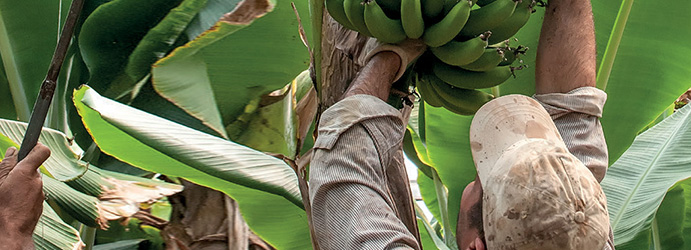
Assessing agricultural workers’ exposure to chlordecone and other pesticides was the objective of the Matphyto-DOM study conducted by Santé publique France and partially funded by the Écophyto plan. This study retrospectively documented, using three data sources, the exposure of banana farm workers to all pesticides used since 1960 in this crop, including chlordecone.
According to this study, the vast majority of agricultural workers in Caribbean banana plantations were exposed to chlordecone during the period when this pesticide was in use (77% in 1989). Furthermore, banana workers in the Caribbean are still exposed today to other pesticides that also have potentially harmful health effects.
Santé publique France and Inserm have reconstructed, using archives and recent data, the cohort of banana workers. This cohort, now comprising more than 13,000 workers, enables the study of the health status of this population highly exposed to various pesticides.
Epidemiological Surveillance of Prostate Cancer in the French West Indies
The study on indicators for the epidemiological surveillance of prostate cancer in the French West Indies is the result of a collaboration between Santé publique France, the National Cancer Institute, the Hospices Civils de Lyon, and the French cancer registry network Francim.
The main finding is that prostate cancer incidence rates in Guadeloupe and Martinique are among the highest in the world. This finding is comparable to the situation on other Caribbean islands and among African-American and Black British populations. However, spatial analysis of the distribution of prostate cancer cases in Martinique does not show an excess in areas contaminated with chlordecone. The role of other risk factors in explaining this high rate of prostate cancer remains to be studied.
What’s next?
Further research will track changes in exposure to chlordecone and other pesticides in the French West Indies to assess the effectiveness of public policies aimed at reducing exposure. In response to these findings, dietary recommendations for the population will be updated to help citizens reduce their exposure.
The Chlordecone Plans I (2008–2010) and II (2011–2013)
In response to concerns expressed by the public regarding the effects of chlordecone pollution in Martinique and Guadeloupe, the French government has deployed significant resources to address this pollution situation through the Chlordecone Plans I and II.
Through these two plans, the actions of the government and its agencies have focused primarily on five areas:
Improving knowledge: characteristics of the molecule, characterization of the pollution and its evolution, effects of exposure to chlordecone on human health and epidemiological studies, characterization of population exposure.
Protecting populations through plans to monitor compliance with food contamination standards;
Developing and strengthening regional measurement capabilities (analytical laboratories);
Raising public awareness.
The Chlordecone III Plan (2014–2020)
Building on the first two plans, this plan aims to continue the actions undertaken to protect the population (surveillance and research) while also supporting professionals heavily impacted by this pollution. The Chlordecone III Plan comprises four key areas:
the development of a sustainable development strategy to improve the quality of life for communities and facilitate rational behavioral change.
The second priority promotes a strategy of health risk prevention and population protection through exposure reduction.
the development of research initiatives in human health, animal health, the environment (air, water, soil, plants), and the humanities, economics, and social sciences;
support for fishing and agricultural professionals whose activities are impacted by this pollution.
Links
Summary providing an update on the work of Santé publique France and ANSES
Exposure of the Caribbean population to chlordecone and certain organochlorine compounds in 2013/2014 – Kannari Study (report and summary)
Assessment of occupational exposure to pesticides used in banana cultivation in the French West Indies and description of their health effects – Matphyto DOM Project (report and summary)
French Agency for Food, Environmental and Occupational Health & Safety (ANSES)












