



Avian influenza: moving toward enhanced human surveillance to detect early transmission to humans
In light of the current spread of highly pathogenic avian influenza viruses in Europe and France, Santé publique France is stepping up its surveillance efforts to detect any cases of transmission of these viruses to humans at an early stage.

Avian influenza
thematic dossier
Some avian influenza viruses can infect humans, and sporadic cases are regularly detected, but the risk of transmission remains low. No cases of human-to-human transmission have been reported...
Since October 2021, Europe has been experiencing the most severe outbreak of highly pathogenic avian influenza (HPAI) ever recorded, caused by H5Nx viruses (almost exclusively H5N1) of clade 2.3.4.4b. Furthermore, since the fall, a new pattern of spread of the highly pathogenic avian influenza (HPAI) virus has been observed in migratory wildlife (particularly greylag geese and barnacle geese) as well as in poultry farms and captive bird facilities.
In France, following a lull of several months in poultry farms, several outbreaks in farms have been detected since late November 2023, leading the Ministry of Agriculture and Food Sovereignty to raise the epizootic risk level for HPAI to its highest level, thereby enabling the strengthening of preventive measures to protect poultry farms. In this context, and given the current situation in Europe and France, a so-called “active” surveillance program for avian influenza cases among individuals exposed to an HPAI outbreak is being tested in four regions to enable early detection of any animal-to-human transmission. This situation calls for heightened vigilance among individuals exposed to these viruses as well as among various stakeholders in animal and human health.
What is avian influenza?
Avian influenza is an animal disease caused by influenza viruses that affect a wide variety of bird species. These diseases can sometimes be transmitted to other species, including humans and many species of wild or domestic mammals. However, transmission of these viruses to humans remains rare, and none of the avian influenza viruses currently known are capable of sustaining human-to-human transmission.
Learn more about avian influenza
What is the purpose of monitoring human cases of avian influenza?
For several years, Santé publique France has been conducting surveillance of human cases of zoonotic influenza. This surveillance is based on monitoring clinically suspected cases of avian or swine influenza (so-called “passive” surveillance) reported by healthcare professionals. Its objective is to:
detect as early as possible any symptomatic case of avian or swine influenza in humans in order to promptly initiate appropriate medical care and investigations aimed at reducing the risk of transmission to others (isolation of confirmed cases and investigation of contacts and co-exposed individuals);
describe and characterize human cases of infection with an avian or swine influenza virus.
SAGA: An Enhanced Surveillance System
In addition to “routine” surveillance, the current situation regarding avian influenza in France and internationally has prompted a strengthening of surveillance for these viruses in collaboration with animal health stakeholders. Santé publique France has therefore developed, in collaboration with the Ministry of Health and Prevention, the Directorate General for Food (DGAL), the National Reference Center (CNR) for Respiratory Infection Viruses, and the French Agency for Food, Environmental and Occupational Health & Safety (ANSES), a so-called “active” surveillance protocol named SAGA (for Active Surveillance of Avian Influenza). This protocol aims to detect cases of zoonotic transmission from animals to humans at an early stage in order to better understand them, thereby reducing risks to exposed individuals and limiting the spread of the virus. People who have been exposed to a confirmed outbreak of highly pathogenic avian influenza (HPAI) on a poultry farm (including asymptomatic individuals) are asked to answer a few questions about their exposure and to provide a nasopharyngeal swab.
This initiative is being implemented as a 4-month pilot study in four regions—Brittany, Pays de la Loire, Occitanie, and Nouvelle-Aquitaine—and aims in particular to assess the feasibility and relevance of this type of surveillance in the national context.
Health authorities, in collaboration with animal health stakeholders, will prioritize which outbreaks to investigate. For individuals not included in the investigation, they will be advised to monitor their health for 10 days following their last exposure to the outbreak. Two outbreaks have been investigated since the pilot program began in early December, with good compliance among exposed individuals. All tested individuals tested negative for avian influenza.
Learn more about the SAGA system
Preventing the Risk of Avian Influenza Transmission to Humans
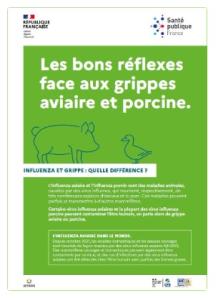
In terms of prevention, Santé publique France, in collaboration with several partners (DGS, DGAL, ANSES, Mutuelle Sociale Agricole, and the French Office for Biodiversity), has also developed an informational brochure on avian and swine influenza, explaining how these viruses are transmitted, how to avoid infection, and what to do in case of exposure to risk, particularly if symptoms appear. The brochure is available for download and can be ordered.
Preventing the risk of avian influenza viruses spreading to humans relies on wearing personal protective equipment when handling sick or dead birds (impermeable gloves, protective goggles, FFP2 masks), as well as on all biosecurity measures when an outbreak occurs (see the Ministry of Agriculture’s leaflet).
Given the current circulation of human, avian, and swine influenza viruses within the country, it is important to emphasize the importance of seasonal flu vaccination for professionals exposed to avian and swine viruses in order to limit the risk of reassortment between human and animal influenza viruses.
Learn more:
European Situation Regarding Avian Influenza
Situation of avian influenza in France












