



Air Pollution: Necessary and Achievable Progress for Our Health
To mark National Air Quality Day on October 14, 2025, Santé publique France is releasing an infographic on the importance of measures to improve air quality and their direct benefits for our health.

Air
thematic dossier
Air pollution affects the entire population. The levels of pollutants found in the atmosphere are linked to health risks, and any reduction in exposure to these pollutants would be beneficial.
Air pollution remains one of the greatest environmental health risks worldwide. In 2021, according to the Institute for Health Metrics and Evaluation, air pollution (both outdoor and indoor) was the second leading risk factor for mortality.
In France, Santé publique France has been leading the Air and Health Surveillance Program (PSAS) since 1997 with two objectives:
To monitor and characterize the short-term (particularly during pollution episodes) and long-term health effects of ambient air pollution (including the development of concentration-risk functions).
To assess the health impacts of ambient air pollution and the benefits of implementing management measures (through EQIS—Quantitative Health Impact Assessments).
Even though air quality is improving overall each year, continuing policies to improve air quality remains a major public health challenge in France. In this context, Santé publique France has published an infographic titled “Air Pollution: Necessary and Possible Progress for Our Health,” and Sylvia Medina, coordinator of the “Air and Health” monitoring program at Santé publique France, discusses the major challenges related to air quality in France and its impacts on our health.
Air Pollution: Progress for Our Health Is Both Necessary and Possible
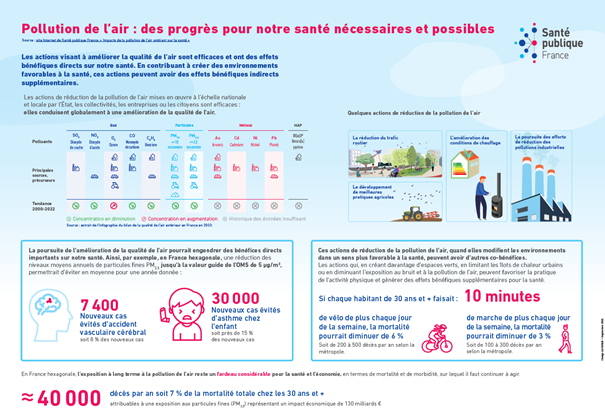
Download the infographic "Air Pollution: Progress for Our Health Is Both Necessary and Possible"
3 questions for Sylvia Medina, coordinator of the "Air and Health" monitoring program at Santé publique France
What is the current state of air pollution in France?

The 2023 annual report on outdoor air quality in France, published by the Ministry of Ecology, confirms that air quality has improved overall, in line with the reduction in pollutant emissions—except for ozone. However, regulatory air quality standards for health protection are still being exceeded in some areas. Furthermore, the European Air Quality Directive, adopted on October 23, 2024, sets stricter targets to be met by 2030 for several pollutants in order to better protect public health. Further improvements will therefore be necessary to achieve these targets.
What is the impact of exposure to air pollution?
40,000
deaths are estimated to be attributable to exposure of people aged 30 and older to fine particulate matter (PM2.5)
Public exposure to ambient air pollution remains a major public health issue. Santé publique France has estimated that nearly 40,000 deaths each year are attributable to exposure of people aged 30 and older to fine particulate matter (PM2.5), representing an annual economic cost to society of 130 billion euros.
The study published this year by Santé publique France estimated for the first time the impact of air pollution on the development of several diseases: tens of thousands of new cases of disease could be prevented by reducing levels of fine particulate matter and nitrogen dioxide in ambient air. For example: nearly 30,000 new cases of childhood asthma could be prevented each year by lowering PM2.5 levels to the WHO’s recommended values. The annual economic impact on society has been estimated at 9.6 billion euros, or 148 euros per year per person.
Read the press release: “Asthma, stroke, diabetes… what are the health impacts of ambient air pollution? And what is the economic impact?”
What about indoor air?
Indoor air is very often more polluted than outdoor air, and indoor air pollutants also have harmful effects on health. It should be noted that there is a significant circulation and transfer of pollutants from outdoor air into buildings. With more than 80% of our time spent in indoor environments (homes, schools, stores, transportation, etc.), it is essential to pay closer attention to the quality of these environments.
Learn more about health issues related to air and indoor environments
What solutions are available?
To continue reducing ambient air pollution and its impact on health, it is necessary to pursue collective and individual actions across all possible avenues. Beyond ambient air quality, public policies aimed at reducing this pollution can generate additional benefits and help create healthier and more pleasant environments to live in.
For example, reducing road traffic (a major source of particulate matter and nitrogen oxide emissions) frees up space currently dedicated to cars, making way for spaces that:
promote physical activity,
reduce noise pollution,
mitigate urban heat islands,
encourage social interaction.
Santé publique France will continue to produce data useful for local and national decision-making, particularly through updated estimates of the impacts of air pollution on mortality and morbidity.
In addition, to support local stakeholders, training sessions on conducting local EQIS* are held annually in collaboration with EHESP.
* Quantitative health impact assessment

Air and Indoor Environments
thematic dossier
Indoor air pollutants, as well as other factors (noise, heat, etc.), can have harmful effects on health. Since we spend more than 80% of our time in indoor environments (homes, schools, stores,...












