


Download

Acute Gastroenteritis: A Review of the 2020–2021 and 2021–2022 Winter Seasons
Santé publique France has released its annual surveillance data on acute gastroenteritis for the 2020–2021 and 2021–2022 winter seasons, which are also available as open data on Géodes.

Acute gastroenteritis
thematic dossier
Every year, there is an increase in cases of acute gastroenteritis (AGE), caused primarily by the circulation of noroviruses and rotaviruses. Noroviruses cause AGE in people of all ages, while rotaviruses mainly affect children under the age of 5.
During the winter season, Santé publique France, together with its network of partners, monitors the epidemiological trends of acute gastroenteritis and publishes weekly national and regional epidemiological bulletins on its website. This data is also made available as open data on Géodes.
Santé publique France is releasing today the summary of its winter surveillance covering the 2020–2021 and 2021–2022 seasons in metropolitan France and reminds the public of simple measures to take to limit the risk of infection.
What were the highlights of the past two seasons?
2020–2021: A season marked by historically low activity levels
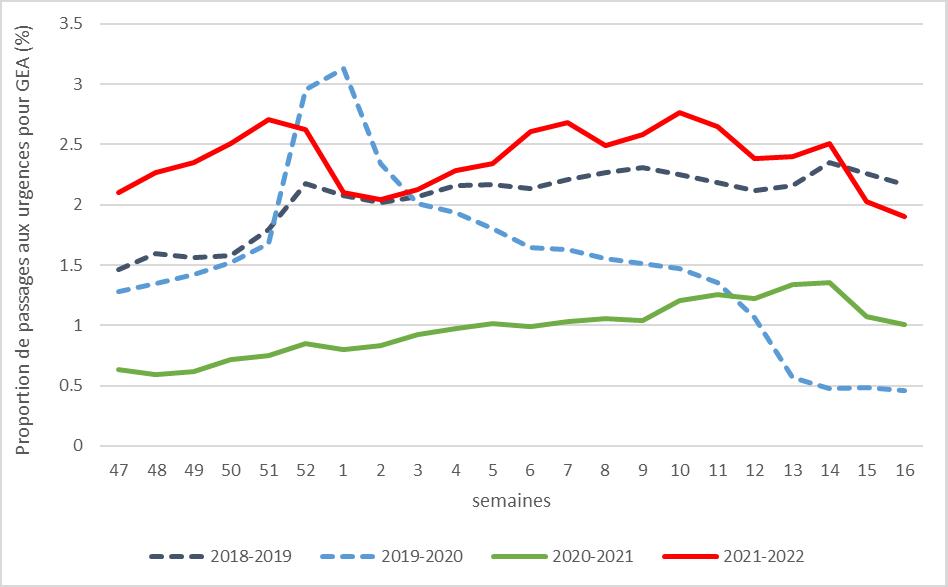
The low level of activity observed starting in March 2020 (end of the 2019-2020 season), amid the COVID-19 pandemic, continued throughout the 2020-2021 season. In private practice and in hospital emergency departments, activity remained relatively stable and lower than in the years prior to the COVID-19 pandemic across all metropolitan areas.
A return to activity levels comparable to pre-COVID seasons during the winter of 2021–2022
Activity levels recorded throughout the 2021-2022 season were once again comparable to those observed during pre-COVID seasons. In hospital emergency departments, activity for acute gastroenteritis remained close to historical highs from December 2021 to April 2022. Consultations at SOS Médecins were similar to the data observed before the COVID-19 pandemic.
Weekly trend in the proportion of emergency department visits for acute respiratory infections in mainland France, all ages, Oscour data, winter seasons 2018–2022
Download

bulletin national
28 February 2023
Acute Gastroenteritis: A Review of the 2020–2021 and 2021–2022 Winter Seasons
Children under 5: a group particularly affected in 2021
Among children under 5, acute gastroenteritis activity saw a particularly sharp increase starting in mid-November 2021, reaching levels comparable to the peaks observed during pre-COVID seasons at the same time of year. This significant resurgence of activity in this age group could be explained by the lack of acquired immunity against the most frequently isolated viruses (rotavirus and norovirus) in the two cohorts of children born in 2020 and 2021, thereby increasing the number of children susceptible to enteric viruses. Indeed, the containment measures taken to control the COVID-19 epidemic (enhanced hygiene measures, lockdowns, closure of preschools, etc.) may have limited the circulation of enteric viruses1.
Rotavirus vaccination for infants and young children

Rotavirus vaccination is now recommended by the HAS in France for all infants. Its purpose is to protect young children from diarrhea—sometimes severe—caused by these viruses, which may require hospitalization. To inform parents, Santé publique France has created a new informational brochure: 5 Good Reasons to Get Vaccinated. This brochure is available for download on our website and can be ordered by all healthcare professionals.
In addition, the website vaccination-info-service.fr answers questions that the general public and healthcare professionals may have about vaccination.
How can you prevent acute gastroenteritis?
Washing your hands frequently (preferably with soap and water, or otherwise with an alcohol-based hand sanitizer) is one of the best ways to limit the spread of enteric viruses.
Thoroughly and regularly clean surfaces at high risk of transmission (in pediatric wards, daycare centers, and facilities for the elderly), as certain viruses (rotavirus and norovirus) are highly resistant in the environment.
Rehydrate early using oral rehydration solutions (ORS), particularly in infants, to prevent complications from acute diarrhea.
Rotavirus vaccination is now recommended in France for all infants.
Public Health France's Roles Regarding Vaccination
Promote vaccination among the general public and healthcare professionals
Monitoring changes in public perception of vaccination and among healthcare professionals, and strengthening their confidence
Conduct epidemiological surveillance of vaccine-preventable diseases
Monitor vaccination coverage
Contribute to expert analysis of vaccination policies at the national and European levels.
1- Nisavanh, A., Horrigue, I., Debin, M., et al. Epidemiology of acute gastroenteritis in France from November 2019 to August 2021, in light of reported adherence to COVID-19 preventive measures. Sci Rep 12, 17504 (2022). https://doi.org/10.1038/s41598-022-22317-7
Geodes
View the indicators for acute gastroenteritis
See also
Epidemiological Surveillance Bulletins for the 2022–2023 Season

Vaccination
thematic dossier
Contagious diseases most often affect children at a very young age. Because children are particularly vulnerable, they are a priority target for vaccination programs.












