




Data
The heart failure surveillance system established by Santé publique France makes it possible to study the epidemiological trends of this disease once it has been diagnosed.
Higher mortality rate among men
In 2013 in France, the CépiDC recorded nearly 70,213 deaths with heart failure as the primary or contributing cause, the majority of whom were women (55.4%). Two-thirds (64.6%) of those who died were aged 85 or older. This proportion was nearly 75% among women, compared with 52.4% among men. The proportion of premature deaths (before age 65) was low (4.7% of total deaths, and only 2.6% among women). In 2013, the crude mortality rate for heart failure was higher among women than among men. After adjusting for age, the estimated mortality rate was conversely higher among men than among women (127.7 vs. 82.8 per 100,000, respectively).
TABLE

Number and rate of deaths from heart failure by sex and age, 2013
The number of deaths has been declining since 1990
Significant changes have been observed over the past 20 years. Thus, despite the aging of the French population, the number of deaths for which the initial reported cause was heart failure decreased by 20% between 1990 and 2008. This can be linked to the significant improvement in the therapeutic management of heart failure since the early 2000s.
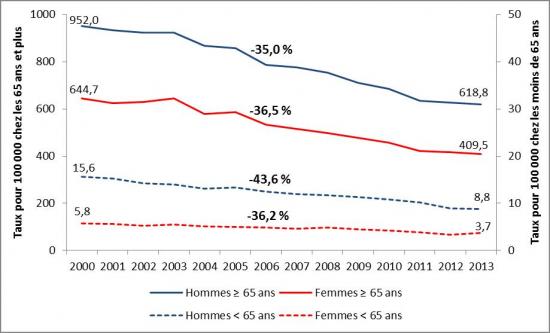
This reduction was more pronounced for age-standardized rates (-39%). Recent trends are even more pronounced among both men and women, with an overall decrease in mortality of -36% between 2000 and 2013. This trend is similar when comparing deaths occurring before age 65 versus those at age 65 and older.
Trends in heart failure mortality rates* by sex from 2000 to 2013
A significant number of patients hospitalized for cardiac decompensation, accompanied by a high rate of rehospitalization
In 2014, the number of patients hospitalized for heart failure as inpatients totaled 165,093. The gender distribution was balanced (49% men, 51% women). More than 43% of patients were 85 years of age or older.
Furthermore, 20% of those hospitalized in 2013 were rehospitalized at least once for the same reason during that year, and the average number of hospitalizations per person was estimated at 1.3. The rehospitalization rate for heart failure has increased by more than 30% since 2002. The in-hospital mortality rate for heart failure is fairly high (7.8% in 2013) but has been declining since 2002.
TABLE
Number and rate of patients hospitalized in MCO acute care for heart failure, by age and sex, in 2014
An increase in the number of people hospitalized for heart failure between 2002 and 2014
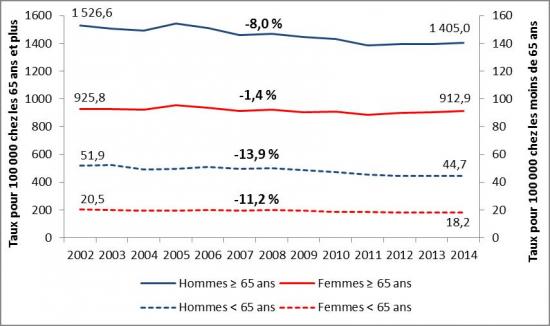
The trend analysis highlights an increase in the number of people hospitalized for heart failure between 2002 and 2014. The aging of the French population partly explains these findings, as a larger proportion of the population is reaching an age at which heart failure is likely to develop. The increased survival of patients who have suffered from acute ischemic heart disease (which includes myocardial infarction) is another explanation for the observed trends. Indeed, these patients have benefited from significant advances in care and the development of effective therapies for treating myocardial infarction, enabling them to survive. However, it turns out that myocardial infarction is associated with a higher risk of developing HF. In fact, nearly half of all cases of HF are believed to have an ischemic origin. Finally, the decline in mortality from HF described above results in a larger number of patients living with HF. However, when controlling for age structure, a slight reduction in the standardized rate is observed over this period, more pronounced among men than among women (-8.6% vs. -5.2%).
Trends in hospitalization rates* for heart failure by gender from 2002 to 2014
A significantly impaired quality of life
The symptoms of heart failure are likely to significantly impact the quality of life of patients with the condition, the majority of whom are elderly or even very elderly:
More than half of patients report reduced physical capacity
Difficulty performing basic activities of daily living (such as dressing or personal hygiene).
More than 50% of adults with heart failure reported being in “poor” or “very poor” health (versus 9% for people without heart failure). Similarly, 50% of those with heart failure felt severely limited “in their usual daily activities” (10% for adults without heart failure). Among working-age adults, there was a significant impact on professional life, with a reduced proportion of employed individuals.
Significant regional disparities
Analysis of regional standardized rates reveals significant disparities in mortality and hospitalization due to heart failure across France.
Mortality rates due to HF:
Hauts-de-France, Corsica, and the Grand-Est region had standardized rates more than 10% higher than the national average
Ile-de-France, Guadeloupe, Martinique, and French Guiana had rates at least 10% lower than the national average.
Hospitalization rates for HF:
The northern half of France (Hauts-de-France and Normandy) had rates more than 10% higher than the national average
Réunion recorded the highest standardized rate (325.3 per 100,000 inhabitants)
The southeastern regions had rates well below the national average (a difference of more than 10%), particularly in Occitanie, Provence-Alpes-Côte d’Azur, Guadeloupe, and Martinique.
Regional disparities in incidence can be explained, in part, by a higher prevalence of cardiovascular disease risk factors in certain regions.
Disparities in mortality can be explained by incidence rates that vary from one region to another. Furthermore, it cannot be ruled out that some of the regional differences in mortality are linked to differences in the management of HF or access to care.
In relation to

Tobacco
thematic dossier
Despite a slight decrease compared to 2015, tobacco remains responsible for more than 68,000 premature deaths in 2023—accounting for 11% of total mortality—making it still the leading cause of...

Nutrition and Physical Activity
thematic dossier
Nutrition and physical activity are two major determinants of health that contribute to improving the health of the population and are key priorities in public health policy.











