




The disease
Human papillomavirus infection
To date, nearly 200 papillomaviruses have been identified, 40 of which are believed to have a specific anogenital tropism.
Regarding HPV types with genital tropism, HPV infection is a very common sexually transmitted infection (STI) in the general population. Infection typically occurs at the onset of sexual activity.
Their prevalence varies depending on anatomical location and geographic region. The International Agency for Research on Cancer has classified 12 types of HPV as known carcinogens, known as high-risk HPV. Persistent infection with high-risk HPV can lead to the development of precancerous lesions that may progress to cancer.
Certain HPV types, notably HPV 6 and 11, are considered “low-risk” in terms of carcinogenicity. They cause condylomas (or genital warts), which are benign genital lesions but whose management can be lengthy and painful, with a high recurrence rate even after treatment.
What cancers are caused by HPV?
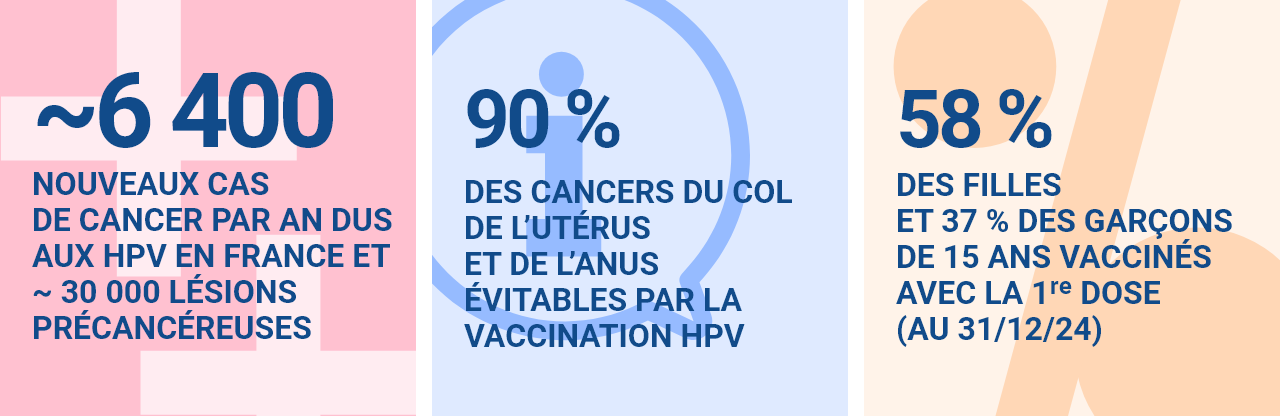
In France, approximately 6,400 new cases of HPV-related cancer are diagnosed each year, with one-quarter occurring in men and three-quarters in women.
The main cancer attributable to HPV is cervical cancer, with just over 3,100 new cases per year in women and 1,100 deaths in France. Oncogenic HPVs can also cause, in both women and men, anal cancers (approximately 1,500 cases per year attributable to HPV), cancers of the head and neck (approximately 1,500 cases per year attributable to HPV), and, more rarely, cancers of the vagina, vulva, or penis. In France, as in many other countries, HPV genotypes 16 and 18 are the high-risk HPV types most frequently implicated in cervical cancer (approximately 70%), and 20% are caused by five additional HPV types (31, 33, 35, 45, 52, 58). Approximately 90% of cervical and anal cancers are preventable through HPV vaccination.
Key statistics on human papillomavirus infections
A sexually transmitted infection
HPV infection is a very common sexually transmitted infection that usually occurs during the early years of sexual activity. HPV is transmitted during sexual contact with people who carry the virus, with or without penetration. Condoms are not sufficient to protect against HPV infection.
An infection that is generally asymptomatic and temporary
Most of the time, the infection causes no symptoms, and the virus is usually cleared by the immune system within one to two years. Approximately 70 to 90% of infections result in viral clearance (elimination of the virus from the body). However, in some cases, the infection can lead to the development of condylomas (genital warts).
More rarely (about 10% of cases involving high-risk oncogenic HPVs), the infection persists and can lead to precancerous lesions. These precancerous lesions may either regress spontaneously or progress, over a period of 10 to 30 years, to invasive cancer.
Vaccine Prevention
Since 2021, HPV vaccination has been recommended for all adolescents, both girls and boys, between the ages of 11 and 14. Vaccination helps prevent HPV infection and thus reduces the risk of developing diseases associated with the HPV types targeted by the vaccine; it also provides herd immunity by reducing HPV transmission within the population. Catch-up vaccination is recommended up to age 26 for young women and men who have not been vaccinated.
Vaccinating young adolescents yields a better immune response and provides long-lasting protection against HPV infections. The vaccination schedule involves two doses spaced 5 to 13 months apart when started between ages 11 and 14, and three doses if started at age 15 or older.
The currently recommended vaccine protects against 9 types of HPV (6, 11, 16, 18, 31, 33, 45, 52, and 58) involved in 90% of cervical cancers, 80–90% of anal cancers, and 90% of anogenital warts.
Vaccination Program
Starting with the 2023–2024 school year, HPV vaccination is offered in middle school to students in 7th grade (with parental consent).
The organization of HPV vaccination campaigns in middle schools complements vaccination services available in the community (community healthcare providers, pharmacies, vaccination centers). By diversifying vaccination sites, the program aims to increase vaccination coverage among adolescents and reduce socioeconomic inequalities by making it easier for adolescents who are more distant from the healthcare system to get vaccinated.
Learn more about vaccination recommendations, indications, and vaccine efficacy.
Prevention of Cervical Cancer
HPV vaccination is the primary means of preventing cervical cancer. In addition, secondary prevention is available through cervical cancer screening. Screening aims to detect precancerous lesions and treat them at an early stage before they develop into cancer.
The organized cervical cancer screening program targets women aged 25 to 65. Between the ages of 25 and 29, a Pap test is recommended, with the first two tests performed one year apart; then, if the results are normal, a Pap test every three years. Between the ages of 30 and 65, an HPV test is recommended every five years. If the HPV test is positive, further testing is recommended.
Screening for precancerous and cancerous lesions of the cervix is recommended for all women, regardless of their vaccination status.
See also: Cervical Cancer Screening | InCA
The HCSP's opinions
Links
In relation to

Cervical cancer
thematic dossier
Cervical cancer, which is caused in nearly 100% of cases by a sexually transmitted human papillomavirus infection, can be prevented through HPV vaccination and screening.

Vaccination
thematic dossier
Contagious diseases most often affect children at a very young age. Because children are particularly vulnerable, they are a priority target for vaccination programs.











