



The disease
Coronaviruses: A Huge Family of Viruses
Coronaviruses form a vast family of viruses. There are many coronaviruses that primarily infect animals. However, these viruses can sometimes cause infections in humans, most often associated with mild colds and flu-like symptoms, but they can also cause respiratory complications such as pneumonia in immunocompromised individuals or infants. Coronavirus infections are generally not diagnosed due to their mild nature and spontaneous recovery. However, aside from the COVID-19 pandemic caused by SARS-CoV-2, two other coronaviruses of animal origin have led to serious epidemics in humans over the past 25 years:
SARS-CoV, responsible for a global epidemic between November 2002 and July 2003;
MERS-CoV, which was first identified in 2012 in the Middle East.
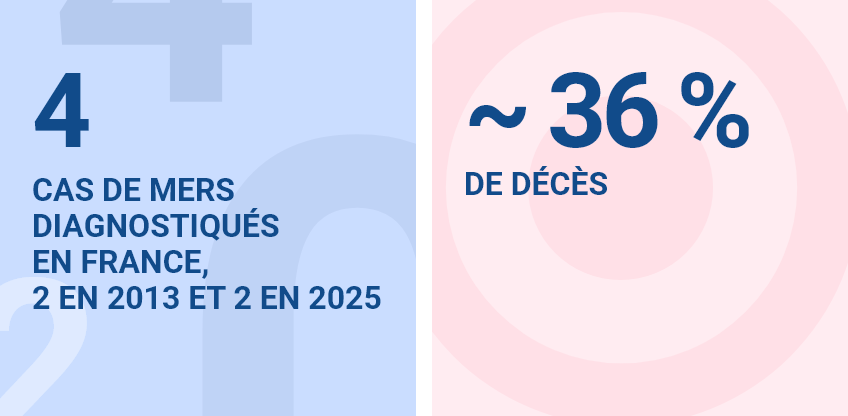
Since the identification in September 2012 of the first human case of infection with the novel coronavirus (Middle East Respiratory Syndrome-Coronavirus, MERS-CoV), the global tally from the European Centre for Disease Prevention and Control (ECDC) reported a total of 2,640 confirmed cases and a case fatality rate of nearly 36% among detected cases as of early November 2025. The vast majority of cases were reported by countries on the Arabian Peninsula (Saudi Arabia, Bahrain, the United Arab Emirates, Kuwait, Oman, Qatar, Yemen) and particularly by Saudi Arabia. All cases occurring outside the Middle East had a direct or indirect link to the epicenter of the outbreak.
Between September 2012 and November 2025, 16 cases of MERS-CoV imported into Europe were recorded, including 2 cases in France identified in 2013. In early December 2025, two new cases were diagnosed in France, in individuals who had traveled together to the Arabian Peninsula within 14 days prior to the onset of their symptoms.
The ECDC considers that the occurrence of MERS-CoV cases imported into Europe from the Arabian Peninsula is possible given the regular detection of cases in that region, significant air traffic, and the possibility of human-to-human transmission, particularly in healthcare settings. However, the ECDC estimates the risk of widespread community transmission in Europe linked to imported cases to be very low. A large cluster that occurred in the summer of 2015 in South Korea, involving several dozen secondary cases, nevertheless demonstrates the need to remain highly vigilant regarding the risk of importation and person-to-person transmission of this virus.
Key statistics on the coronavirus infection
Transmission of MERS-CoV
Current knowledge indicates that dromedaries are the primary reservoir of MERS-CoV. Transmission of the virus to humans is believed to occur from the animal reservoir through direct or indirect contact (consumption of raw products derived from the animal), although the precise modes of transmission have not yet been identified.
Human-to-human transmission of the virus has also been documented, particularly within households and in healthcare settings. These healthcare-associated infections involving patients and healthcare workers are responsible for numerous clusters, facilitated by the absence or inadequacy of hygiene measures such as standard precautions and droplet precautions.
Finally, sporadic cases are regularly reported in the Arabian Peninsula, without direct exposure to an animal source or an identified human case.
Preventive measures against MERS-CoV
Preventive measures regarding contact with camels, mechanical barriers such as the use of masks or gowns by healthcare workers, regular handwashing, and, above all, the isolation of suspected cases, are effective.
Nonspecific symptoms
The clinical presentation varies, ranging from no symptoms (asymptomatic cases) to mild respiratory symptoms, or even severe acute respiratory illness that can be fatal. The usual clinical signs of MERS-CoV infection are fever, cough, and difficulty breathing. Pneumonia is common, though not always present. Gastrointestinal symptoms, including diarrhea, have also been reported.
Symptomatic management only
No vaccine or specific treatment is currently available to prevent or treat MERS-CoV infections. Reactive surveillance of cases imported from known risk areas (primarily the Arabian Peninsula) is therefore essential to prevent the establishment of a chain of transmission. Case management relies on symptomatic treatment.












