




The disease
Myocardial infarction, blockage of a coronary artery
Myocardial infarction (MI), or myocardial necrosis, is the most severe form of ischemic heart disease (IHD) or coronary artery disease. Acute forms of these conditions are also more commonly referred to as acute coronary syndromes (ACS). MI is caused by insufficient oxygen supply to the heart muscle (myocardium) due to the development and complications of atherosclerosis in one (or more) coronary artery(ies). The blockage of the coronary arteries can be more or less complete and more or less sudden. The resulting lack of oxygen supply can lead to myocardial damage of varying severity, ranging from ischemia to myocardial necrosis.
The main individual risk factors for myocardial infarction are age, male gender, smoking, hypercholesterolemia, diabetes, obesity, hypertension, stress, and a sedentary lifestyle. Environmental factors such as air pollution have also been identified as risk factors for ischemic heart disease, including myocardial infarction.
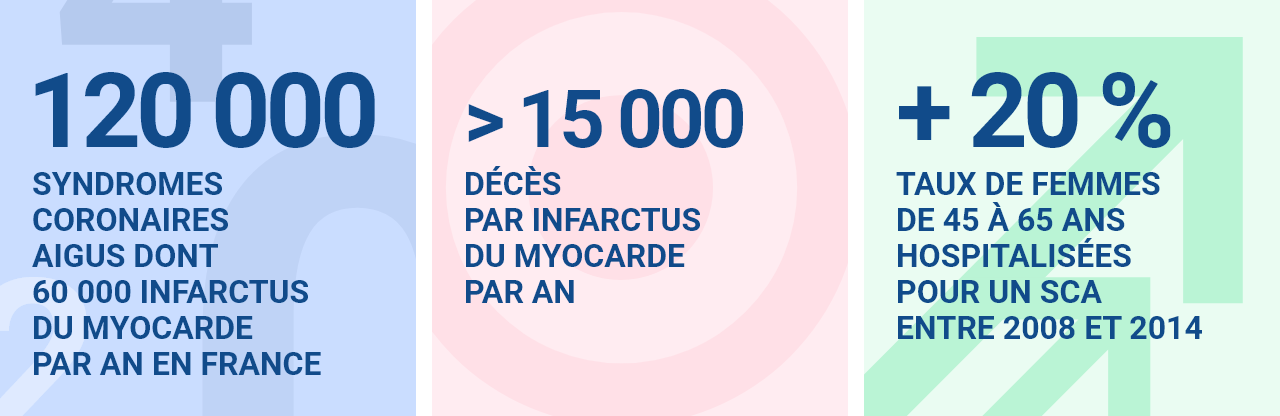
In-hospital mortality following a myocardial infarction was estimated at 7.2% in 2013. This rate is twice as high among women (10.8%) as among men (5.6%).
This disparity is primarily explained in women by a higher age at the onset of myocardial infarction (on average 10 years older) and the presence of more comorbidities. In fact, there is an increased risk of bleeding in women compared to men, linked to invasive techniques used to treat myocardial infarction, whether diagnostic (coronary angiography) or therapeutic (angioplasty, thrombolysis, etc.).
Key Statistics on Heart Attacks
Bas-Rhin Ischemic Heart Disease Registry
Scientific Director
: Dr. Marie MOITRY, Physician - University Hospital Assistant
, Laboratory of Epidemiology and Public Health. Faculty of Medicine. University of Strasbourg
4 rue Kirschleger 67085 STRASBOURG Cedex
Phone: +33(0)3 68 85 40 20
Fax: +33(0)3 68 85 31 89
Email: mmoitry@unistra.fr
Administrative Director
: Professor Michel VELTEN, MD - Full Professor
Laboratory of Epidemiology and Public Health. Faculty of Medicine. University of Strasbourg
4 rue Kirschleger 67085 STRASBOURG Cedex
Phone: +33 (0)3 68 85 31 95
Fax: +33 (0)3 68 85 31 89
Email: michel.velten@unistra.fr
Haute-Garonne Ischemic Heart Disease Registry
Scientific and Administrative Director
Professor Jean FERRIERES, MD – Full Professor,
Department of Epidemiology, Toulouse Faculty of
Medicine 37 Allées Jules GUESDE 31062 TOULOUSE Cedex 9
Phone: +33 (0)5 61 14 59 49
Fax: 33 (0)5 61 14 56 27
Email: jean.ferrieres@univ-tlse3.fr; ferrieres.j@chu-toulouse.fr
Lille Community Ischemic Heart Disease Registry
Scientific and Administrative Director
: Professor Philippe AMOUYEL, MD – Full Professor, Department
of Epidemiology and Public Health / INSERM U1167
Institut Pasteur de Lille
1 rue Calmette 59019 Lille Cedex
Phone: +33 (0)3 20 87 77 10
Fax: +33 (0)3 20 87 78 94
Email: philippe.amouyel@pasteur-lille.fr
Co-Principal Investigator of the registry: Dr. Michèle MONTAYE Research and public
health investigation: Drs. Jean DALLONGEVILLE and Aline Meirhaeghe.
In relation to

High blood pressure
thematic dossier
High blood pressure (HBP), defined as blood pressure that is too high, is the most common chronic condition in France and a major risk factor for cardiovascular and cerebrovascular diseases.

High cholesterol
thematic dossier
A major cardiovascular risk factor, high cholesterol can generally be prevented or treated through lifestyle and dietary changes, possibly in combination with medication.

Tobacco
thematic dossier
Despite a slight decrease compared to 2015, tobacco remains responsible for more than 68,000 premature deaths in 2023—accounting for 11% of total mortality—making it still the leading cause of...











