




Data
The surveillance system for ischemic heart disease, particularly myocardial infarctions, established by Santé publique France makes it possible to study the epidemiological trends of these conditions:
Data from the registries
|
Hospitalizations (New cases and recurrences) |
ST-segment elevation myocardial infarction (STEMI) |
|
|---|---|---|
|
Year 2015 |
Men |
Women |
|
Bas-Rhin |
||
|
Crude incidence rates (n) |
|
|
|
35–44 years |
58.2 (43) |
5.4 (4) |
|
45–54 years |
131.7 (104) |
32.7 (26) |
|
55–64 |
188.5 (131) |
49.8 (36) |
|
65–74 |
242.3 (106) |
71.2 (34) |
|
Rates standardized to the European population aged 35–74 (n) |
149.3 (384) |
37.7 (100) |
|
Haute-Garonne |
||
|
Crude incidence rates (n) |
|
|
|
35–44 years |
52.4 (48) |
3.3 (3) |
|
45–54 years |
93.3 (82) |
16.7 (15) |
|
55–64 |
178.8 (126) |
29.0 (22) |
|
65–74 |
203.9 (100) |
54.5 (31) |
|
Rates standardized to the European population aged 35–74 (n) |
118.5 (356) |
21.3 (71) |
|
Lille Urban Community |
||
|
Crude incidence rates (n) |
|
|
|
35–44 years |
50.0 (37) |
16.1 (12) |
|
45–54 years |
140.1 (94) |
25.3 (18) |
|
55–64 |
170.9 (96) |
35.8 (23) |
|
65–74 years |
265.0 (92) |
61.6 (26) |
|
Rates standardized to the European population aged 35–74 (n) |
149.7 (319) |
33.1 (79) |
|
Hospitalized and non-hospitalized events (New cases and recurrences) |
Acute coronary syndrome* and probable coronary deaths |
|
|---|---|---|
|
Year 2015 |
Men |
Women |
|
Bas-Rhin |
||
|
Crude incidence rates (n) |
|
|
|
35–44 years |
73.1 (54) |
10.7 (8) |
|
45–54 years |
188.7 (149) |
57.9 (46) |
|
55–64 |
332.5 (231) |
81.7 (59) |
|
65–74 |
585.1 (256) |
207.2 (99) |
|
Rates standardized to the European population aged 35–74 (n) |
528.2 (690) |
158.3 (212) |
|
Haute-Garonne |
||
|
Crude incidence rates (n) |
|
|
|
35–44 years |
96.1 (88) |
13.2 (12) |
|
45–54 years |
260.6 (229) |
70.0 (63) |
|
55–64 |
532.1 (375) |
104.2 (79) |
|
65–74 |
793.2 (389) |
241.0 (137) |
|
Rates standardized to the European population aged 35–74 (n) |
356.9 (1,081) |
86.6 (291) |
|
Lille Urban Community |
||
|
Crude incidence rates (n) |
|
|
|
35–44 years |
110.9 (82) |
34.8 (26) |
|
45–54 |
339.7 (228) |
99.8 (71) |
|
55–64 years |
657.0 (369) |
221.1 (142) |
|
65–74 |
1,183.7 (411) |
376.6 (159) |
|
Rates standardized to the European population aged 35–74 (n) |
534.5 (1,090) |
170.7 (398) |
Mortality from ischemic heart disease, acute coronary syndrome, and myocardial infarction: variations by age and sex
Data collected from death certificates show that myocardial infarctions accounted for 45% of deaths from ischemic heart disease and acute coronary syndromes for 51%. Crude mortality rates increased significantly with age. After adjusting for age, men had a mortality rate from ischemic heart disease more than twice that of women (77.2 vs. 31.8 per 100,000 in 2013). This finding was also observed for deaths from acute coronary syndrome and myocardial infarction.
TABLE

Number and rate of deaths from CPI, SCA, and IDM by sex and age, in 2013
Declining Mortality from Ischemic Heart Disease
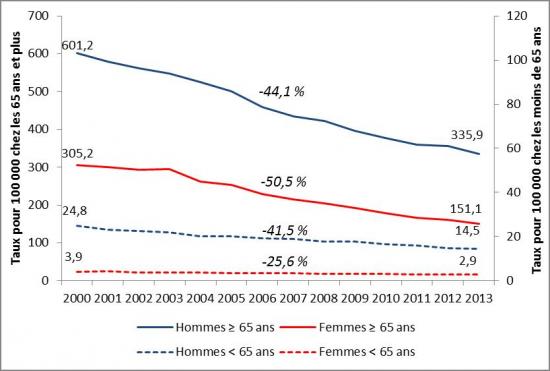
Between 2000 and 2013, the age-standardized mortality rate from ischemic heart disease decreased by 44% among men and by 49% among women, across all age groups. Among those under 65, the mortality rate decreased more significantly among men than among women (-42% vs. -26%). This overall reduction in coronary mortality is due in part to the reduced incidence of acute coronary events and in part to the reduced 28-day mortality rate following such events. These trends are attributed to combined improvements in primary prevention—both individual and population-based—in the management of coronary patients, as well as in secondary prevention treatments prescribed following a first myocardial infarction.
Trends in death rates* per 100,000 population by age and sex from 2000 to 2013
A higher hospitalization rate among men than among women
In 2014, 221,108 patients residing in France had at least one full hospitalization for ischemic heart disease (including first-time events and recurrences), of whom 119,015 were hospitalized for acute coronary syndrome—including 62,251 for myocardial infarction. Hospitalization rates were three times higher among men than among women for ischemic heart disease, acute coronary syndrome, or myocardial infarction.
TABLE
Number and rate of patients hospitalized in acute care for CPI and IDM, by sex and age, in 2014
An increase in the rates of women under 65 hospitalized for myocardial infarction
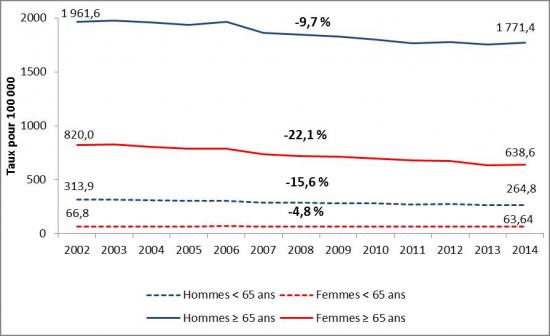
An analysis of overall trends between 2002 and 2014 in the standardized rates of patients hospitalized for ischemic heart disease, acute coronary syndrome, and myocardial infarction shows a downward trend (–13%, –20%, and –17%, respectively). However, these overall trends mask different patterns depending on sex and age. Among those under 65, the standardized rate of patients hospitalized for ischemic heart disease decreased more significantly among men (-15.6%) than among women (-4.8%). Regarding myocardial infarctions, the standardized rate among those under 65 remained virtually stable in the male population (-1.4%), while it rose sharply for women (+26%).
Trends in the rates* of hospitalized patients with a primary diagnosis of ischemic heart disease by age and sex from 2002 to 2014
Improvements in Follow-up Care and Rehabilitation Following a Myocardial Infarction
Following a myocardial infarction in the first half of 2014, slightly more than one-third (36.9%) of patients were hospitalized for follow-up care and rehabilitation within the year (N = 8,380): 28.5% for cardiac rehabilitation and 8.5% for “other” care purposes. Furthermore, the proportion of patients in cardiac rehabilitation was lower for women than for men, with age-standardized rates of 24.9% and 29.6%, respectively.
Between 2010 and 2014, the rate of cardiac rehabilitation increased by an average of 5.0% per year among men and 6.6% per year among women.
Furthermore, the proportion of inpatient admissions for cardiac rehabilitation decreased in favor of outpatient care (p<0.0001).
Significant regional disparities
Analysis of regional standardized rates reveals significant disparities in mortality and hospitalization rates due to ischemic heart disease across France.
Mortality rates due to ischemic heart disease:
The Normandy, Brittany, and Hauts-de-France regions exceeded the national average by more than 20%
Réunion had the highest rate in France
The regions of Île-de-France, Provence-Alpes-Côte d’Azur, and the three other overseas regions (Martinique, Guadeloupe, and French Guiana) had rates more than 10% lower than the national rate.
Rate of patients hospitalized for ischemic heart disease:
Corsica, Provence-Alpes-Côte d’Azur, and Grand-Est exceeded the national average by more than 10%.
Martinique, Guadeloupe, and Brittany had the lowest rates.
The differences in hospitalization rates observed from one region to another could be due to differences in the prevalence of risk factors (primarily smoking, high cholesterol, diabetes, high blood pressure, physical inactivity, obesity, and socioeconomic disadvantage).
In relation to

High blood pressure
thematic dossier
High blood pressure (HBP), defined as blood pressure that is too high, is the most common chronic condition in France and a major risk factor for cardiovascular and cerebrovascular diseases.

High cholesterol
thematic dossier
A major cardiovascular risk factor, high cholesterol can generally be prevented or treated through lifestyle and dietary changes, possibly in combination with medication.

Tobacco
thematic dossier
Despite a slight decrease compared to 2015, tobacco remains responsible for more than 68,000 premature deaths in 2023—accounting for 11% of total mortality—making it still the leading cause of...











