


The disease
A viral zoonosis
Hantaviruses are viruses of the Bunyaviridae family and are found on every continent. Their natural hosts are certain species of rodents which, once infected, remain asymptomatic carriers (the virus is present in their urine and feces) and serve as an excellent reservoir for the virus.
In mainland France, these are primarily voles that live in forests and human dwellings (barns, attics, sheds, abandoned cabins, etc.).
The reservoirs for hantavirus pulmonary syndromes are rodents found in the Americas (Peromyscus maniculatus, known as the wood mouse; Oryzomys palustris, known as the rice rat; Sigmodon hispidus, or cotton rat…) that also exhibit asymptomatic infection.
Human infection generally occurs through inhalation of dust and aerosols contaminated by the excretions of infected animals (urine, feces, saliva) during activities in the forest or in buildings near the forest that have been uninhabited for a long time, as well as during activities in rural areas where fields and farms provide a favorable habitat for reservoir rodents. No human-to-human transmission has been reported to date, except for the South American Andes hantavirus.
When they infect humans, hantaviruses can cause infections of varying severity, sometimes fatal:
in Europe and Asia, hemorrhagic fevers with renal syndrome (HFS);
in the Americas, hantavirus cardiopulmonary syndrome (HCPS).
There is no specific treatment or vaccine prophylaxis.
In this context, Santé publique France’s mission is to ensure the epidemiological surveillance of hantaviruses in collaboration with the National Reference Center for Hantaviruses and its associated laboratory in French Guiana.
Key facts about hantaviruses
Several species of hantavirus
Four species of zoonotic hantaviruses circulate on the European continent:
The Puumala virus (PUUV)
The Seoul virus (SEOV)
The Dobrava-Belgrade virus (DOBV)
The Tula virus (TUV).
PUUV is the virus responsible for the highest number of HFSR cases and circulates in Northern and Western Europe with a low case-fatality rate of approximately 0.4%. SEOV is ubiquitous due to the very wide distribution of its reservoirs—the black rat (Rattus rattus) and the brown rat (R. norvegicus)—but reported human cases in Europe are very rare. DOBV circulates in the Balkans and Central Europe and can cause severe human illness (case fatality rate up to 10%). The Tula virus has been found in only two patients, one of whom was in mainland France.
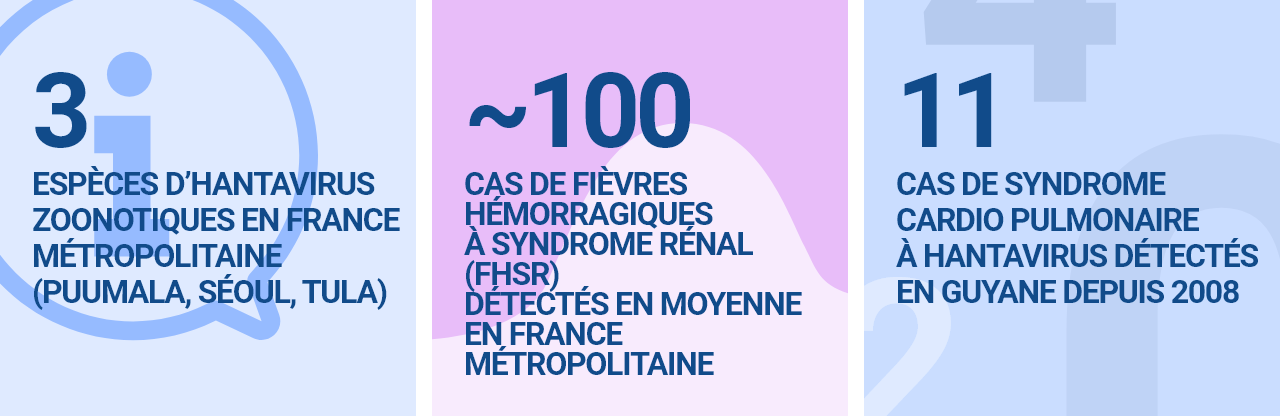
Three of these viruses have been detected in mainland France. Hemorrhagic fever with renal syndrome (HFRS) is caused primarily by PUUV, first identified in the 1980s. Human cases of HRHF caused by PUUV are mainly detected in the northeastern quarter of the country. PUUV can cause localized outbreaks. In addition to PUUV, other hantaviruses have been detected. Human cases of Seoul virus infection are sporadic, and there is currently no specific geographic location associated with these infections. TUV, whose zoonotic potential is poorly understood, has been detected in its reservoir, the common vole (Microtus arvalis), in the Jura Mountains, the Bas-Rhin, and the Aveyron, and for the first time in 2015 in a patient residing and exposed 60 km east of Paris.
On the American continent, and particularly in several South American countries, other hantavirus species circulate among humans, causing hantavirus cardiopulmonary syndrome (HCPS). In French Guiana, several human cases of hantavirus infection have been identified since 2008. These were caused by a hantavirus described in connection with these cases, the Maripa virus, which was subsequently detected in two species of wild rodents (Zygodontomys brevicauda and Oligoryzomys fulvescens).
In metropolitan France, hantaviruses are primarily present in the northeastern quarter
Hantaviruses are primarily found in the northeastern quarter of mainland France. Small outbreaks can occur, especially in the spring and summer. Variations in incidence, including so-called “epidemic” years, are well known for hantavirus infections and are linked to the population dynamics of reservoir rodents and the dynamics of viral circulation among these rodents.
Simple measures can reduce the risk of infection
Prevention of infection consists primarily of limiting contact with rodents, their secretions, and excretions.
There is no vaccine against hantaviruses.
In France, the people most at risk of hantavirus infection are those who, in the affected geographic areas (French Guiana and the northeastern quarter of France):
live near a forest or other habitats favorable to rodents (fields, farms)
work in forests or rural agricultural areas (primarily in French Guiana)
engage in activities in the forest
have direct or indirect contact with rodents.
Activities that increase the risk of respiratory exposure include work performed in or near wooded areas, particularly:
handling wood
cleaning of premises that have been unoccupied for a long time,
any activity that stirs up dust or soil (renovation of old, dusty premises, backfilling, etc.).
Preventive measures:
Avoid respiratory contamination
Do not enter closed or abandoned premises
Wear a mask, ventilate, and spray with water (or better yet, disinfectant or bleach) before cleaning the floors of premises that have been closed or unoccupied for a long time (sheds, attics, barns, basements, etc.)
Ventilate closed spaces before and during cleaning
Use a vacuum cleaner instead of a broom
Do not use high-pressure water jets
Control rodent infestations in the premises
Exterminate rodents in homes located in or near forests, as well as in barns, cellars, sheds, etc.
Prevent rodents from entering homes
Avoid attracting them: store food in closed areas inaccessible to rodents
Remove any shelters that rodents can use (such as woodpiles).
Avoid contact with rodent droppings
Apply a bandage to any wounds before handling wood or working with soil.
Avoid handling live or dead rodents or their nests. Wear rubber or latex gloves.
Two clinical forms
Hantaviruses are responsible for:
Hemorrhagic fever with renal syndrome (HFRS) in Europe and Asia
With an incubation period ranging from one week to two months,
Which vary in severity, ranging from flu-like symptoms—sometimes accompanied by severe muscle pain, transient visual accommodation disorders, thrombocytopenia, and mild kidney damage—to severe kidney failure, which usually has a favorable outcome.Neurological forms of the disease caused by the PUUV virus affecting the central nervous system have been described in Russia and Austria.
These can be fatal, with a case-fatality rate ranging from 0 to 10% depending on the virus. If these clinical signs are present, it is important to consult a doctor and report any potential risk activities: outdoor recreation in the forest, handling wood, cleaning a house that has been unoccupied for a long time, or contact with rodents (or when signs of rodent presence are observed in one’s immediate environment).
Hantavirus Pulmonary Syndrome (HPS) on the American continent, and therefore in French Guiana,
With an incubation period ranging from one to six weeks,
Which manifests as severe and rapid lung damage with respiratory and cardiac distress and shock following a febrile prodromal phase with myalgia.
With a high case fatality rate (up to 60%).
Diagnosis
Regardless of the clinical presentation, diagnosis in humans relies on serology, which detects anti-hantavirus immunoglobulins (IgM and IgG) in plasma or serum via ELISA and indirect immunofluorescence.
Hantavirus RNA can also be detected in early serum or plasma samples using molecular techniques performed at the National Reference Center (CNR) for Hantaviruses and by the laboratory affiliated with the CNR in French Guiana.

Sending a CNR sample

Clinical, Laboratory, and Epidemiological Fact Sheet from the National Reference Center for Hantaviruses

Guyana Hantavirus Fact Sheet
Symptomatic treatment
Treatment for hantavirus infections is symptomatic (rest, acetaminophen, etc.). There is no specific treatment available.












