



Data
Cases of Andes hantavirus aboard the MV HONDIUS
An outbreak of Andes hantavirus has occurred on the Dutch-flagged cruise ship MV HONDIUS in the South Atlantic, with nearly 150 passengers of 23 nationalities on board. Following the alert issued on May 2, 2026, by the World Health Organization (WHO), a system for identifying, monitoring, and providing medical and health care for cases and their contacts (people who have been exposed to a case of Andes hantavirus) was established by international and French health authorities.
As of May 26, 13 cases of Andes hantavirus infection had been diagnosed among the cruise ship’s passengers, including one case in a French national.
In France, 25 contacts (including 4 cruise passengers) were identified, isolated, and treated in specialized hospitals for up to 42 days. As of May 26, none of these individuals were showing symptoms, and all tested negative.
On May 15, Santé publique France, in collaboration with ANRS-MIE and the national COREB mission, issued guidelines for close contacts and their families.
French health authorities are closely monitoring the situation, in close coordination with the European Centre for Disease Prevention and Control (ECDC) and the WHO.
Learn more:
- Hantavirus cases aboard the MV HONDIUS | Press release from the Ministry of Health
- Frequently Asked Questions on the Andes Hantavirus | Ministry of Health
- The Pasteur Institute confirms through full sequencing the Latin American origin of the Andes hantavirus detected aboard the MV HONDIUS | Press release from the Pasteur Institute
- Andes hantavirus outbreak on cruise ship, May 20, 2026 | European Centre for Disease Prevention and Control
Data for France, 2005–2024
In mainland France, from 2005 to 2024, 2,046 cases of hemorrhagic fever with renal syndrome (HFRS) exposed in mainland France were diagnosed by the National Reference Center (CNR) for Hantaviruses (Institut Pasteur), with a peak in 2021 (320 cases) and a low in 2013 (14 cases).
The geographic distribution of cases has remained generally stable since 2005, with the majority of cases occurring in the endemic zone comprising the northeastern quarter of mainland France, although an expansion of the Puumala virus endemic zone toward the south and west has been observed in recent years.
In French Guiana, no cases of hantavirus pulmonary syndrome (HPS) were detected in 2024. Since 2008, eleven human cases of HPS caused by the Maripa hantavirus have been detected, including six fatal cases.
From 2005 to 2024, 2,199 human cases of hemorrhagic fever with renal syndrome (HFRS) were identified by the National Reference Center for Hantaviruses at the Pasteur Institute, primarily caused by the Puumala hantavirus, of which 2,046 had a reported most likely place of exposure in mainland France (Table 1). For the remaining cases, exposure was reported to have occurred abroad (Table 1). The highest number of cases was diagnosed in 2021 (320 cases) and the lowest in 2013 (14 cases). Eleven cases of Seoul virus infection have been identified in mainland France since the diagnostic test was introduced in 2012, with the most recent case diagnosed in the Rhône department in 2023.
In 2024, 76 cases of FHSR were confirmed by the CNR (55 confirmed by the presence of the Puumala virus, 1 case of the Seoul virus, and 21 confirmed by serology and most likely caused by the Puumala virus).
The year 2024 was considered an inter-epidemic year in mainland France, with only 75 human cases of hantavirus infection reported in mainland France, compared to an average of 108 cases over the 2012–2023 period. The sociodemographic characteristics of the cases are similar to those of previous years, with a median age of 46 years and a predominance of men (84%). Forty percent of the cases were detected in traditional endemic areas (Avesnois, Aisne, and Ardennes); the remaining cases were exposed in departments where cases had already been confirmed in previous years.
Only the Rhône department reported its first confirmed hantavirus case in 2024. This was a case of infection with the Seoul virus. The strain detected in this patient is similar to strains circulating among wild rats captured in Lyon within the Tête d’Or Park.
A case of hantavirus pulmonary syndrome (HPS) caused by the Choclo virus was confirmed by the CNR: this involves a resident of the French West Indies who was infected in Panama in the province of Los Santos, a known area of virus circulation.
In 2024, no cases of HPS caused by the Maripa virus were detected.
Annual number of cases of hemorrhagic fever with renal syndrome reported by the CNR from 2005 to 2024, CNR data on hantaviruses (Institut Pasteur)
| Year | Number of cases |
|---|---|
| 2024 | 75 |
| 2023 | 50 |
| 2022 | 23 |
| 2021 | 320 |
| 2020 | 26 |
| 2019 | 123 |
| 2018 | 53 |
| 2017 | 231 |
| 2016 | 55 |
| 2015 | 124 |
| 2014 | 103 |
| 2013 | 14 |
| 2012 | 162 |
| 2011 | 90 |
| 2010 | 145 |
| 2009 | 52 |
| 2008 | 72 |
| 2007 | 109 |
| 2006 | 21 |
| 2005 | 196 |
Traditionally, the peak in case detection is observed each year in late spring, a period when young rodents born in early spring become infected through contact with their peers and release large quantities of the virus into the environment. In 2024, cases of FHSR were diagnosed throughout the year, with a peak in May, when 12 cases were reported.
Monthly distribution of FHSR cases reported by the CNR from 2010 to 2024 and occurring in mainland France, based on CNR data on hantaviruses (Institut Pasteur) (N=1,596)
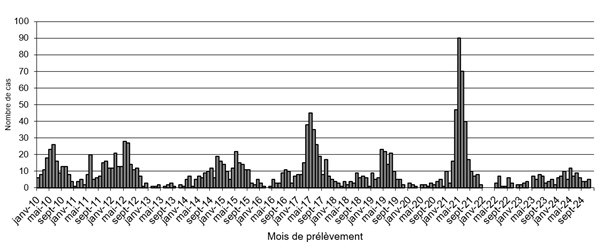
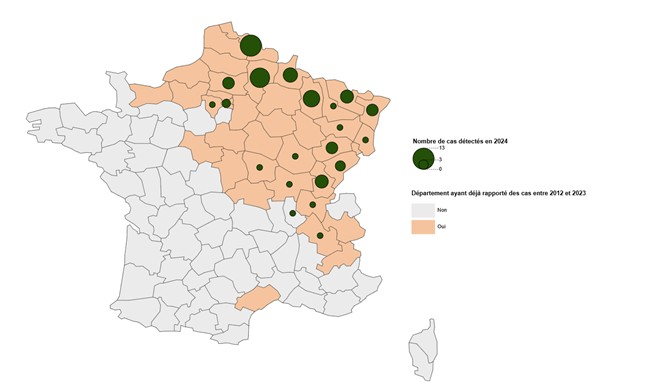
The geographic distribution of FHSR cases has remained largely similar since 2005, with the majority of cases residing in and having been exposed in the northeastern quarter of mainland France. In 2024, the majority of cases (57%) were diagnosed in the departments of Nord, Aisne, Ardennes, Meuse, and Moselle, one of the main endemic areas for the Puumala virus. Since 2017, the Puumala virus endemic zone has expanded southward and westward, with 43 departments now reporting at least one diagnosed case of hantavirus infection, compared to 31 in 2015. In 2024, the only case detected outside the documented circulation area of the virus, in the Rhône department, was a case of infection with the Seoul hantavirus.
Number of FHSR cases reported by the CNR in 2024 and identified in mainland France, by department and virus circulation zone (as evidenced by case detection during the 2005–2023 period), CNR Hantavirus Data (Institut Pasteur) (N = 75)
Epidemiological data from 2014 to 2017
All epidemiological characteristics of hantavirus infections in metropolitan France can be viewed by clicking on the links below:












