


GAST - Occupational Health Alert No. 3
Subscribe
If you would like to receive the newsletter by email, please subscribe to our mailing list.
Key Milestones
Launch of Gast Corse: The kick-off meeting was held in January 2017 in Ajaccio. In attendance were epidemiologists from the Regional Intervention Unit and the Occupational Health Directorate of Santé publique France, the occupational health inspector from the Direccte, and the physician from the occupational disease consultation centers, as well as physicians representing the Corsican Society of Occupational Medicine and Health and the two occupational health services in Corsica: Sist 2A and SST 2B.
11 regions have a GAST, bringing coverage of mainland France to 85% and of all of France to 65%.
Publication of the report: Investigation of a suspected excess of cancer cases in a research laboratory.
In 2016, 10 reports (suspected disease clusters (3), unexplained collective syndrome (5), and unusual exposures (2)) were processed within the framework of a GAST (2016 report summary).
Presentation of the program at the Centre Médical Interentreprise Europe (CMIE) in April 2017 in Paris
Presentation of the program by the Occupational Health Department and Cire Normandie to the French Society of Occupational Medicine in June 2017 in Paris
Internal evaluation of the Gast program currently underway: 10 years after the creation of the first group in the Aquitaine region
It’s summer: preparing for heat waves
There is no doubt that climate change is underway, and with it, the risk of heat waves is increasing. Following a major heat wave in June that had a significant impact on workers, it is time for us to prepare collectively to prevent serious health impacts on workers from likely future summer heat waves. Starting now, let’s begin organizing the resources—primarily for primary prevention, but also for monitoring and early warning—that will enable us to do so effectively.
Since 2006, the Occupational Health Directorate, in collaboration with the General Directorate of Labor, has established a monitoring system for the health effects of heat waves related to occupational activity. The reporting of health events among workers linked to high outdoor temperatures is carried out by occupational physicians: This is done using a standardized form that is transmitted to the DGT via regional occupational health inspectors (MIT) before being forwarded to Santé publique France. This monitoring system will remain in place for 2017 and will be improved in the coming years (particularly in terms of responsiveness).
Preventing occupational risks associated with high outdoor temperatures requires proactive planning not only from occupational health services but also from workers and their supervisors. This involves identifying, within the company as of now, all vulnerable positions and high-risk activities in order to define the measures to be taken in the event of extreme heat: adjusting work schedules, modifying scheduled activities, ensuring water supply, providing air-conditioned facilities, or, if not possible, making cool areas available, etc. During heat waves, close vigilance is required to remind workers of these preventive measures and ensure they are followed in the workplace, as well as to train exposed teams to recognize the early signs of dehydration or heatstroke.
For information on preventing occupational risks related to extreme outdoor heat, visit the INRS website. Information materials for workers are available on this site.
Internal Evaluation of the GAST Program
Since its initial pilot program in 2008 in the Aquitaine region, the Gast program has expanded to cover nearly the entire metropolitan area. After 10 years, it appears necessary to conduct an evaluation of the program in order to identify areas for improvement.
This evaluation aims to determine:
its usefulness
as perceived by reporters and Gast members (satisfaction with the response, problem resolution, effectiveness of assistance, improvement in procedures, etc.)
objective (implementation of recommendations or best practices, resolution of the problem, monitoring put in place, etc.)
its technical performance (responsiveness, simplicity, visibility, consistency, flexibility, ethics, etc.)
its mode of operation (information flow, role of members, human resources, etc.)
Data for these indicators will be collected through three complementary approaches:
Qualitative and quantitative survey of occupational physicians. A thesis in occupational medicine by Dr. M. Dehmas provided an overview of the professional experiences of occupational health alert networks and offered insights to enhance occupational physicians’ understanding of these networks.
Internal feedback session (RetEx) An internal RetEx session at Santé publique France’s Gast division is scheduled for September 2017 to capitalize on experience and identify areas for improvement. It will take place over one day with members of the Cire and the DST. Prior to this, feedback from all Gast members will be collected via a semi-structured questionnaire. Strengths, weaknesses, and areas for improvement will be identified qualitatively, leading to recommendations and an action plan.
Supplementary StudyTo supplement the findings from Areas 1 and 2, a random selection of 20 reports processed by a Gast will be made. Criteria related to utility and performance can thus be identified based on these reports.
This evaluation will result in a summary document and will be shared with all Gast members.
Dr. Catherine Verdun-Esquer,
Head of the Department of Occupational Medicine and Occupational Pathology at Bordeaux University Hospital
Have you noticed a difference in your region before and after the introduction of Gast?
It’s difficult for me to answer that question because the Gast system has been in place in the Aquitaine region since 2008. It’s truly integrated into my daily workflow. This system is very reassuring, especially when the cases to be handled are complex.
What has working with Gast brought you personally? For your practice?
The Gast system allows for a cross-disciplinary review of reports, leveraging the complementary skills and knowledge of each member. I feel like I’m growing and developing my skills by participating in this group, particularly regarding environmental issues raised in the context of unexplained collective syndromes.
In your opinion, what are the main advantages and disadvantages of a GAST?
The main benefit I see is the expertise provided by the Gast system, which is independent and external to the company. It can sometimes help defuse difficult situations. As for the drawback, I would highlight the administrative burden involved in handling certain reports—such as organizing conference calls, reviewing documents, and the lack of in-person meetings—which sometimes makes it harder for me to follow up on certain cases.
Is there a report that particularly stood out to you, and why?
It’s not a single report but rather a type of report that stands out to me, particularly those involving unexplained collective syndromes. These often require on-site interventions (which I actually enjoy!), and I feel they are useful since they generally help improve the situation.
Describe how a report is handled in practice
Generally, I receive an email from the Cire outlining the situation. All available information regarding the report is included in the document attached to the email. A conference call is scheduled. During the call, Gast members discuss the information they have and determine the course of action. Subsequently, additional conference calls are scheduled by the Cire, and a progress update is provided each time, with collective decisions made at every key stage.
Spotlight on an investigation conducted as part of a Gast
Ronan OLLIVIER,
Epidemiologist at the DiRe-CIRE of the Pays de la Loire
In June 2015, the CAPTV in Angers notified the regional health surveillance and emergency platform that four employees at a municipal workshop in an industrial zone in Le Mans had experienced discomfort after noticing foul odors at their workplace.
Firefighters had responded to the scene and found that the employees were complaining of headaches, nausea, and sensory irritation associated with the perception of very unpleasant odors. However, the workers’ condition did not appear serious and did not require hospitalization. Measurements taken on-site by the firefighters ruled out the risk of carbon monoxide poisoning. Over the past two years, 70 complaints related to foul odors had been recorded by the occupational health and safety department.
As part of the Gast program, the Cire conducted an investigation in collaboration with the occupational health physician responsible for monitoring the workers.
The municipal workshop employed 700 workers and was located in an industrial zone containing several facilities classified for environmental protection (ICPE), including a waste incineration plant located south of the workshop. Decentralized state services (at the time, the DDASS) had recorded complaints regarding foul odors at this site as early as 2008. In 2009, this plant underwent compliance measures and changed its treatment system. In 2014, a process accident at the plant released mercaptans, leading to numerous complaints among employees. A prefectural order issued in November 2014 required the company to implement measures to prevent this type of accident.
At the end of June 2015, the occupational health physician met with the six employees most exposed to the odors. The clinical examination of the employees was normal, but the physician noted a certain weariness, even exasperation, among them due to the recurrence of these episodes. At the same time, the occupational health department launched a campaign of toxicological measurements in the workshops, which revealed no abnormalities in the outdoor air.
The problem of odor nuisances, which was both significant and longstanding, specifically affected municipal workshop employees working on-site. These employees reported symptoms of sensory irritation to the occupational health physician during episodes of intense odor emissions. Nevertheless, episodes of less intense foul odors occurred fairly regularly. Although a neighboring factory was suspected, the source of these odors had not been formally identified. To determine the origin, the occupational health department provided the Cire with a daily log of reports of foul odors recorded within the municipal workshop between May 2014 and April 2015. It was agreed to compare this information with meteorological data measured at a station located 7 kilometers from the industrial site. The objective was to quantify the number of odor episodes and to assess under which prevailing wind conditions they were perceived in the workshop.
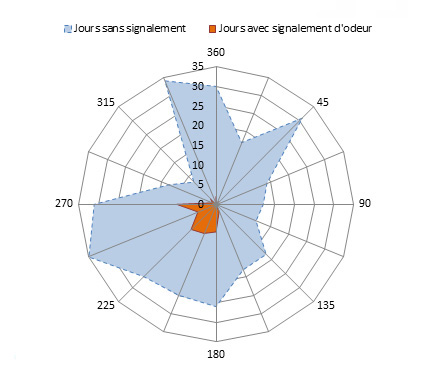
In total, 47 episodes lasting no more than 24 hours were recorded over the period. A “gas” odor was most frequently reported. However, during the last quarter of 2014, half of the episodes involved a sulfur odor. The majority of episodes were reported when winds were coming from the southwest (Figure).
The investigation conducted with the support of GAST provided evidence to pinpoint the source of the odors south of the workshops, where the industrial hazardous waste treatment plant was located.
In 2016, the occupational health department considered collaborating with the Air-Pays de la Loire association to train staff to better characterize odors and to implement an alert system modeled after the odor monitoring program in Basse-Loire. This program, launched in 2015 on the north bank of the Loire estuary in partnership with local residents’ associations and industrial companies, established an odor monitoring system to diagnose and address industrial emissions and improve odor conditions in the municipalities
Learn more
Figure - Distribution of odor reports based on the direction of the prevailing wind (0 to 360°)
Suspected unusual event
Have you observed or suspect an unusual health event occurring in the workplace?
Report it to Santé publique France by contacting the regional health surveillance and emergency response platform of your regional health agency.












