


GAST - Occupational Health Alert No. 2
Subscribe
If you would like to receive the newsletter by email, please subscribe to our mailing list.
Highlights
Santé publique France participated in the 34th National Congress on Occupational Medicine and Health in June 2016. A workshop on “Responding to Reports of Unusual Health Events in the Workplace” was led by the steering committee of the Gast system.
Launch of the Burgundy-Franche-Comté GAST in June 2016.
The GAST system was chosen as the topic of a thesis by an occupational medicine resident. An overview of the work conducted is presented in this bulletin.
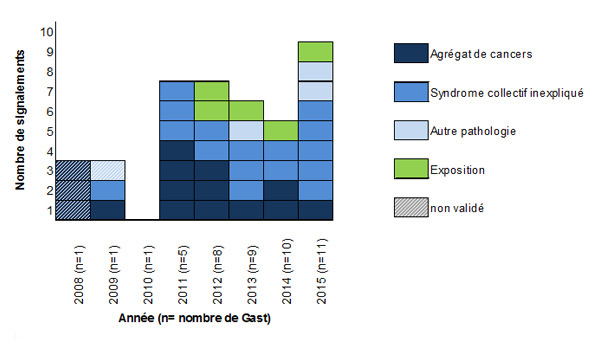
From 2008 to 2015, 40 reports were processed through a Gast.
March 2016: Presentation of the Gast program to occupational physicians at Inserm
June 2016: Presentation of the Gast system during a session titled “From Prevention to Occupational Risks” at the Rencontres de Santé publique France in Paris
June 2016: Oral presentation of the system at the 34th National Congress on Occupational Medicine and Health in Paris
June 2016: Presentation of the Gast program to occupational physicians at BASF
September 2016: Presentation of the Gast program to physicians and nurses at an occupational health service in Bordeaux / meeting of Gast members from the Occitanie region to discuss adapting the program’s organization to territorial reform
October 2016: Presentation of the Gast program at the Public Health Days in Corsica
Monitoring the impact of heat in the workplace
To assess the impact of heat on workers, the Occupational Health Inspection Unit of the General Directorate of Labor (DGT), in collaboration with the Occupational Health Division of Santé Publique France, has been collecting data every summer since 2006 on health incidents and accidents occurring in the workplace and linked to summer weather conditions.
Several heat waves affected France this summer; while moderate in intensity, they were characterized by sudden temperature fluctuations, particularly during the first episode in July. During this period, occupational physicians reported 8 heat-related health incidents to Santé publique France, including 3 deaths. These deaths occurred as a result of exhaustion or heatstroke among men working outdoors. For two of them (Brittany and Pays-de-la-Loire), Météo France had issued a yellow alert, while for the third (Nouvelle-Aquitaine), an orange alert was in effect in the affected department. One of these deaths involved a young person (21 years old), and the other two involved older individuals (56 years old), resulting from the worsening of a pre-existing condition for one of them.
This health monitoring system relies on voluntary reports from occupational physicians. It is passive and cannot claim to be exhaustive, even for the most serious events, such as deaths. Thus, following the summer season, 12 deaths potentially linked to heat were reported to the DGT.
Although these were not major heat waves, their health impact on workers was likely significant. The rapid rise in temperatures, which characterized the first episode, may have been a factor exacerbating the risk by reducing physiological adaptation to heat and further compromising the health of individuals whose condition was already compromised by illness.
In any case, occupational risks associated with high outdoor temperatures are relatively easy to avoid. Prevention requires foresight on the part of occupational physicians and nurses, as well as workers and their supervisors, to identify all vulnerable positions and high-risk activities within the company at the start of the hot season; and a high degree of vigilance during heat waves to remind everyone of and enforce the key preventive measures against dehydration and heatstroke.
For information on preventing risks associated with working outdoors in high heat, visit the INRS website.
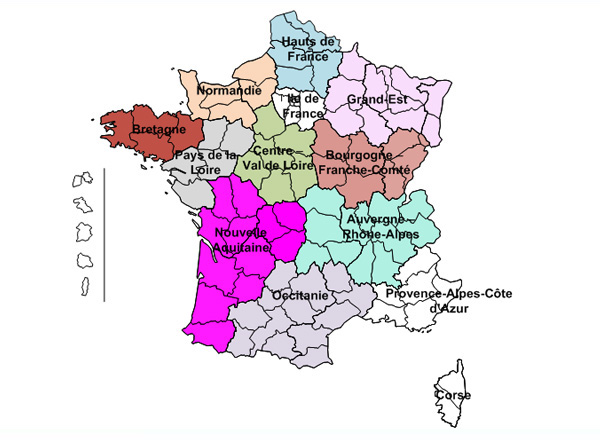
As of November 1, 2016, the GAST system is operational in 10 regions: Auvergne-Rhône-Alpes, Brittany, Burgundy-Franche-Comté, Centre-Val de Loire, Grand Est, Hauts-de-France, Normandy, New Aquitaine, Occitanie, and Pays de la Loire. In other regions, occupational health reports are handled by the Regional Intervention Unit (Cire) of Santé publique France, with support from a lead epidemiologist from the Occupational Health Directorate of Santé publique France.
From 2008 to 2015, 40 reports of unusual events occurring in the workplace were processed by a Gast. Nearly 80% had been reported by occupational health services. Among the reports, 87.5% concerned a medical condition (n=35), and 12.5% concerned exposure (n=5).
Among the reported medical conditions, the majority involved clusters of nonspecific symptoms (n=16), such as headaches or irritations often associated with unexplained collective syndromes and suspected cancer clusters (n=15).
The 4 invalidated reports did not meet the criteria for an unusual occupational event defined in this system because, upon verification, they were not clusters of the same medical condition.
In terms of responsiveness, half of the reports were the subject of a GAST meeting within 10 days of receiving the report.
The average time to action was 18 days between receipt of the report and the first consultation among GAST members (min: 1 day; max: 2.5 months). The report for which the delay was 2.5 months was unique because it involved the reopening of a case that had already been addressed by a GAST.
The average time between receiving the report and closing the case was 7 months (min: 7 days; max: 3 years). The longest processing times were for reports concerning suspected cancer clusters.
Map of Gast deployment as of November 1, 2016
Number of reports - 2008 to 2015
An Overview of the Professional Experiences of Occupational Health Alert Networks Among Occupational Physicians - A Look Back at a Thesis in Occupational Medicine
Written by Dr. M. Dehmas, occupational physician (Center for Occupational Diseases Consultation, Nancy University Hospital)
Occupational physicians play a key role in occupational health surveillance and monitoring due to their in-depth knowledge of the field and their active participation in monitoring and alerting within the workplace. They may feel overwhelmed when faced with complex medical situations that can create a climate of concern and uncertainty in the workplace.
A study combining both quantitative and qualitative methods was conducted between February and July 2016 among occupational physicians practicing in mainland France. The objectives of this study were to describe occupational physicians’ attitudes toward unusual health events in the workplace and to assess their knowledge of the Gast. A total of 723 occupational physicians responded to the online questionnaire sent to them via the regional medical inspectors (MIRT) of the Direccte.
More than half of the responding occupational physicians (n=394) reported knowing whom to notify regarding the three types of unusual workplace events studied: clusters of cancers or other serious illnesses, unexplained collective syndrome, and unusual exposure to an atypical substance. However, 16% of occupational physicians stated that they did not know offhand whom to contact to report any of these three situations. The percentage of physicians who felt unprepared to handle one or another of these situations varies and is significant: clusters of cancers or other serious diseases (28%), unexplained collective syndrome (33%), or exposure to an atypical substance (28%).
The GAST system is known to 146 of the doctors surveyed (20%). Among doctors familiar with GAST, they most often learned about it through MIRT (56%). Other sources of information include the Cire epidemiologist (13%), the “colleagues, occupational health service” network (7%), medical literature and the Internet (6%), professional societies (5%), and continuing education (2%).
Of all the physicians surveyed, 37% consider that the GAST system serves an alert function, 29% view it as a tool for data collection, response, and event management, and 18% see it as an investigative tool. Less than 10% of occupational physicians believe this system serves an informational role.
Even after the questionnaire reminded respondents of the Gast’s missions, the percentage of physicians unaware of the existence of such a system in their region remains high (76% in regions with a Gast). Among physicians stating that their region does not have a Gast, 14% believe that establishing a Gast is essential, 28% consider it necessary, 44% view it as desirable, and 1% deem it unnecessary.
These initial results highlight the need for better communication about the GAST program to occupational physicians.
Meeting of the National Steering Committee for the Gast
Launch of Gast Corsica
Internal evaluation of the Gast program, 10 years after the creation of the first group in the Aquitaine region
Suspected unusual event
Have you observed or suspect an unusual health event occurring in the workplace?
Report it to Santé publique France by contacting the regional health surveillance and emergency response platform of your regional health agency.












