




Data
The diphtheria surveillance system established by Santé publique France makes it possible to study the epidemiological trends of this vaccine-preventable disease as well as vaccination coverage.
Epidemiological data on diphtheria in France
In 2025 in France, 39 cases of tox+ diphtheria occurred and were reported:
14 cases of C. diphtheriae diphtheria in mainland France (10 cutaneous forms, 3 ENT forms, 1 form not specified)
7 cases of C. diphtheriae diphtheria in Mayotte (5 cutaneous forms, 2 ENT forms) and 1 case of cutaneous C. diphtheriae diphtheria in French Guiana
17 cases of diphtheria caused by C. ulcerans in mainland France (14 cutaneous forms, 2 ENT forms, 1 blood culture)
Additionally, in mainland France, one clinical case (ENT form) with an epidemiological link identified during the investigation of a case was reported. In Mayotte, 4 cases of C. diphtheriae carriers—without confirmation of the bacterium’s tox+ status—with an epidemiological link identified during the investigation of a case were also reported.
In mainland France, among the 14 reported cases of C. diphtheriae diphtheria, 5 were travelers returning from an African country (or individuals linked to a traveler), 2 were migrants who had recently arrived in France, and 7 were individuals for whom the investigation did not reveal any link to travel or a stay abroad. Eight of them resided in the Île-de-France region. Among these, two confirmed cases (as well as the clinical case) belonged to the same cluster, associated with a return from Mauritania. Five of the other cases in the Ile-de-France region were homeless (3 cases) or drug users (2 cases). Among the 14 cases of diphtheria caused by C. diphtheriae, 3 were under the age of 18.
Sequencing analyses by the National Reference Center for Corynebacteria of the diphtheriae complex showed that the strains from 4 of the 8 cases in the Île-de-France region, who had not traveled, belonged to the same genetic cluster—one of the main clusters of the 2022–2023 epidemic among migrants. These strains were genetically very closely related, with 2 to 5 allelic differences at the genomic level. This genetic proximity is consistent with very recent transmission and suggests circulation of the bacterium in this region, particularly among people in precarious situations, although one of the cases involved did not belong to this group. It should be noted that strains from the same cluster had already been identified in 2024 in 5 patients, 4 of whom resided in the Île-de-France region and 1 in the Provence-Alpes-Côte d’Azur region.
Furthermore, the strains from two migrant patients—one reported in the Grand Est region in March 2025 and the other in the Provence-Alpes-Côte d’Azur region in December 2025—shared an identical genotype. However, the epidemiological investigation revealed no common location or identical exposure for these two patients.
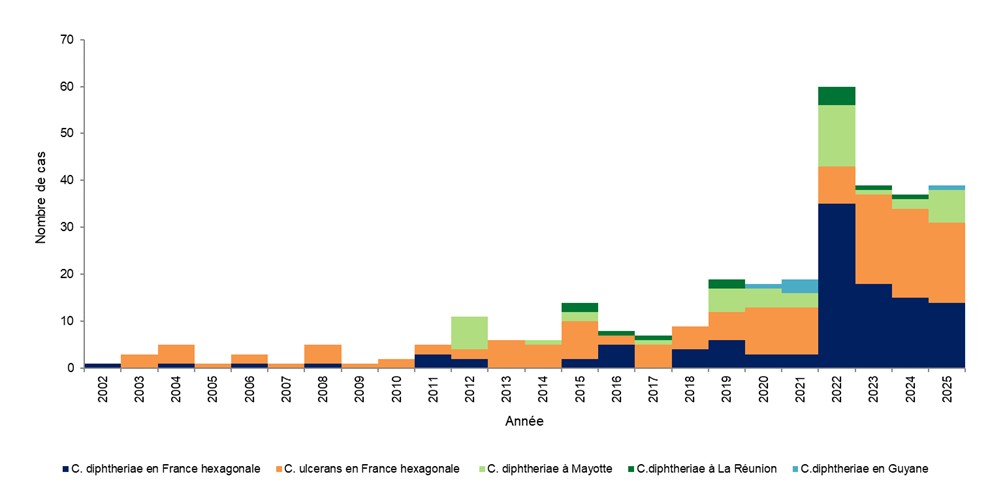
The year 2022 was marked by a sharp increase in the number of C. diphtheriae diphtheria cases reported in mainland France. The majority of these cases involved migrants. This increase continued into the first quarter of 2023 before subsequently declining. In 2025, the number of cases of diphtheria caused by C. diphtheriae was higher than the annual average observed over the 2017–2021 period (3.4 cases) but lower than in 2022 (35 cases), 2023 (18 cases), and 2024 (15 cases).
In the overseas territories, in Mayotte, two cases and four carriers of C. diphtheriae—all children—belonged to the same cluster that occurred in a school. Five of them were diagnosed following case finding and screening organized among contacts of the index case. In French Guiana, the case was a 15-year-old.
The cases of diphtheria caused by C. ulcerans were all adults, and at least 14 of them had had contact with an animal (dog and/or cat).
Number of annual cases of diphtheria by Corynebacterium species reported in France from 1989 to 2025, source: mandatory reporting—Santé publique France
| Year | Number of cases of C. diphtheriae |
Number of cases of C. ulcerans |
|---|---|---|
| 1989 | 1 case | |
| ... | ||
| 2002 | 1 imported case | |
| 2003 | 3 cases | |
| 2004 | 1 imported case | 4 cases |
| 2005 | 1 case | |
| 2006 | 1 imported case | 2 cases |
| 2007 | 1 case | |
| 2008 | 1 imported case | 4 cases |
| 2009 | 1 case | |
| 2010 | 2 cases | |
| 2011 | 3 cases, including 2 imported | 2 cases |
| 2012 | 2 imported cases + 7 cases in Mayotte | 2 cases |
| 2013 | 6 cases | |
| 2014 | 1 case in Mayotte | 5 cases |
| 2015 | 4 imported cases + 2 cases in Mayotte | 8 cases |
| 2016 | 6 imported cases | 2 cases |
| 2017 | 1 imported case + 1 case in Mayotte | 5 cases |
| 2018 | 4 cases, including 3 imported | 5 cases |
| 2019 | 13 cases, including 5 in Mayotte and 2 in Réunion | 6 cases |
| 2020 | 8 cases, including 4 in Mayotte and 1 in French Guiana | 10 cases |
| 2021 | 9 cases, including 3 in Mayotte and 3 in French Guiana | 10 cases |
| 2022 | 35 cases in mainland France + 13 in Mayotte + 4 in Réunion | 8 cases |
| 2023 | 18 cases in mainland France + 1 in Mayotte + 1 in Réunion | 19 cases |
| 2024 | 15 cases in mainland France + 2 in Mayotte + 1 in Réunion | 19 cases |
| 2025 | 14 cases in mainland France + 7 in Mayotte + 1 in French Guiana | 17 cases |
Figure 1 - Number of reported diphtheria cases per year, France, 2002–2025
See also

actualité
Increase in cases of C. diphtheriae diphtheria in France in 2022. Update as of December 31, 2022.
Vaccination Coverage Data
In relation to

Vaccination
thematic dossier
Contagious diseases most often affect children at a very young age. Because children are particularly vulnerable, they are a priority target for vaccination programs.











