



Increase in cases of C. diphtheriae diphtheria in France in 2022. Update as of December 31, 2022.
Update as of December 31, 2022, following reports of diphtheria cases caused by C. diphtheriae in several regions of mainland France, as well as in Mayotte and Réunion.

Diphtheria
thematic dossier
Diphtheria is caused by a bacterium that includes several species (Corynebacterium diphtheriae, C. ulcerans, C. pseudotuberculosis), some of which carry a gene responsible for the severity of the...
Since the beginning of 2022, several cases of diphtheria have been reported in nine regions of mainland France, as well as in Mayotte and Réunion. Compared to other years, the number of cases of C. diphtheriae is significantly higher than average. In mainland France, the majority of cases were reported among migrants and travelers. Thanks to very high vaccination coverage over many years, the occurrence of severe cases or clusters within the general population appears extremely low in mainland France and Réunion. In Mayotte, where vaccination coverage is insufficient, the bacterium has been circulating for several years.
Santé publique France is monitoring the evolving situation and the increase in diphtheria cases among migrants, the vast majority of whom are not up to date on their vaccinations. A reminder of vaccination and care recommendations has been sent to associations and healthcare professionals.
Overview of the Disease
Diphtheria, caused by Corynebacterium diphtheriae, is a highly contagious bacterial infection that spreads from person to person, primarily from sick individuals but also from healthy carriers (who may carry the bacteria for several weeks or months). Transmission occurs either directly via droplets or indirectly through contaminated objects (rare) or untreated skin lesions. The incubation period is short, less than 7 days (2 to 5 days). The disease presents as either an upper respiratory tract or skin infection.
Diphtheria is a notifiable disease.
Situation Update in France
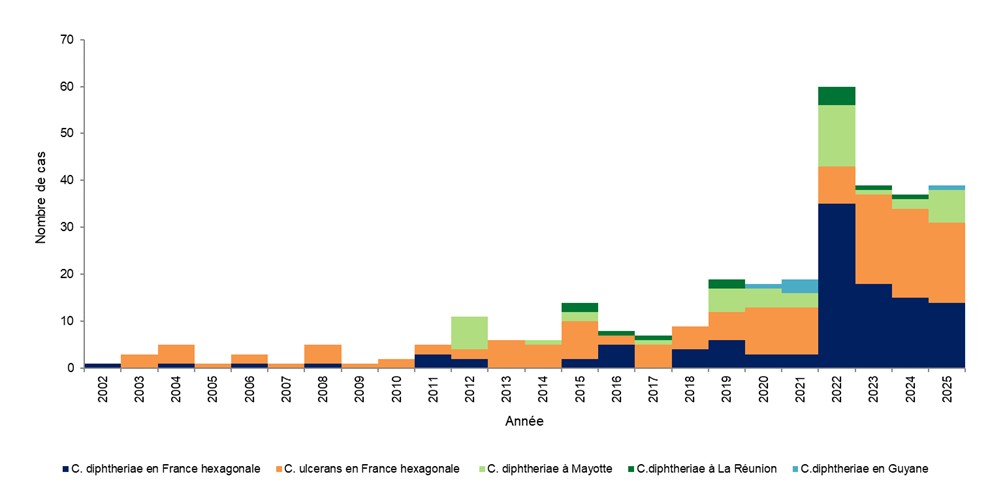
As of December 31, 2022, 60 cases of diphtheria (biologically confirmed as tox-positive, i.e., carrying the tox gene encoding the diphtheria toxin) have been reported in France since the beginning of the year (Figure 1):
8 cases of diphtheria caused by Corynebacterium ulcerans (C. ulcerans) in mainland France;
35 cases of diphtheria caused by Corynebacterium diphtheriae (C. diphtheriae) in mainland France;
13 cases of diphtheria caused by C. diphtheriae in Mayotte and 4 in Réunion.
In 2022, compared to the previous 5 years, the number of C. ulcerans diphtheria cases was similar (an average of 7.2 cases per year), but the number of C. diphtheriae diphtheria cases was significantly higher than the average observed at that time (mainland France: 3.4 cases per year; Mayotte: 2.6 cases per year; Réunion: 0.6 cases per year). There was therefore a clear increase in C. diphtheriae cases in 2022, particularly in mainland France.
Figure 1 - Number of reported diphtheria cases per year, France, 2002–2025
In mainland France
The majority of cases were reported among migrants (n=28) but also among travelers (n=6) (Figure 2). For these 34 cases, a history of travel to one or more of the following countries was identified: Afghanistan (n=24), Turkey (n=6), Italy (n=5), Serbia (n=6), Austria (n=4), Tunisia (n=3), Bulgaria (n=2), Iran (n=2), Hungary (n=2), Mali (n=2), Switzerland (n=2), Bosnia (n=1), Slovenia (n=1), Syria (n=1), Senegal (n=1), Thailand (n=1), Madagascar (n=1). When the date of their arrival in France was known (n=12), it was most often less than 15 days prior to the date of disease notification (n=9). One case, which could not be interviewed, for whom we have no information regarding travel history.
Furthermore, one case was likely infected in France through contact with a person returning from a trip to Togo.
Cases of diphtheria caused by C. diphtheriae in mainland France were primarily men (n=32), aged 11 to 59 years (average age 23). Only three of them were up to date on their diphtheria vaccinations. For 25 of them, vaccination status was unknown.
Among the cases occurring in migrants, 11 resided in shelters.
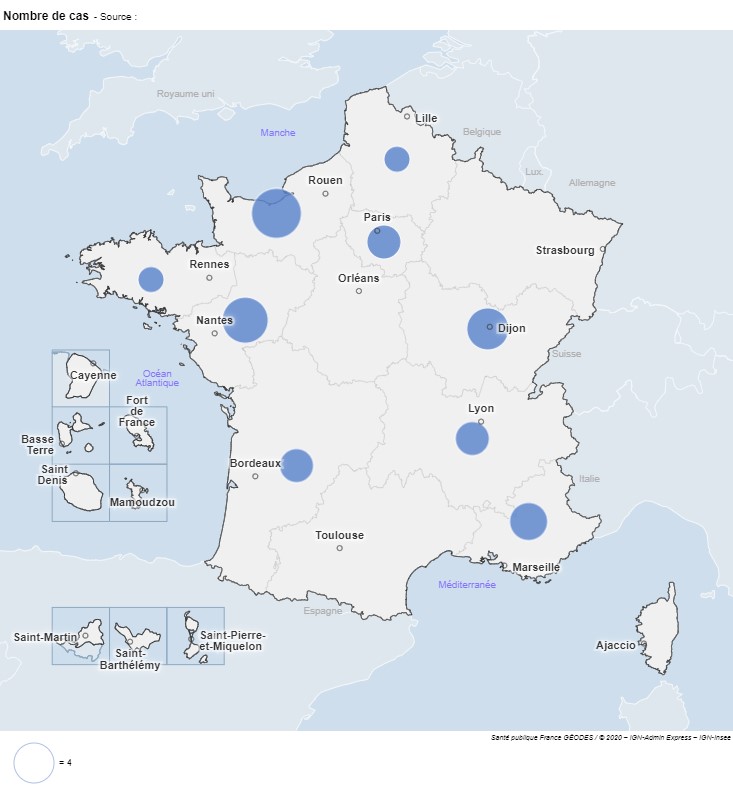
Cases were diagnosed in 9 regions. The Normandy region was the most affected with 7 reported cases, but cases were scattered across mainland France (Figure 3). Twenty-seven cases were cutaneous forms, 3 were asymptomatic carriers (in the oropharyngeal region), one was a mildly symptomatic respiratory form (autochthonous case), and four others presented with symptoms of classic diphtheria angina (migrant). One of these ENT cases died.
Genotyping via genomic sequencing of the 34 isolates by the National Reference Center (NRC) for Corynebacteria of the diphtheriae complex (https://www.pasteur.fr/fr/sante-publique/CNR/les-cnr/corynebacteries-du-complexe-diphteriae ) revealed 12 distinct genetic groups (defined by their “sublineage” (SL) and more precisely by their “genomic cluster” (GC)), including 5 among the migrant cases linked to Afghanistan: SL377-GC817 (8 cases), SL466-GC823 (1 case), SL384-GC805 (7 cases), SL698-GC795 (7 cases), SL698-GC804 (2 cases). These groups have also been identified in other European countries.
Two clusters of cases were reported: one involved 4 cases who had traveled together on a bus, and the other involved two cases who had traveled together. Genotyping via genomic sequencing showed that among the cases who had traveled on the bus, there were two pairs of cases with two distinct genotypes and therefore likely two chains of transmission.
Figure 2 - Number of diphtheria cases caused by C. diphtheriae among individuals returning from abroad, by reporting week, mainland France, 2002 – Data as of December 31, 2022
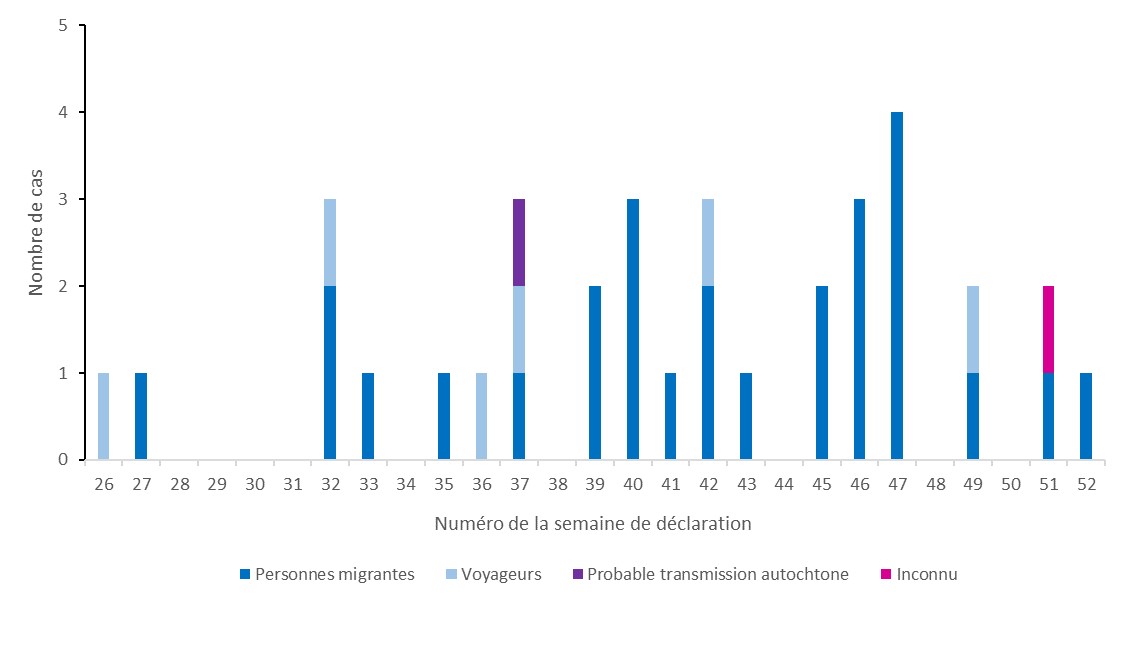
Figure 3 - Number of cases by region, France, 2022 - Data as of December 31, 2022
An increase in the number of cases among migrants has also been observed in other European countries, notably in England, Germany, and Switzerland. As of November 25, 2022, England had reported 50 cases since the beginning of the year (UK Health Security Agency, Public Health Control and Management of Diphtheria in England: Supplementary Guidance for Cases and Outbreaks in Asylum Seeker Accommodation Settings, December 2022). Germany reported three times as many cases in 2022 (weeks 30–39) compared to the number of cases reported over the past three years (Badenschier et al. Euro Surveill. 2022). In October 2022, Switzerland reported two ongoing diphtheria outbreaks among migrants (Kofler J et al. Euro Surveill. 2022). The European Centre for Disease Prevention and Control (ECDC) and the WHO also reported cases of diphtheria in Austria, the Czech Republic, Belgium, Italy, and Norway.
Mayotte and Réunion
In Mayotte, local transmission of the bacterium has been known for several years. In 2022, of the 13 reported cases, 7 were cutaneous, 1 was an ENT case, and 5 were asymptomatic carriers (ENT) of the bacterium. These last 5 infections were identified among close contacts of 2 symptomatic cases. One death occurred in an unvaccinated 7-month-old infant.
In Réunion, during the 2021–2022 period, all reported cases were imported cases. In 2022, 4 cases were reported, and no travel history was identified. These 4 cases were not linked to one another and were cutaneous forms.
Genomic cluster analysis by the CNR showed that 10 strains (6 in Mayotte and 4 in Réunion) shared the same characteristics, strongly suggesting that these cases are linked. We have no hypothesis at this stage regarding the nature of this link.
What measures have been put in place?
France (excluding Mayotte) has very high vaccination coverage (VC) against diphtheria: 99% for the primary vaccination and 96% for the booster at 11 months among infants in 2019. These vaccination coverage rates have been very high for many years, as the vaccine was mandatory up to age 13 until 2018. Furthermore, vaccination is mandatory for infants born in 2018 or later. The risk of cases emerging, particularly severe cases and/or clusters within the general French population, therefore remains extremely low.
However, the increase in diphtheria cases among migrants—the vast majority of whom are not up to date on their vaccinations—raises concerns about the emergence of clusters of C. diphtheriae infections in shelters for migrants, refugees, or asylum seekers (this scenario has been described in Switzerland, (Kofler J et al Euro Surveill 2022)). To prevent this risk, a message1 informing about this increase in cases among migrants and reiterating vaccination and management recommendations2 was sent to organizations supporting migrant populations and to healthcare professionals.
Investigations and discussions regarding cases occurring among migrants are being conducted at the European level (ECDC and WHO), particularly to identify a potential source of infection (countries traversed along the migration route or countries of origin such as Afghanistan).
During the first three weeks of January 2023, cases of diphtheria among migrants, particularly those from Afghanistan, continued to be reported. Healthcare professionals caring for these populations should be reminded to be particularly vigilant in identifying signs of diphtheria and to provide care for individuals for whom access to healthcare may be difficult (Diphtheria Fact Sheet: Identifying and Managing a Suspected Case in France, July 6, 2022, COREB).
In Mayotte, studies conducted in recent years show insufficient vaccination coverage to ensure herd immunity. In 2019, 93.2% of children aged 24 to 59 months; 45.3% of 7- to 11-year-olds; and 27.1% of 14- to 16-year-olds were up to date on their diphtheria vaccinations. Efforts to increase vaccination coverage in these populations must be strengthened in this territory.
1- MINSANTE No. 2022_66 dated September 27, 2022
2- Opinion of the High Council for Public Health regarding the appropriate course of action in the event of a diphtheria case, dated March 4, 2011, and supplement dated September 10, 2022: https://www.hcsp.fr/explore.cgi/avisrapportsdomaine?clefr=215












