




The disease
Depressive and Anxiety Disorders
Feeling sad, being “depressed,” having “dark thoughts,” or having trouble sleeping does not necessarily mean that you are suffering from depression. A major depressive episode (MDE) is characterized by a specific combination of subjective and clinical symptoms that significantly impact daily life and disrupt normal activities. Depression can occur at any stage of life (infants, children, adolescents, adults, older adults), with symptoms varying by age.
Similarly, states of stress or anxiety may arise at certain times in life, but these symptoms only constitute a diagnosis of an anxiety disorder if they persist for at least six months and interfere with normal daily functioning.
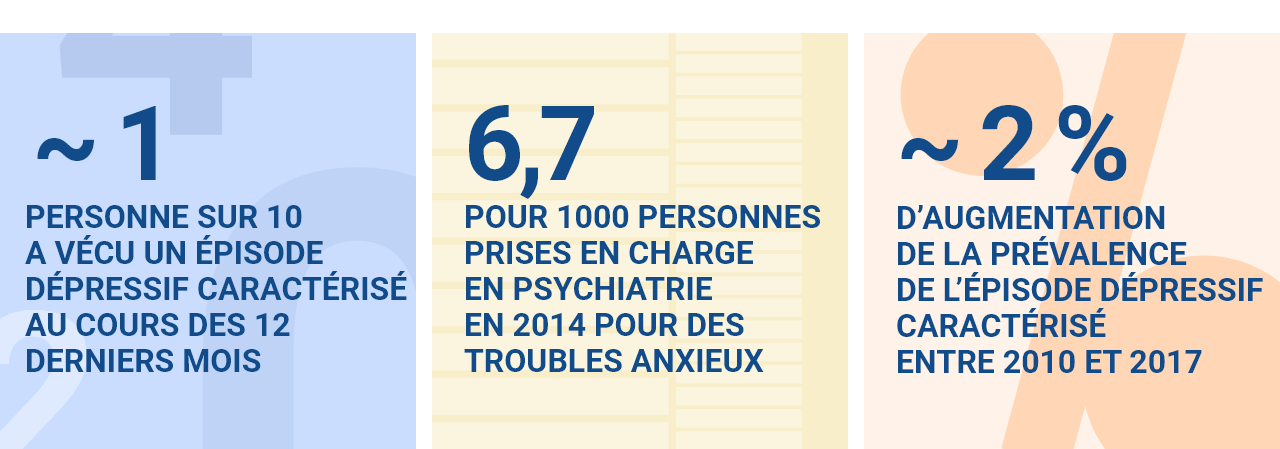
Key Statistics on Depression
Depression: A Cluster of Symptoms
A major depressive episode is characterized by at least one of the two primary symptoms, accompanied by at least three secondary symptoms, with an impact on daily life and a disruption of usual activities.
The primary symptoms:
experiencing a period of at least two consecutive weeks of feeling sad, depressed, or hopeless nearly all day, almost every day;
experiencing a period of at least two consecutive weeks of having lost interest or pleasure (in hobbies, work, or activities that usually bring pleasure) almost all day and nearly every day.
Secondary symptoms:
significant weight loss or gain without dieting, or a decrease or increase in appetite almost every day;
insomnia or hypersomnia almost every day;
psychomotor agitation or retardation almost every day;
fatigue or loss of energy almost every day;
feelings of worthlessness or excessive or inappropriate guilt almost every day;
difficulty concentrating or thinking almost every day;
recurrent thoughts of death, recurrent suicidal ideation.
Anxiety Disorders: A Group of Anxiety-Phobic, Obsessive, and Adaptive Syndromes
Anxiety disorders encompass a range of anxiety-phobic, obsessive, and adaptive syndromes, making them psychiatric disorders frequently encountered in the general population and in primary care. States of stress or anxiety may arise at certain times in life, but these symptoms constitute a diagnosis of an anxiety disorder only if they persist for at least six months and interfere with the proper functioning of daily life.
People with anxiety disorders experience intense, prolonged, and excessive anxiety relative to the actual threat. They are more common in women than in men, and symptoms typically appear during childhood and adolescence (for phobias and obsessive-compulsive disorders) or in early adulthood (for generalized anxiety). There is very often comorbidity between the various types of anxiety disorders, as well as between these disorders and depression, alcohol abuse, or physical conditions, particularly cardiovascular and asthmatic conditions. Furthermore, their link to an elevated risk of suicide is well established.
Depression and Anxiety Disorders: An Impact on Daily Life
Anxiety and depressive disorders can be intense, long-lasting, and have a significant impact on the activities and functioning of those affected. Depressive disorders are believed to account for 35 to 45% of sick leave. Anxiety and depressive disorders contribute significantly to the risk of suicide.
Social and Regional Disparities
The 2017 Health Barometer survey showed that unemployed individuals and homemakers reported a major depressive episode (MDE) in the past 12 months nearly twice as often as employed individuals. Economically inactive individuals reported an MDE 3.4 times more often. Women reported an MDE twice as often as men. People with high incomes are less likely to have experienced a CDE.
Anxiety disorders are more common among women than among men.
In relation to

Mental distress and burnout
thematic dossier
Mental health can be affected by certain psychosocial workplace exposures, leading to conditions such as burnout, depression, and suicidal behavior.

Suicides and suicide attempts
thematic dossier
France has one of the highest suicide rates in Europe. Suicide is preventable, and its prevention must be a priority. Effective prevention measures are available.

Post-traumatic stress
thematic dossier
Terrorist attacks have a profound and lasting psychological impact on exposed civilians and first responders, particularly on civilians who were directly threatened or have lost loved ones, but...











