




Data
One in six adults will experience a major depressive episode in 2024
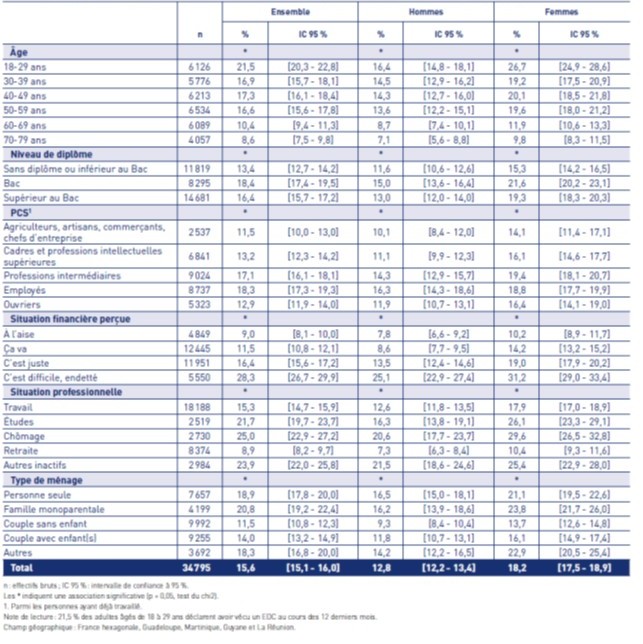
According to the results of the 2024 Santé publique France Health Barometer, the prevalence of a major depressive episode (MDE) is estimated at 15.6% among adults aged 18 to 79 in mainland France and the overseas departments and regions (excluding Mayotte). The prevalence is significantly higher among women than among men (18.2% vs. 12.8%).
The 2024 edition of the France Public Health Barometer introduces major changes to the survey methodology (new sampling plan, data collection primarily via the Internet). Consequently, no trends can be established through a direct comparison between the 2024 data and those from 2021.
As a reminder, among those aged 18–75, after remaining stable between 2005 and 2010, the prevalence of EDC in the past 12 months—which had increased by 1.8 percentage points over the 2010–2017 period—rose sharply over the 2017–2021 period, rising from 9.8% to 13.3%.
The increase between 2017 and 2021 affected both men (+3.4 percentage points) and women (+3.6 percentage points). The largest increase was observed among 18- to 24-year-olds (+9.1 percentage points), with prevalence rising from 11.7% in 2017 to 20.8% in 2021.
21.5%
prevalence of EDC in the past 12 months among 18- to 29-year-olds in 2024
Beyond the effects of age or gender, those with a high school diploma or equivalent appear to be the most affected (18.4%). The results also reveal a significant disparity by socio-professional category: employees (18.3%) and intermediate professions are more affected than managers and professionals or manual workers, for example. Marked differences are observed based on perceptions of one’s financial situation: those reporting financial difficulties have a prevalence three times higher than those reporting financial comfort. The prevalence of EDC is also higher among the unemployed (25.0%) and the economically inactive (23.9%), while it is significantly lower among retirees (8.9%). Finally, people living alone or in single-parent households have higher prevalence rates compared to other household types, particularly childless couples (11.5%). Women appear to be more affected than men in all categories analyzed.
Percentage of adults aged 18–79 who reported an EDC in the past 12 months
Learn more

rapport/synthèse
4 September 2026
Depressive episodes: prevalence and use of healthcare services. Santé publique France Barometer: results from the 2024 edition
More than one in 20 adults will be affected by generalized anxiety disorder in 2024
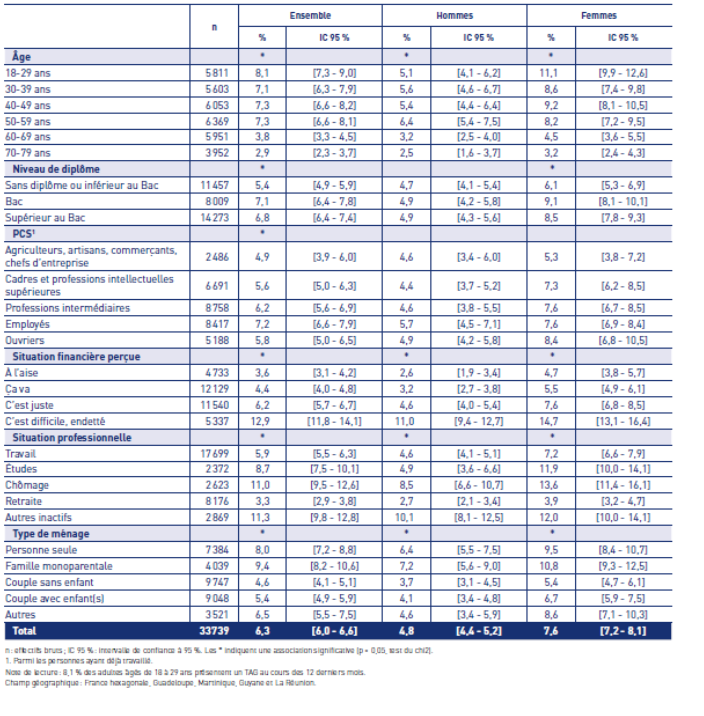
According to the results of the 2024 Santé publique France Health Barometer, the prevalence of generalized anxiety disorder (GAD) is estimated at 6.3% among adults aged 18 to 79 in mainland France and the overseas departments and regions (excluding Mayotte). The prevalence is higher among women than among men (7.6% vs. 4.8%).
Since questions on GAD were asked for the first time in the Public Health France Barometer, no trend analysis is possible.
8.1%
prevalence of GAD in the past 12 months among 18- to 29-year-olds in 2024
Differences are observed based on educational attainment, perception of financial situation, employment status, or household type. Individuals with a high school diploma or higher have a higher prevalence of TAG than those with fewer credentials (7.1% and 6.8%, respectively, vs. 5.4%). Employees (7.2%) and intermediate-level professionals (6.2%) have the highest prevalences. Individuals reporting financial difficulties have a significantly higher prevalence of GAD than those reporting financial comfort (12.9% vs. 3.6%). Individuals living in single-parent families (9.4%) or living alone (8.0%) also have a higher prevalence compared to other household types. Unemployed individuals (11.0%) and other economically inactive individuals (11.3%) are more affected by GAD than retirees (3.3%) and employed individuals (5.9%). Women appear to be more affected than men in all categories analyzed. It is also worth noting that female students have a high prevalence of GAD, estimated at 11.9%, whereas it is only 4.9% among male students.
Percentage of adults aged 18–79 who reported a depressive disorder in the past 12 months
Learn more
rapport/synthèse
4 September 2026
Generalized Anxiety Disorder: Prevalence and Use of Healthcare Services. Santé publique France Health Barometer: Results of the 2024 Edition
Treatment for mood disorders has increased every year among both men and women between 2010 and 2014
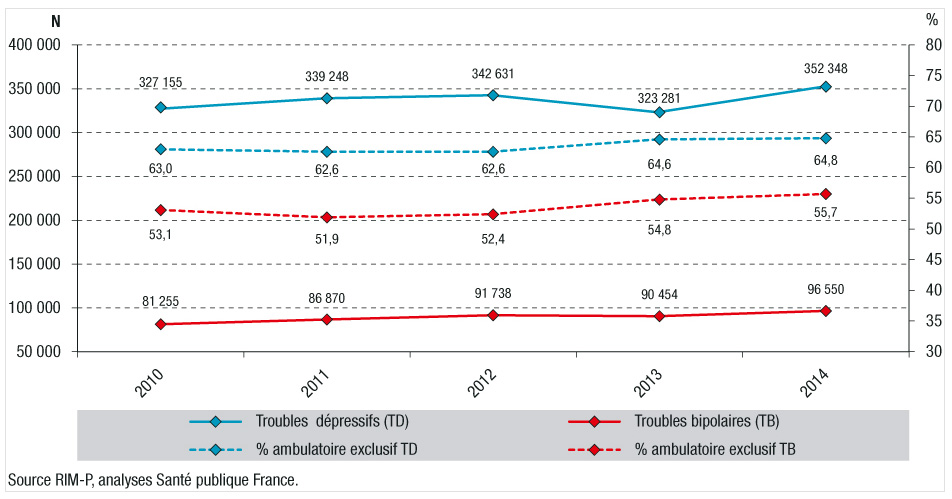
Between 2010 and 2014, 1,684,663 and 446,867 patients were treated for depressive disorders (DD) and bipolar disorders (BD), respectively, in facilities authorized to provide psychiatric care.
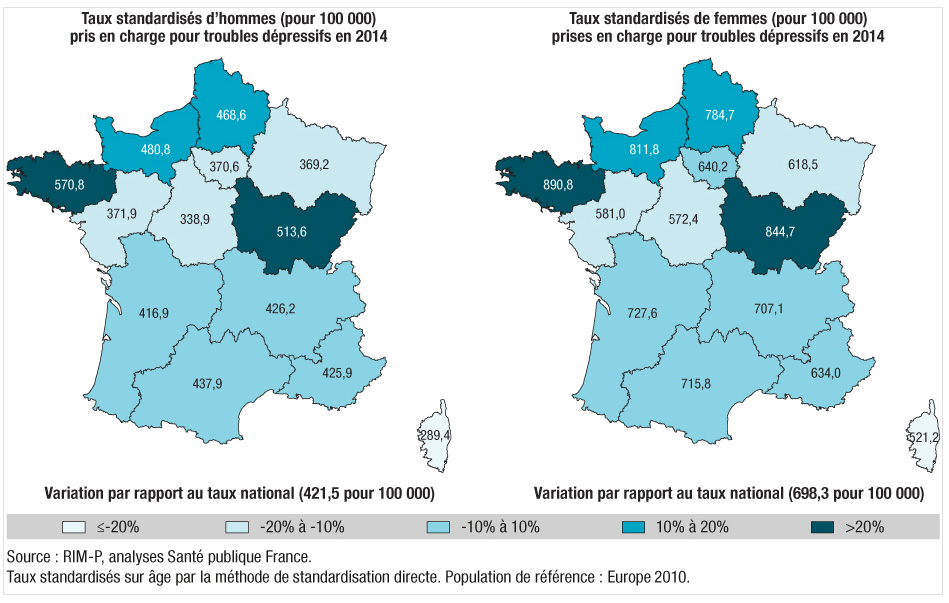
In 2014, treatment rates for DT were 564.8 per 100,000 people, higher among women (698.3 vs. 421.5 among men). They varied little over the study period. Treatment rates for BD were 157.1 per 100,000 people (190.3 among women and 120.8 among men). An annual increase of 2.6% was observed among men (p=0.01) and 3.4% among women (p<0.001) between 2010 and 2014.
For both TB and TD, the highest rates were found among men and women aged 50 to 54. Among both men and women, treatment rates 20% higher than the national rate were observed in Brittany and Bourgogne-Franche-Comté for TD and in the Southwest for TB.
Number of patients treated for depressive disorders or bipolar disorders in facilities licensed to provide psychiatric care, and percentage of those treated exclusively on an outpatient basis, mainland France, 2010–2014
Standardized rates of patients treated for depressive disorders in facilities licensed to provide psychiatric care, by region and sex, per 100,000 inhabitants, mainland France, 2014
Learn more

Management of mood disorders in facilities licensed to provide psychiatric care between 2010 and 2014 in mainland France. Analysis of RIM-P data
Work-related psychological distress
In relation to

Mental distress and burnout
thematic dossier
Mental health can be affected by certain psychosocial workplace exposures, leading to conditions such as burnout, depression, and suicidal behavior.

Suicides and suicide attempts
thematic dossier
France has one of the highest suicide rates in Europe. Suicide is preventable, and its prevention must be a priority. Effective prevention measures are available.

Post-traumatic stress
thematic dossier
Terrorist attacks have a profound and lasting psychological impact on exposed civilians and first responders, particularly on civilians who were directly threatened or have lost loved ones, but...











