




The disease
Whooping cough is a bacterial infection of the lower respiratory tract that is typically accompanied by little or no fever. It is highly contagious and progresses slowly in humans.
Whooping cough, a bacterial infection
Whooping cough is a bacterial infection of the lower respiratory tract that causes little or no fever but has a prolonged course and is highly contagious. Two bacteria of the genus Bordetella are responsible for whooping cough-like syndromes in humans: primarily Bordetella pertussis and Bordetella parapertussis.
The number of pertussis cases has decreased significantly since the introduction of the vaccine. However, the bacterium continues to circulate because neither vaccination nor the disease itself provides lifelong protection against infection. The affected populations include infants too young to be vaccinated, as well as adolescents and adults who have lost the protection conferred by the vaccine or the disease.
Key statistics on whooping cough
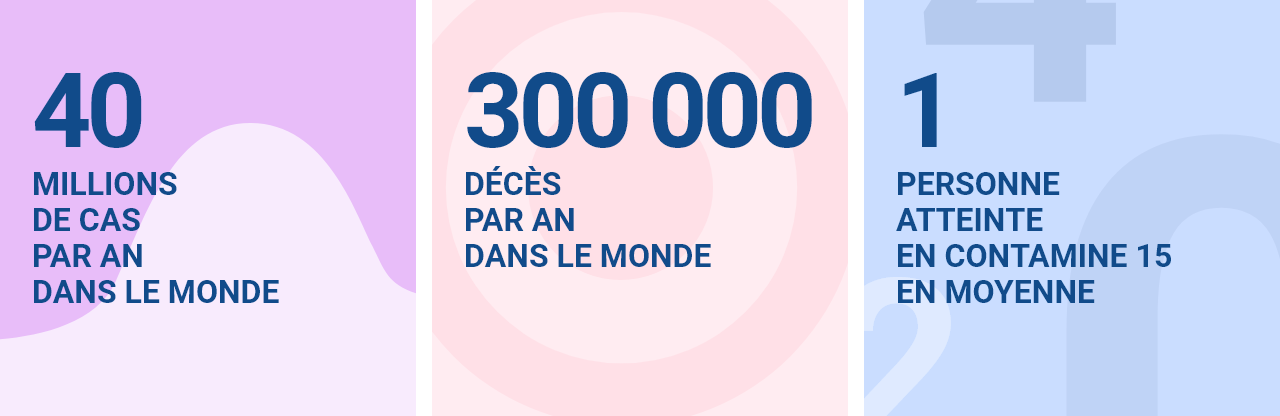
Whooping cough, a highly contagious infection
Transmission occurs through the air and by contact with an infected person who is coughing. It occurs primarily within families or in group settings. A systematic investigation must be conducted around the infected person to identify sources of infection and secondary cases. In family settings, infection rates of 90% have been observed among unvaccinated individuals. Contagiousness is highest during the first week. It then decreases over time and is considered negligible after 3 weeks of the illness without antibiotic treatment or after 3 to 5 days of antibiotic therapy, depending on the antibiotic chosen.
A prolonged course
The average incubation period is 10 days (ranging from 7 to 21 days), and clinical presentation varies depending on the individual and their age. It can present as severe pertussis in infants under 3 months of age with respiratory distress and multi-organ failure, or as atypical pertussis in adults—often unrecognized—where the diagnosis should be considered in the presence of any cough without an obvious cause that is persistent or worsens beyond one week. In fact, symptoms may be much less dramatic in adults; when mild, they may resemble a simple upper respiratory infection. Vaccination reduces symptoms.
The diagnosis of pertussis is therefore made using several methods:
Clinical: The clinical diagnosis of pertussis varies from person to person. There are several criteria for establishing the diagnosis:
The course of the disease: it begins during the first 4 to 6 days with mild signs of upper respiratory tract infection: rhinitis, mild cough. Then the cough persists and worsens rather than improving, as is generally the case with common nasopharyngitis. Fever is usually mild or absent;
A cough persisting beyond 7 days and its worsening suggest the diagnosis, especially as it becomes characteristic (spasmodic, particularly at night, occurring in paroxysmal episodes). Often paroxysmal: violent and repeated coughing fits, without effective inspiratory recovery. These fits can sometimes cause facial turgidity, conjunctival redness, vomiting, cyanosis, and a loud inspiratory sound at the end of the fit, comparable to a rooster’s crow (may be absent in infants, adults, and previously vaccinated individuals).
Epidemiological
Identification of a primary case in the immediate environment, namely a person with a prolonged cough within 3 weeks prior to the onset of symptoms in the case under investigation
Or identification of a secondary case, namely the onset of a cough in a person in contact with the case under investigation within 3 weeks after the onset of the latter’s symptoms.
Biological: Sample collection for culture and/or PCR (“Polymerase Chain Reaction” or gene amplification test to identify the bacterium’s DNA) via aspiration or nasopharyngeal swab according to the following procedures:
cough duration < 15 days: direct diagnosis by culture and real-time PCR (RT-PCR);
15 days ≤ duration of cough < 21 days: direct diagnosis by RT-PCR;
cough duration ≥ 21 days: clinical diagnosis first and foremost. Perform RT-PCR in potential secondary cases.
PCR is the most sensitive diagnostic method and is performed by many laboratories. It is no longer necessary to perform PCR after three weeks of coughing. PCR and culture are covered by health insurance.
Prevention is primarily through vaccination
Prevention relies primarily on vaccination. Only the acellular vaccine is used in France.
For children, the primary vaccination is administered at 2 and 4 months of age, followed by a booster at 11 months. A second booster is given at age 6, followed by a third at ages 11–13 with a reduced antigen dose.
For adults, pertussis vaccination is recommended with a booster at age 25 (catch-up vaccination possible up to age 40) and as part of the “cocooning” strategy (for those in close contact with the infant during the first 6 months of life).
For pregnant women, the HAS published an advisory on April 12, 2022, regarding pertussis vaccination, which recommends:
vaccination of pregnant women starting in the second trimester of pregnancy, with a preference for the period between the fifth and eighth months of pregnancy;
vaccination of people in the infant’s immediate circle when the mother was not vaccinated during pregnancy or was vaccinated less than one month before delivery.
For healthcare and early childhood professionals, booster shots at ages 25, 45, and 65 must now include the pertussis component (tDap).
In light of the marked resurgence of pertussis in France in 2024, the French National Authority for Health (HAS) recommended on July 22, 2024, that anyone in close contact with a newborn and/or infant under 6 months of age in a professional setting receive a booster shot if their last pertussis vaccination was more than 5 years ago.
If the mother was not vaccinated during pregnancy, or if she gave birth less than one month after vaccination, the HAS recommended a booster for adults over the age of 25 in the newborn’s immediate circle, with a dose of dTcaPolio vaccine if the previous pertussis vaccination was 5 years or more ago (this interval being 10 years outside of specific public health contexts). These recommendations remained in effect in 2025.
Other non-vaccine control measures
Excluding pertussis cases from group settings helps prevent secondary cases. This must be done during the contagious phase (3 weeks after symptom onset if no appropriate antibiotic treatment is prescribed, or until the 3rd or 5th day of treatment depending on the antibiotic chosen).
Antibiotics indicated for prophylaxis prevent individuals in contact with pertussis cases who are not or no longer protected by vaccination from developing the disease. They are administered to highly exposed individuals (unprotected family members), vulnerable individuals (primarily unvaccinated infants), and those in contact with them (pregnant women, parents of unvaccinated infants, etc.). In this case, it must be administered as soon as possible after exposure and, at the latest, 21 days after contact with an index case during the infectious period. The guidelines for use are identical to those recommended for curative treatment.
Antibiotic treatment
Hospitalization is strongly recommended for children aged 0 to 3 months to ensure appropriate cardiopulmonary monitoring and nursing care, and for those over 3 months of age depending on clinical tolerance.
Treatment primarily involves antibiotics (macrolides) during the first 3 weeks of the illness. This rapidly reduces contagiousness and allows for a return to group settings after 5 days of treatment (or 3 days if the patient is treated with azithromycin). However, the effect of antibiotic therapy on the course of the disease has not been demonstrated.
For special cases in pregnant and breastfeeding women:
In pregnant women, azithromycin or clarithromycin may be used at any stage of pregnancy. If contraindicated, cotrimoxazole may be used, but its use should be avoided during the first 10 weeks of amenorrhea or combined with folic acid supplementation.
In breastfeeding women, no specific precautions are required if the newborn is also being treated. Otherwise, azithromycin and clarithromycin may be used.
Reference materials
In relation to

Vaccination
thematic dossier
Contagious diseases most often affect children at a very young age. Because children are particularly vulnerable, they are a priority target for vaccination programs.











