



Data
Santé publique France is studying the impact of climate change on health risks.
An increase in heat waves that pose the greatest health risks in France
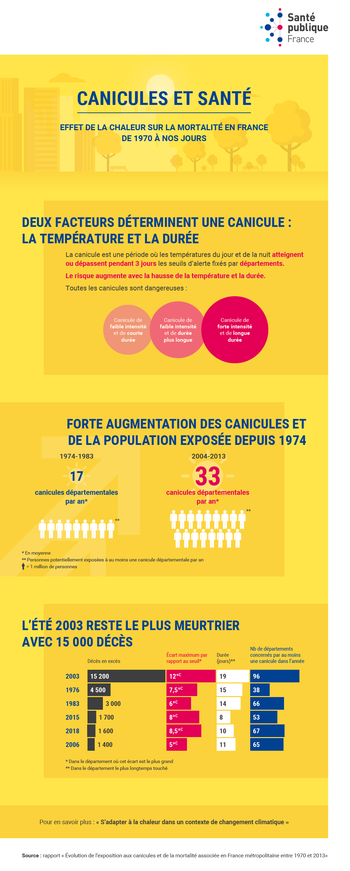
The study “Changes in Heat Wave Exposure and Associated Mortality in Metropolitan France Between 1970 and 2013” documented all heat waves that occurred in metropolitan France over the past 40 years, using the heat wave and health alert system approach retrospectively.
The results highlight a clear increase in the number of heat waves and the population exposed over the decades. Nationally, the size of the population exposed to at least one heat wave per year doubled between the 1974–1983 decade and the 2004–2013 decade. Before the implementation of the heat wave plan in 2004, an average of 18 departmental heat waves were observed per year. Since 2004, an average of 40 have been observed per year.
Nearly 32,000 excess deaths were recorded across all 921 heat waves identified between 1974 and 2013, half of which occurred in 2003—a year with no historical precedent. Annual
reports from the heat wave and health alert system provide data to complete the series for the most recent years. The years 2015, 2016, 2017, and 2018 were marked by significant heat waves, resulting in nearly 4,000 excess deaths.
Climate Change and Heat Waves: Impact on Mortality from 1970 to the Present.
Heat-related indicators since 1974 in Géodes
Annual heat-related indicators can be viewed and exported on Géodes, the cartographic observatory of Santé publique France:
cumulative degrees above thresholds during heat waves;
increase in mortality observed during heatwave periods: number, proportion, and rate of excess deaths.
All these indicators are available by department and by year from 1974 to 2018
An expected increase in the number of temperature-attributable deaths worldwide
The MCC has already yielded significant findings on the associations between meteorological variables, climate, and health. In particular, it concluded that there would be a net increase in the number of temperature-attributable deaths under the most severe warming scenarios, an increase that would be substantially reduced under warming scenarios involving greenhouse gas emission reduction strategies.
For France, the results indicate that there would be an increase in temperature-related mortality, which could account for up to 4% of total mortality by 2090 under the most pessimistic scenario (RCP8.5).
|
|
Percentage of mortality attributable to heat, by scenario and time horizon |
Percentage of mortality attributable to cold, by scenario and time horizon |
||||||
|---|---|---|---|---|---|---|---|---|
|
|
RCP 2.6 |
RCP 8.5 |
RCP 2.6 |
RCP 8.5 |
||||
|
|
2050–2059 |
2090–2099 |
2050–2059 |
2090–2099 |
2050–2059 |
2090–2099 |
2050–2059 |
2090–2099 |
|
France |
1.8% |
1.7% |
3.5% |
7.7% |
7.5% |
7.7% |
6.8% |
5.6% |
|
United Kingdom |
0.5% |
0.5% |
1.1% |
2.6% |
6.5% |
6.9% |
5.8% |
4.5% |
|
Switzerland |
1.3% |
1.2% |
2.5% |
6.2% |
5.1% |
5.2% |
4.6% |
3.7% |
|
Italy |
2.8% |
2.6% |
4.7% |
10.0% |
6.1% |
6.2% |
5.3% |
4.1% |
|
United States |
0.8% |
0.7% |
1.5% |
3.5% |
4.7% |
4.8% |
4.2% |
3.3% |
|
China |
1.4% |
1.4% |
2.4% |
6.1% |
10% |
10.1% |
8.9% |
7.1% |
|
Brazil |
1.7% |
1.7% |
3.3% |
8.2% |
2.1% |
2.1% |
1.3% |
0.6% |
See also
Gasparrini A, Guo Y, Sera F, Vicedo-Cabrera AM, Huber V, Tong S, et al. Projections of temperature-related excess mortality under climate change scenarios. The Lancet Planetary Health. 2017;1(9):e360-e7.
Percentage difference in heat-related mortality between 2090–2099 and 2010–2019 under the RCP8.5 scenario
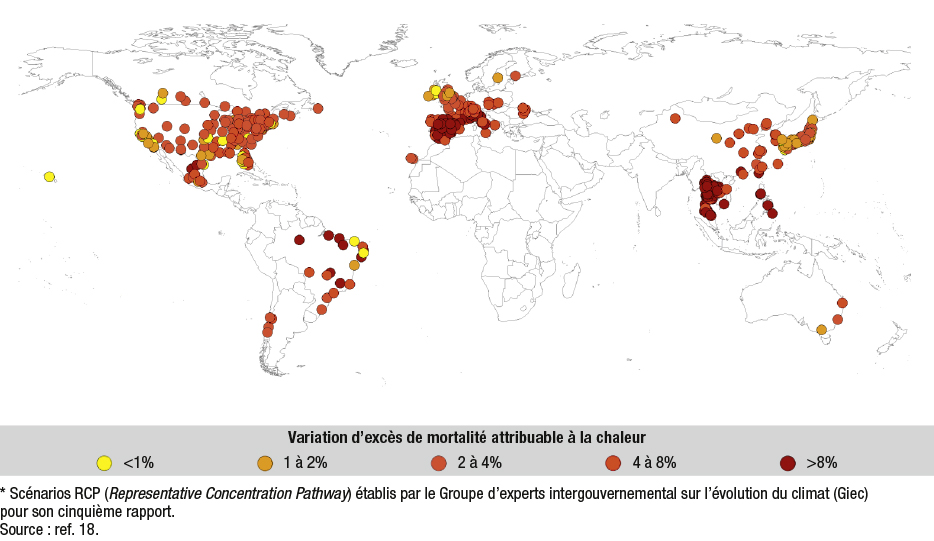
These studies are based on climate and epidemiological models that involve numerous assumptions and uncertainties. The results should be viewed as orders of magnitude and indications of expected trends based on current knowledge. The main findings are that by 2050:
We must prepare for a higher risk of heat-related mortality, and a risk of cold-related mortality nearly identical to today’s
Heat waves are expected to account for an increasingly significant proportion of total heat-related mortality, which poses specific management challenges (potential spikes in excess mortality over a very short period, as in 2003).
It is possible that cold waves, which will be less frequent and therefore more unusual for the population, will have a greater impact than they do today.
The expected impacts will likely be much smaller under limited warming; the difference is already significant between global warming of +1.5°C versus +2°C
See also

article
6 September 2019
How to Better Understand the Health Impacts of Climate Change: The Value of International Multicenter Collaborations
A higher number of cardiovascular deaths attributable to fine particulate matter is expected worldwide
The ACHIA project examined changes in PM2.5 and ozone levels resulting from the implementation of greenhouse gas emission reduction scenarios used by the IPCC. The effects of these pollutants on cardiovascular and respiratory mortality were then estimated for 2030 and 2050 under a scenario of rising emissions (RCP8.5) and a scenario of emission reductions (RCP2.6).
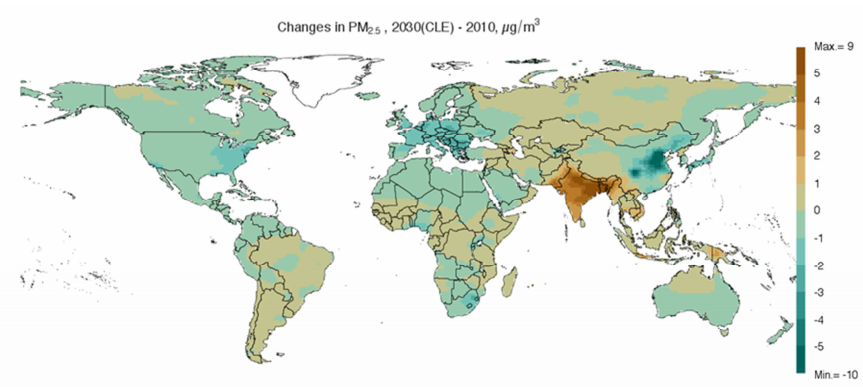
Today, more than 2.3 billion people worldwide are exposed to levels of fine particulate matter (PM2.5) exceeding those recommended by the World Health Organization (10 µg/m³). In a scenario where every country were to apply current emissions regulations, by 2030 more than 2.8 billion people would remain exposed to these excessively high levels. In India, for example, the number of people affected would rise from over 640 million in 2010 to over 1 billion in 2030.
In this scenario, by 2030, the number of deaths from cardiovascular causes attributable to fine particulate matter would be higher than today, with an additional 6,800 deaths per year worldwide. The majority of these deaths would occur in Asia.
The scenario reflecting the implementation of all available pollution control technologies would lead to a decrease in mortality. Asia would benefit the most; PM2.5 concentrations there could be reduced by a factor of four. This scenario would also lead to improved air quality in South America and North America. However, it would have very little impact on air quality in Africa.
Changes in annual concentrations of fine particulate matter (PM2.5) in 2030 compared to 2010, estimated based on the scenario of implementing current regulations
In Europe, improvements in air quality and health are expected under both scenarios.
In 2010, more than 250 million Europeans were exposed to particulate matter levels exceeding the World Health Organization’s recommended limit. This number could be cut in half by 2030 if current regulations are followed. As a result, starting in 2030, 109,000 deaths from cardiovascular causes could be prevented each year.
Changes in deaths associated with changes in particulate matter and ozone levels in Europe in 2030 compared to 2010 (per 100,000 inhabitants)

If countries were to implement all available technical measures to improve air quality, the benefits would be twice as great.
The greatest benefits are expected in Eastern Europe for PM2.5 and in Southern Europe for ozone.
In the context of climate change, it is therefore crucial that policies to reduce air pollutant and greenhouse gas emissions be coordinated. This will allow for greater effectiveness in improving air quality in the short term while limiting the negative effects of climate change in the longer term.
The AC-HIA project reports that if all countries in the world were to implement all currently known emission reduction technologies—for example, in the sectors of transportation, heating, industry, etc.—1.5 million premature deaths from cardiovascular causes could be prevented each year.
In 2010, more than 250 million Europeans were exposed to particulate matter levels exceeding the World Health Organization’s recommended limit. This number could be cut in half by 2030 if current regulations are followed. Thus, by 2030, 109,000 deaths from cardiovascular causes could be prevented each year.
In the Île-de-France region, by 2050, the most ambitious scenario could “prevent” more than 2,800 deaths each year. Compared to 2010, this would represent a nearly 20% decrease in cardiovascular mortality.
Learn more
The public’s experiences regarding their exposure to extreme weather events and their impact on physical and mental health
The increase in the frequency, intensity, and geographic extent of extreme weather events is one of the most visible manifestations of climate change. These events can have serious and lasting impacts on the physical and mental health of affected populations. For the first time, the 2024 edition of the Santé publique France Barometer included questions on the public’s experiences regarding their exposure to extreme weather events and their impact on physical and mental health.
Seventy-nine percent of adults report having experienced at least one extreme weather event (flood, storm, heat wave, wildfire, drought) in the past two years. Among them, 37% report having suffered physically, and 23% psychologically. Finally, more than 70% of adults believe they will face extreme weather events in the next two years, and the majority believe they will suffer as a result.
These results highlight the significant impact of extreme weather events on physical and mental health, as well as an awareness of the risks associated with these events and marked concern for the future.
Thus, ambitious measures to adapt to these events, while reducing social inequalities and greenhouse gas emissions, are essential to preserving the health of present and future generations.
Learn more:
In relation to

Extreme heat, heat wave
thematic dossier
Heat waves can have a significant impact on health. It is therefore essential to take proper precautions. Certain measures must be put in place, especially for those most at risk.

Extreme cold
thematic dossier
Cold weather increases the risk of cardiovascular and respiratory conditions and can lead to hospitalizations and death. This impact is observed within 3 to 21 days of exposure to the cold.












