



What We Do
Chronic obstructive pulmonary disease (COPD) is a chronic respiratory condition that significantly impacts the quality of life of those affected. It is primarily caused by smoking, and the majority of cases could therefore be prevented.
The mission of Santé publique France is to conduct epidemiological surveillance of COPD and to help shape national policies for the prevention of this disease.
Epidemiological surveillance of COPD
Santé publique France conducts epidemiological surveillance of COPD and chronic respiratory failure (CRF) through a network of partners who participate in defining surveillance indicators, conducting surveys, and analyzing and interpreting data.
In the case of chronic diseases, analyzing all causes reported by the physician on the death certificate (multiple causes) allows for a more accurate assessment of the overall burden of a cause of death. COPD-related mortality is therefore analyzed by considering deaths where COPD is listed as the underlying cause of death (COPD mortality) and deaths where COPD is listed as either the underlying cause or a contributing cause of death (COPD-related mortality).
For more information:
ICD-10 codes used to define COPD
| ICD-10 codes used to define COPD |
J40 (bronchitis, unspecified), J41-J42 (chronic bronchitis), J43 (emphysema) and J44 (other chronic obstructive pulmonary diseases). |
COPD exacerbations are a factor associated with a poor prognosis for disease progression. The most severe cases require hospitalization. Some of these hospitalizations could be prevented through optimal management as soon as signs of worsening symptoms appear. It is therefore important to assess the overall burden of these hospitalizations and track trends over time.
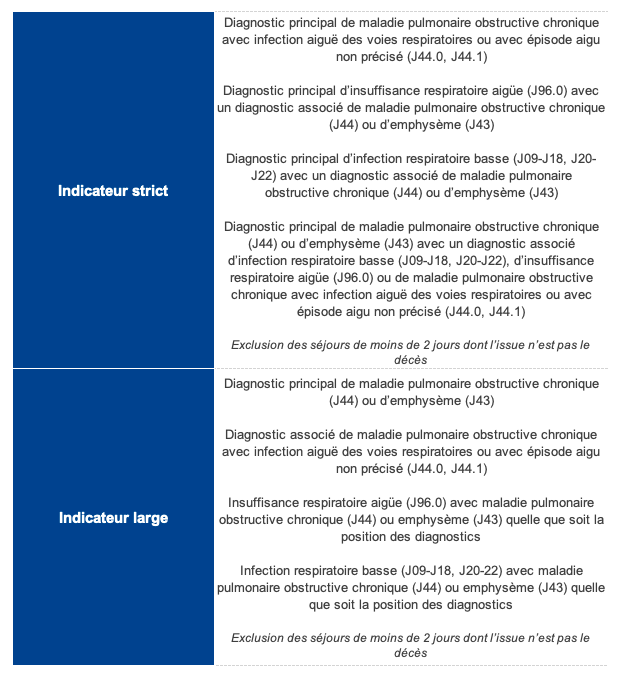
Data from the Medical Information Systems Program (PMSI) provide information on trends in hospitalization rates (ATIH). To understand the principles and history of the PMSI in MCOs. Identifying COPD exacerbations within this database is, however, complex. On the one hand, some hospitalizations for COPD exacerbations may not be recognized or coded as such, and on the other hand, given frequent comorbidities, COPD may not appear as the primary diagnosis on the anonymous discharge summary. Two indicators are proposed to identify hospital stays for COPD exacerbations in the national PMSI database: a strict indicator and a broader indicator. This second indicator allows for potential coding transfers to be accounted for and verifies the robustness of trends over time.
For more information:
Algorithm for defining hospital stays for COPD exacerbations in the PMSI (ICD-10 codes)
The monitoring of work-related COPD will rely primarily on data from large cohorts covering the three main social security schemes: Constances, COSET-MSA, and COSET-indépendants. Respiratory function test data will be available in the Constances cohort. This will allow for the study of links between obstructive ventilatory disorder (OVD) and occupational parameters (industry sectors, occupation, and occupational exposures). For the COSET-MSA and COSET-Indépendants cohorts, only symptoms of chronic bronchitis are available.
Cohort data will also enable the study of the socio-occupational consequences of COPD (approximated by OBV or by symptoms of chronic bronchitis).
For more information
In addition, COPD mortality by industry sector and occupation is also tracked as part of the Cosmop project.
The data analyzed comes from the General Beneficiary Sample (EGB), a permanent sample representative of the population covered by health insurance. This sample is drawn by random selection (at a rate of 1 in 97) from beneficiaries of the general scheme (excluding local mutual insurance sections (SLM) covering civil servants and students) since 2006, and since 2011, from beneficiaries of the two other main health insurance schemes: social security for the self-employed and the agricultural social mutual insurance (MSA). These three schemes (the general scheme excluding SLMs, social security for the self-employed, and MSA) cover approximately 85% of health insurance beneficiaries.
The analysis of trends in the prevalence rates of long-term oxygen therapy (LTOT) focuses solely on data from beneficiaries of the general scheme (excluding SLM).
COPD Prevention Initiatives
Information for healthcare professionals
- Tobacco
Santé publique France has developed the website http://pro.tabac-info-service.fr/. Its goal is to support all healthcare professionals who wish to assist their patients in their efforts to quit smoking.
The site brings together key data on smoking, best practice recommendations, and tools that can be downloaded or ordered free of charge.
- Vaccinations
Santé publique France supports healthcare professionals by providing them with information such as:
The vaccination-info-service website, which lists vaccination recommendations and the target groups for each vaccine-preventable disease. Routine vaccinations (diphtheria, tetanus, etc.), as well as those against pneumococcus and influenza, are recommended for all patients with COPD or chronic respiratory failure, as stated on the dedicated page (routine vaccinations and the flu vaccine).
- HAS Guides and Recommendations
The French National Authority for Health (HAS) provides downloadable guides and recommendations
- Information provided by professional organizations and learned societies
Detailed information is available on the websites of professional organizations such as:
Information for the general public
- Tobacco
Santé publique France supports interventions aimed at preventing people from taking up smoking. These are primarily based on strengthening psychosocial skills. Interventions with proven effectiveness are listed in a directory maintained by Santé publique France.
In addition, Santé publique France operates the remote smoking cessation support service Tabac info service.
39 89: free telephone support throughout the quitting process. Call 39 89 (available from 8:00 AM to 8:00 PM, free service plus the cost of the call) to schedule an appointment with a tobacco specialist.
The website www.tabac-info-service.fr: information, advice, addresses of tobacco specialists near you, and tests to help you prepare and increase your chances of success.
A personalized coaching program. Download the smartphone app or visit https://coaching.tabac-info-service.fr/#/index to receive personalized advice, ask questions, and track your progress.
The Tabac info service Facebook page https://www.facebook.com/tabacinfoservice/: A supportive community of former smokers and smokers looking to quit, always ready to offer support during difficult times.
Finally, Santé publique France develops social marketing campaigns throughout the year. These aim to encourage smoking cessation and may focus on various levers for behavior change: motivations to quit, cessation support tools, reminders of the risks, misconceptions about tobacco, etc.
- Vaccinations
Through a radio spot, Santé publique France provides information on the risk of exacerbating a chronic respiratory disease during the flu season, and on the recommended preventive measure: annual flu vaccination.
"Who should get a flu shot? Why?"
- Patient organizations
Patient organizations provide information and support to people with COPD.
In relation to

Tobacco
thematic dossier
Despite a slight decrease compared to 2015, tobacco remains responsible for more than 68,000 premature deaths in 2023—accounting for 11% of total mortality—making it still the leading cause of...

thematic dossier
Work-related illnesses
Dues à des expositions professionnelles, les principales maladies en lien avec le travail sont surveillées par Santé publique France dans l’objectif d’élaborer, avec les partenaires, les...

Air
thematic dossier
Air pollution affects the entire population. The levels of pollutants found in the atmosphere are linked to health risks, and any reduction in exposure to these pollutants would be beneficial.












