Data
Surveillance of human botulism cases in mainland France is based on mandatory reports (MRs) received by Santé publique France and supplemented by data from the National Reference Center (NRC) for Botulism at the Pasteur Institute.
A stable incidence rate
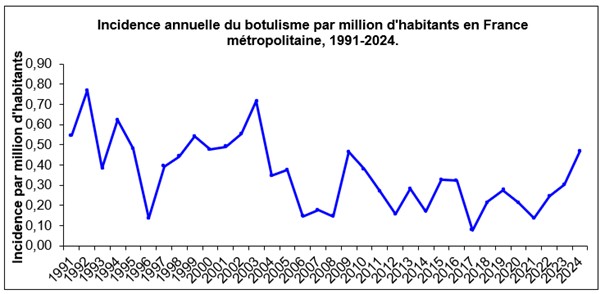
Since 1991, the incidence rate of botulism has remained stable in France.
Annual incidence of botulism per million inhabitants in mainland France for the period 1991–2024.
From January 1, 2018, to December 31, 2024, 74 outbreaks were reported in metropolitan France, totaling 122 cases (including 107 hospitalizations and 1 death).
The incidence rate of botulism in mainland France was 0.27 per million inhabitants for the 2018–2024 period (min=0.14 in 2021, max=0.47 in 2024). By comparison, the average incidence rate for the 1991–2017 period was 0.38 per million inhabitants. These epidemiological data suggest a slight decline in the incidence of botulism in mainland France.
In 2023 and 2024, the observed incidence rates (0.30 and 0.47 per million inhabitants, respectively) were higher and were due to three outbreaks involving a large number of botulism cases: an outbreak resulting from the consumption of homemade canned sardines in a restaurant (2023, 10 reported cases), an outbreak resulting from the consumption of homemade pesto (2024, 5 reported cases), and an outbreak caused by illegal botulinum toxin injections administered by a cosmetologist (2024, 8 reported cases).
Botulism More Prevalent in Central France
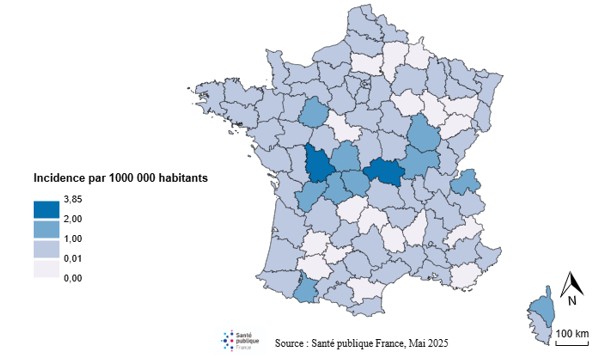
Between 1991 and 2017, the departments with the highest incidence of botulism were Vienne (3.85 per million inhabitants), Allier (3.11), Indre (1.91), Saône-et-Loire (1.87), and Creuse (1.78).
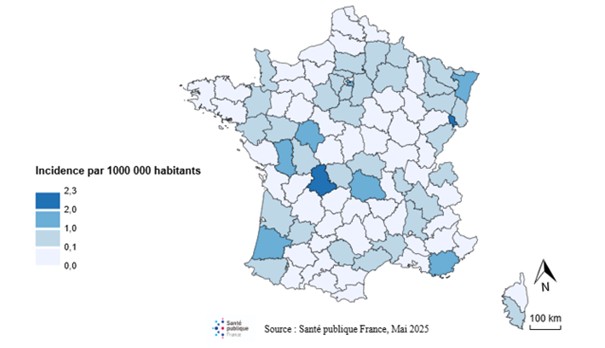
For 2018–2024, the highest incidence rates per million inhabitants were observed in the departments of Haute-Vienne (2.31 per million inhabitants), Bas-Rhin (1.99), Var (1.87), Puy-de-Dôme (1.46), and Landes (1.34).
Average annual incidence of botulism by department, mainland France, 1991–2017
Average annual incidence of botulism by department, mainland France, 2018–2024