



The disease
Urogenital schistosomiasis is a parasitic disease caused by Schistosoma haematobium. It is a notifiable disease.
Infection from contaminated water
Urogenital schistosomiasis (or urogenital bilharzia) is caused by Schistosoma haematobium. Its life cycle involves humans and an intermediate host, the snail, a freshwater mollusk.
The snail is infected by larvae that have recently hatched from Schistosoma haematobium eggs. Four to six weeks after infection, it releases immature forms (cercariae) of the parasite into freshwater. The optimal temperature for infection of the snail is 20 to 30°C.
Humans become infected when cercariae penetrate healthy skin during contact—even brief contact—with contaminated freshwater (rivers, lakes, marshes, ponds, etc.).
In the weeks following infection, the parasites mature and migrate through the bloodstream to the perivesical venous plexuses (invasion phase). After 10 to 12 weeks, female parasites lay eggs that are excreted in the urine. Without treatment, egg excretion can continue for several years.
Urogenital schistosomiasis is endemic in intertropical Africa, Madagascar, and the Middle East. In France, cases of schistosomiasis are diagnosed primarily in tourists, expatriates, and migrants from endemic areas.
Since a local transmission cluster has been identified in Southern Corsica, Santé publique France’s priorities are to monitor the extent of disease transmission at known contaminated sites and to detect any new transmission sites.
Intestinal schistosomiasis, which is not present in France, is caused by five other species of schistosomes:
Schistosoma mansoni, the second most common species after S. haematobium, found in Africa, the Middle East, the Caribbean, Brazil, Venezuela, and Suriname
Schistosoma japonicum in China, Indonesia, and the Philippines
Schistosoma mekongi, found in Cambodia and the Lao People’s Democratic Republic
Schistosoma guineensis and the related species S. intercalatum in the rainforests of Central Africa.
Schistosomiasis caused by S. mansoni has been considered eradicated from the French West Indies since the late 1980s.
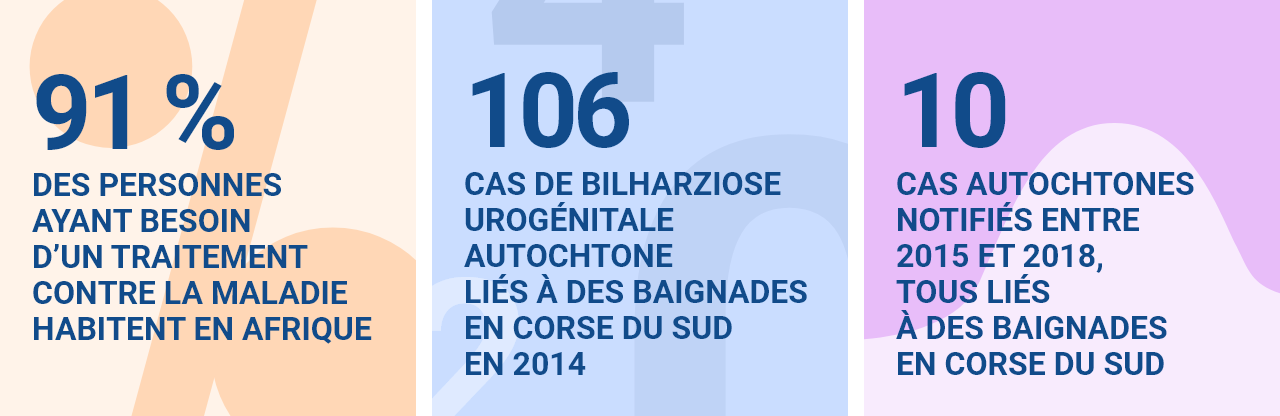
Key statistics on urogenital schistosomiasis
Clinical and Laboratory Diagnosis
The symptoms of urogenital schistosomiasis are variable and depend on the stage of the disease.
The penetration of cercariae (immature forms of the parasite) may be accompanied by itching and a transient rash.
During the invasion phase, in the weeks following infection, immuno-allergic reactions may occur.
In the chronic phase, approximately 2 months after infection, symptoms are related to the body’s inflammatory response to the parasite’s eggs.
Urogenital schistosomiasis can then lead to:
hematuria (blood in the urine)
genital lesions, gynecological bleeding, or blood in the semen, pain during sexual intercourse
at a more advanced stage, fibrosis of the bladder and urethra is common, as well as kidney damage
Bladder cancer is a possible complication in the late stages.
Bilharzia can be diagnosed by:
serology: several techniques are used, including indirect immunofluorescence, indirect hemagglutination (IHAT), ELISA, and Western blot
search for parasite eggs in urine (parasitological urine examination) or stool
PCR in urine or stool
Possible complications in the absence of treatment
The progression of schistosomiasis over several years can eventually lead to serious complications (obstructive or even neoplastic damage to the urinary tract and fertility problems). In children, it can cause anemia, stunted growth, and impaired learning ability.
Effective treatment
Treatment for Schistosoma haematobium schistosomiasis is simple, inexpensive, and effective, and relies on praziquantel.
Diagnosis and treatment of schistosomiasis make it possible to:
at the individual level, prevent the disease from becoming chronic
at the community level, to break the disease cycle and thus prevent new cases
In relation to

Water
thematic dossier
Whether microbiological or chemical, the sources of contamination in the water supply are varied and can have an impact on public health.












