



The disease
Neurodevelopmental disorders
Autism or autism spectrum disorders are chronic neurodevelopmental disorders that typically appear in childhood.
Since the initial description of childhood autism by the American child psychiatrist Leo Kanner in 1943, the definition of autism has undergone numerous changes, leading to the terms “pervasive developmental disorders” (PDD) and, more recently, “autism spectrum disorders” (ASD), which is now the standard term.
ASD is characterized by both persistent deficits in social communication and reciprocal social interactions and a restricted and repetitive pattern of behaviors, interests, and activities.
The diagnosis of these disorders is clinical. They encompass a wide range of clinical presentations and varying degrees of disability, which can be significantly exacerbated, particularly by intellectual disability—which is common and itself varies in severity—epilepsy, or motor and sensory impairments: from milder forms that may sometimes go unrecognized throughout a person’s entire life to very severe cases involving multiple comorbidities. Factors related to the risk and severity of ASD are still poorly understood.
Key Statistics on Autism
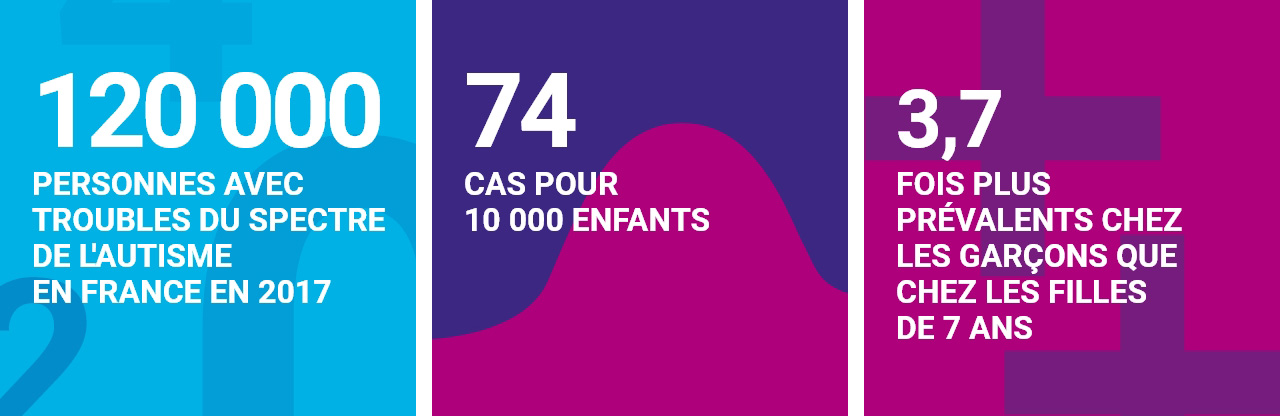
Learn more: HAS - Autism and Other Pervasive Developmental Disorders. Position Paper - January 2010.
Hospital-based care or care in specialized centers
Institutional care for ASD is primarily provided:
the healthcare sector: hospitalization and outpatient psychiatric care for diagnosis and, if necessary, follow-up. Financial coverage for the care of individuals with ASD may be provided under the Long-Term Conditions (ALD 23 “Long-Term Psychiatric Conditions”) program.
by the medical-social sector: in particular medical-psycho-pedagogical centers (CMPP), medical-educational institutes (IME), medical-pedagogical institutes (IMP), early medical-social intervention centers, medical-vocational institutes, therapeutic, educational, and pedagogical institutes, and specialized education and home care services.
Autism Plans
Significant milestones have been reached in the recognition and management of ASD, notably thanks to the impact of the first three government Autism Plans (2005–2007, 2008–2010, 2013–2017), particularly with the establishment of an Autism Resource Center in each region and the development of professional guidelines for the early identification and diagnosis of these conditions during childhood. However, little data exists to describe the prevalence of these disorders and their evolution over time.
Following these first three plans, the strategy for autism within neurodevelopmental disorders (2018–2022) was published in April 2018. It focuses on the importance of early diagnosis followed by appropriate support, higher school enrollment rates for children starting at age 3, improved identification and diagnosis among adults, and the development of employment programs to facilitate their professional integration. It highlights the need to structure the research community on autism and neurodevelopmental disorders. Furthermore, the collection of French epidemiological data will be organized to establish a surveillance system and reliable indicators at various territorial levels for the evaluation of policies and interventions.
In 2012, autism was declared a major national cause.
International classifications currently in use
The ICD-10 (International Classification of Diseases, 10th Revision, WHO, 1993) (Table 1). French prevalence data from the two childhood disability registries or those derived from the analysis conducted by Santé publique France refer to the ICD-10, hence the use of the term PDD in their presentation in this report. ICD-11 (International Classification of Diseases, 11th Revision), which will take effect on January 1, 2022, has incorporated the term ASD (category of neurodevelopmental disorders).
Table 1 - Pervasive Developmental Disorders, ICD-10 codes (1993)
| F84 | PDD |
|---|---|
| F84.0 | Childhood autism |
| F84.1 | Atypical autism |
| F84.2 | Rett syndrome |
| F84.3 | Other childhood disintegrative disorder |
| F84.4 | Hyperactivity associated with mental retardation and stereotyped movements |
| F84.5 | Asperger syndrome |
| F84.8 | Other PDDs |
| F84.9 | PDD, unspecified |
The DSM-IV (Diagnostic and Statistical Manual of Mental Disorders, American Psychiatric Association, 4th edition, 1994), the DSM-IV-TR (2000), and the DSM-5 (5th edition, 2013) (Table 2).
Table 2 - Changes between the DSM-IV, DSM-IV-TR, and DSM-V
| DSM-IV (1994) | DSM-IV-TR (2000) | DSM-5 (2013) |
|---|---|---|
| Pervasive Developmental Disorders | Pervasive developmental disorders | Autism Spectrum Disorder |
| 299.00 Autistic disorder | 299.00 Autistic Disorder | 299.00* |
| 299.80 Rett syndrome | 299.80 Rett syndrome | |
| 299.10 Childhood Disintegrative Disorder | 299.10 Childhood disintegrative disorder | |
| 299.80 Asperger syndrome | 299.80 Asperger syndrome | |
| 299.90 PDD-NOS (including atypical autism) | 299.90 PDD-NOS (including atypical autism) |
* The DSM-5 classification now includes only one code (299.00) for autism spectrum disorder, for which it is necessary to specify whether or not it is associated with intellectual disability, language impairment, or another developmental, mental, or behavioral disorder, as well as the level of severity (3 levels).












