



Data
Santé publique France analyzes data from the National Health Data System (SNDS) to estimate the prevalence of these conditions among children and adults based on healthcare utilization data, and to describe their distribution by sex and age at various administrative levels (national, regional, and departmental).
The SNDS, managed by the National Health Insurance Fund (Cnam), is a source of medical-administrative data covering approximately 99% of the French population. It contains:
data on healthcare reimbursements (consultations and medical procedures, medications, laboratory tests, etc.). The history of these reimbursements is available for individuals enrolled in the general health insurance scheme since 2006, with data from other schemes being gradually integrated (the Agricultural Social Mutual Insurance Scheme and the Social Scheme for the Self-Employed since 2009, and other specific schemes starting in 2012).
data on hospitalizations, in the public or private sector, in medicine-surgery-obstetrics (PMSI MCO), in psychiatry (RIM-P), in follow-up care and rehabilitation (PMSI SSR), and in home hospitalization (HAD). These data provide information on all medical diagnoses made during hospital stays, whether these diagnoses were coded as primary causes or associated causes. Data on SSR hospitalizations and home hospitalizations were not used to estimate the prevalence of TED/TSA.
RIM-P data also provide information on outpatient follow-up at Medical-Psychological Centers (CMP) through the Outpatient Activity Summary (RAA).
Data on long-term conditions (ALD).
Medical causes of death (database of the Center for Epidemiology on Medical Causes of Death, CépiDC, at Inserm). These data were not used to estimate the prevalence of TED/ASD.
As it stands, the SNDS does not contain disability data from the Departmental Houses for People with Disabilities (MDPH). For this reason, analysis of SNDS data does not allow for the identification of individuals receiving care exclusively in medical-social facilities. In the coming years, the SNDS is expected to gradually incorporate this data, which will then allow—subject to its quality—for the implementation of a national epidemiological surveillance system with more precise estimates of prevalence across all life stages.
To estimate the prevalence of PDD/ASD using SNDS data, Santé publique France conducted this initial analysis covering the 2010–2017 period.
PDDs and ASDs refer to the same clinical condition. The term PDD, which corresponds to code F84 in the ICD-10 (the current international classification), is used here to present the results of the estimate made by Santé publique France.
The method for identifying cases of TED based on healthcare utilization in the 2010–2017 SNDS: linking data on long-term conditions (ALD) with hospitalization data.
Linking enables the counting of:
of individuals receiving care under ALD 23 “Long-term psychiatric conditions” for TED (ICD-10 code F84),
and individuals who have been hospitalized in medical, surgical, or obstetric wards (via the PMSI-MCO) or in a psychiatric hospital (via the RIM-P), with ICD-10 code F84 as the primary or associated diagnosis.
Note that it is not possible to identify cases in the SNDS based on medication use, as there is no specific drug treatment for TED/ASD.
Estimated prevalence by age group and sex in the SNDS
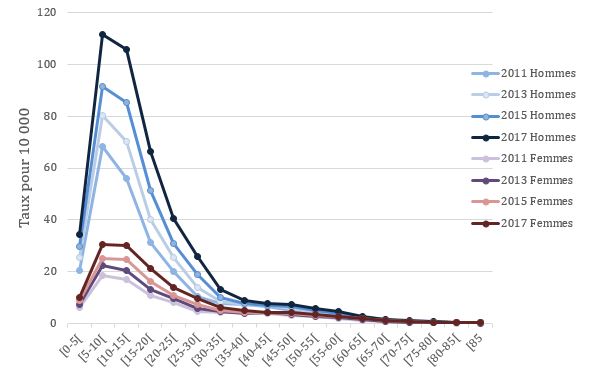
In 2017, in France, 119,260 people with PDD were identified in the SNDS, corresponding to a crude prevalence of 17.9 per 10,000. It was highest among 5- to 9-year-olds (72.2 per 10,000). Among 7-year-olds, the prevalence (per 10,000) was 73.6, or 1 in 136 children (114.5 among boys and 30.7 among girls). After age 15, the prevalence estimated in the SNDS drops sharply, tending toward very low values, even close to 0 among adults.
Generally speaking, SNDS data allow for the estimation, using algorithms based on healthcare utilization, of the prevalence and incidence of a condition requiring such care, which is often the case with chronic conditions. Nevertheless, healthcare utilization for PDDs—undoubtedly severe and chronic disorders—is not systematic: there is no specific drug treatment, and hospitalizations are not always necessary. As for care in medical-social facilities, which constitutes the bulk of institutional care, it is not yet included in these databases. This is why relying solely on healthcare utilization to construct frequency indicators underestimates the prevalence of these disorders, particularly beyond childhood, as shown in Figure 1, with a sharp decline beginning at age 15. The prevalence rates we observe after age 15 must be considered significantly underestimated and invalid.
A steady increase in prevalence figures is observed in the results of the SNDS data analysis, as well as in the regions covered by the two French registries and internationally. This is largely explained by a steady and positive evolution in screening and diagnostic practices, resulting from improved awareness and training among professionals, increased public awareness, the development of specialized services, and favorable changes in special education policies. In France, the implementation of successive government autism plans since 2005 and the recommendations of the Haute Autorité de Santé since 2010 have contributed to this.
Figure 1 - Estimated annual prevalence of developmental disorders based on healthcare utilization, by age group (per 10,000 inhabitants), France, 2011, 2013, 2015, and 2017
Conditions more common in men
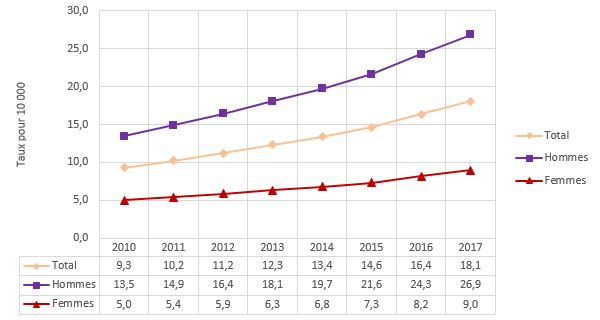
With a crude prevalence (per 10,000) of 27.9 among men and 8.5 among women, the male-to-female prevalence ratio was 3.3 overall.
Among 7-year-olds, the male-to-female prevalence ratio was 3.7.
A steady increase in prevalence
A steady increase in prevalence was observed over the eight years studied (from 2010 to 2017), more pronounced among men (Figure 2).
Figure 2 - Estimated annual prevalence rates based on healthcare utilization for ASD (per 10,000 inhabitants), age-standardized, France, 2010–2017
The estimated prevalence among children aged 7 years and older in the SNDS databases:
Analysis of SNDS data shows rates among children aged 7 years and older (8th year of life) that are close to those in the two registries: 74 per 10,000, comparable to that observed by the RHE31 (77 per 10,000) and not far from that of the RHEOP (56 per 10,000).
Among boys: 115 according to the SNDS vs. 123 (RHE31) and 90 (RHEOP);
Among girls: 31 in the SNDS vs. 30 (RHE31) and 20 (RHEOP).
Thus, the comparability of the prevalence rates observed in the SNDS with those provided by the registries suggests that most children of this age receive care within the healthcare system.
Regional disparities observed
When adjusted for the population of the region of residence and standardized to the 2015 age structure of the French population, the highest prevalence rates are observed, for both sexes, in Brittany, Nouvelle-Aquitaine, and Normandy; for metropolitan France, the lowest prevalence is found in Hauts-de-France (Figure 3). It should be noted that the lowest rates are observed in the DROMs (an average of 17.2 among men and 5.6 among women).
Estimated prevalence rates of developmental disorders based on healthcare utilization by region (per 10,000 inhabitants), age-standardized, France, 2017
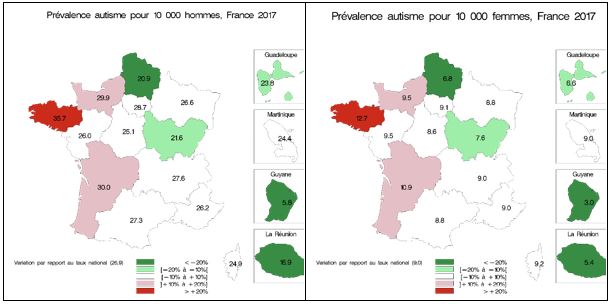
The regional disparities observed may partly reflect differences in screening, diagnosis, and treatment practices. Given the current state of knowledge, these findings should be interpreted with caution.
Learn more

magazines/revues
10 March 2020












