
Data
The stroke surveillance system established by Santé publique France makes it possible to study the epidemiological trends of this disease.
An Overview of Strokes in France in 2022
Higher stroke mortality rate among men
Data collected from death certificates show that the number of deaths from stroke as the underlying cause in France totaled 31,576 in 2022, 58% of whom were women. Strokes accounted for nearly 98% of deaths from cerebrovascular disease, with 30,682 deaths in 2021, including 13,091 men and 17,591 women. After adjusting for age, men had a higher mortality rate from cerebrovascular disease and stroke than women.
| Number and rate per 100,000 inhabitants of deaths from stroke by age and sex, 2022 | |||
|---|---|---|---|
| By age group (crude rates) | Men | Women | Total |
| 18–44 years | 196 (1.1) | 119 (1.1) | 315 (1.1) |
| Ages 45–64 | 1,437 (16.8) | 782 (8.7) | 2,219 (12.7) |
| 65–84 years | 6,216 (117.1) | 5,189 (81.1) | 11,405 (97.4) |
| 85 years and older | 5,242 (724.8) | 11,501 (749.7) | 16,743 (741.7) |
| Total | 13,091 (40.0) | 17,591 (63.1) | 30,682 (50.6) |
| Mean age (standard deviation) | 79.0 (12.6) | 85.5 (10.9) | 82.7 (12.1) |
| Standardized rates* - Total (per 100,000 population) | 54.4 | 43.3 | 48.4 |
*Standardized to the age structure of the European population in 2010.
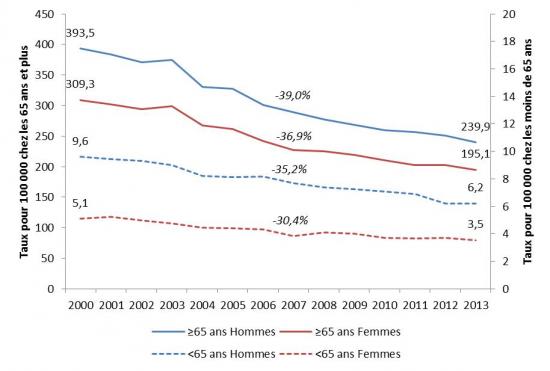
A sharp decline in the number of deaths from stroke since 2000
Between 2000 and 2013, age-standardized mortality rates from cerebrovascular disease and stroke decreased by more than 35% across all age groups and by approximately 30% among those under 65.
Trends in stroke mortality rates* by sex from 2000 to 2013
A higher rate of hospitalizations for stroke among men
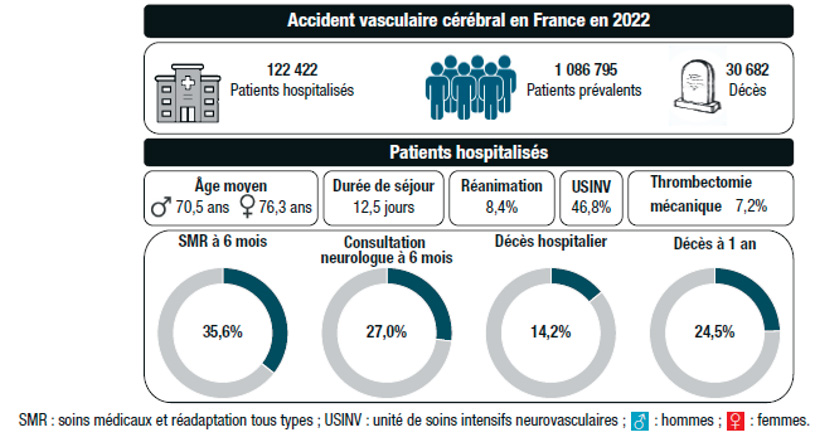
In 2022, 122,422 patients residing in France were hospitalized for the treatment of a stroke, 78% of whom were hospitalized for an ischemic stroke. More than half (53%) were men. The average age at admission was 73 years, higher among women (76 years) than among men (70 years). Annual rates of patients hospitalized for stroke were higher among men than among women.
| Number and rate per 100,000 population of patients hospitalized in acute care for stroke by age and sex, 2022 | |||
|---|---|---|---|
| By age group (crude rates) | Men | Women | Total |
| 18–44 years | 3,197 (29.7) | 2,413 (22) | 5,610 (25.8) |
| Ages 45–64 | 16,963 (200.6) | 8,524 (96) | 25,487 (147) |
| 65–84 years | 33,896 (621) | 26,266 (398.5) | 60,192 (499.3) |
| 85 years and older | 11,012 (1,485.9) | 20,151 (1,305.1) | 31,163 (1,363.7) |
| Total | 65,068 (255.8) | 57,354 (205.1) | 122,422 (229.3) |
| Mean age (standard deviation) | 70.5 (14.2) | 76.3 (14.9) | 73.2 (14.8) |
| Standardized rates* - Total (per 100,000 population) | 247.3 | 157.8 | 198.8 |
*Standardized to the age structure of the European population in 2010.
An increase in incidence and hospitalization rates among people under 65
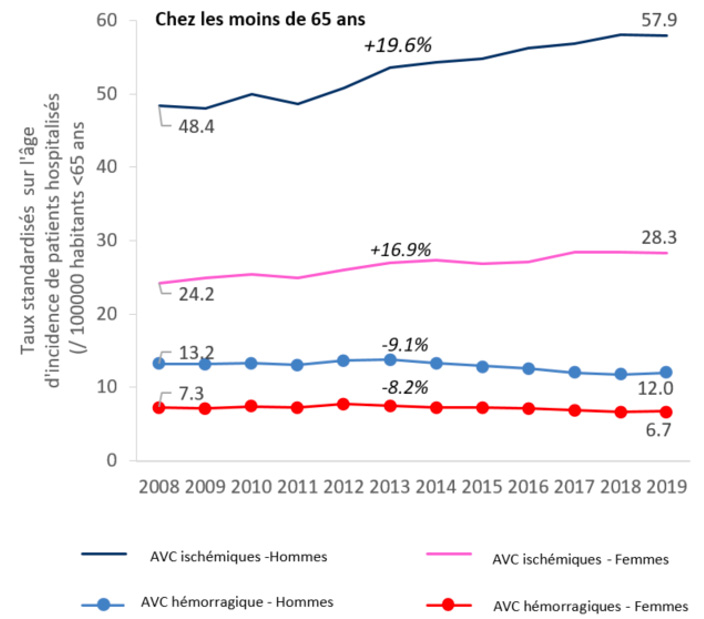
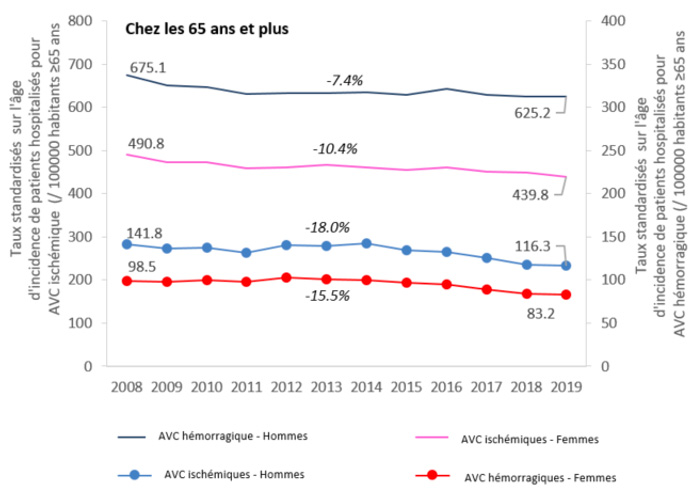
Analysis of trends between 2008 and 2019 in standardized hospitalization rates for stroke shows a decrease among men (-2.4%) and women (-2.2%) aged 65 and older, for both ischemic and hemorrhagic strokes. In contrast, among those under 65, the standardized rate of hospitalizations for ischemic stroke is increasing, with a rise of 16.9% for women and 19.6% for men.
These findings regarding hospitalized patients confirm the trends observed between 2002 and 2014. These results are also consistent with data from the Dijon Stroke Registry, which showed an increase in stroke incidence among those under 55 years of age between 1985 and 2011.
Trends in annual incidence rates* of hospitalized stroke patients under 65 years of age, by sex, stroke type, and age, from 2008 to 2019
Trends in annual incidence rates* of hospitalized stroke patients aged 65 and older by sex, stroke type, and age from 2008 to 2019
Admission rates to post-acute care or rehabilitation remain low despite an increase in recent years
The proportion of patients transferred to follow-up care or rehabilitation (SSR) following hospitalization for stroke was estimated at 35.6% in 2022. Admission to a neurovascular unit (NVU) increased the likelihood of admission to SSR up to age 75. This proportion of patients admitted to follow-up care or rehabilitation has risen slightly since 2010, when it stood at 33.8%.
Mortality remains high in 2022
Mortality, defined as the proportion of patients who die following a stroke, remains high: it exceeds 14% within 30 days of hospital admission and reaches nearly 24.5% at one year. Although declining (15% at 30 days and 30% at one year in 2015), this mortality rate remains high. The mortality rate for hemorrhagic strokes (10% within 30 days and 21% at one year) is higher than that for ischemic strokes (28% within 30 days and 38% at one year), particularly in the short term. Advanced age, lack of care in a neurovascular unit (NVU—a unit specialized in stroke care), and living in a socially disadvantaged community were among the factors associated with higher mortality, regardless of the type of stroke.
Data from the registries
Table

Trends in the rates* of hospitalized patients with a primary diagnosis of stroke, by sex, from 2002 to 2014
*Rates per 100,000 inhabitants, age-standardized to the 2010 European reference population (Eurostat 2013). Scope: All of France
Difficulties with activities of daily living
The reported prevalence of a history of stroke stands at 1.2% among the French population according to the Handicap Santé surveys conducted in 2008–2009, and the prevalence of sequelae was estimated at 0.8%. Furthermore, among those reporting sequelae, more than half reported having great difficulty or being unable to walk 500 meters, and nearly half reported having difficulty with at least one activity of daily living (personal hygiene in most cases).
Significant Social and Regional Disparities
In 2022, significant disparities in the incidence of patients hospitalized for stroke were observed, with rates 30% higher in socially disadvantaged municipalities compared to more advantaged ones.
Significant departmental disparities in age-standardized hospitalization rates were also observed, without a clear geographic gradient. The overseas departments and regions (DROM) had much higher rates compared to the national rate. In mainland France, the highest rates were found in Côtes-d’Armor, Nord (232.5/100,000), Pas-de-Calais, Seine-Saint-Denis, and several departments in the Southwest such as Lot-et-Garonne and Landes.
See also: our cardiovascular health indicators available as open data on Odissé.
Learn more

In relation to

High blood pressure
thematic dossier
High blood pressure (HBP), defined as blood pressure that is too high, is the most common chronic condition in France and a major risk factor for cardiovascular and cerebrovascular diseases.

Tobacco
thematic dossier
Despite a slight decrease compared to 2015, tobacco remains responsible for more than 68,000 premature deaths in 2023—accounting for 11% of total mortality—making it still the leading cause of...

Nutrition and Physical Activity
thematic dossier
Nutrition and physical activity are two major determinants of health that contribute to improving the health of the population and are key priorities in public health policy.