




Data
Epidemiological data
Tuberculosis Worldwide
Tuberculosis remains a common disease worldwide, with an estimated 10 million new cases each year, according to the WHO. However, the number of diagnosed and reported cases dropped significantly in 2020 and 2021 amid the COVID-19 pandemic, bringing reporting rates back to 2012 levels, followed by a return to pre-pandemic trends starting in 2022. The distribution of the disease is heterogeneous. Since 2016, the countries bearing the heaviest burden of tuberculosis have been classified by the WHO into three lists based on the incidence of tuberculosis, multidrug-resistant tuberculosis (MDR: resistance to isoniazid and rifampicin), and HIV co-infection. Each list contains 30 countries that account for 90% of the global burden for each indicator.
India and Indonesia are the countries most affected by the disease, but other countries, particularly in Africa (South Africa and the Democratic Republic of the Congo, for example), also account for a significant number of cases as well as a high proportion of multidrug-resistant cases.
In the European Union, 38,003 cases were reported in 2023, representing an average notification rate of 8.6 cases per 100,000 inhabitants per year. Tuberculosis is responsible for a significant number of deaths: approximately 1.25 million deaths were estimated worldwide in 2023.
8.6
cases/100,000 inhabitants
About 10% of new tuberculosis cases worldwide occur in children, or about one million. The majority of cases were reported in sub-Saharan Africa and Southeast Asia. Children under 5 years of age, who account for approximately 50% of pediatric tuberculosis cases, are at the highest risk of developing meningeal or disseminated forms of the disease and are therefore at the highest risk of death and long-term complications.
Tuberculosis in France
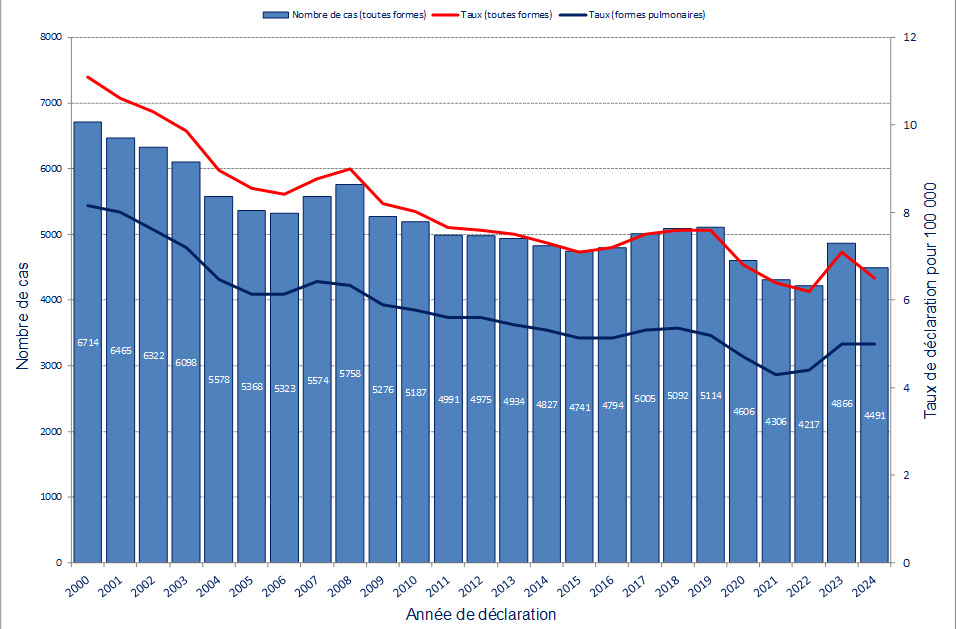
In France, as in most Western European countries, the disease is rare. Its incidence declined sharply between the early 1970s and the late 1980s. The overall trend over the past 30 years has been downward, though there was a slight increase in incidence in 2016 and 2017 and a significant decline in 2020, 2021, and 2022 following the arrival of the COVID-19 pandemic in France. The situation appears to be returning to pre-pandemic levels starting in 2023, though this will need to be confirmed in the coming years.
However, the national incidence rate—which has been below 10 cases per 100,000 inhabitants per year for over a decade—masks significant regional disparities. The regions with the highest number of cases are those where the largest urban areas are located (notably Paris, Lyon, and Marseille). In terms of incidence rates, Mayotte, French Guiana, and Île-de-France are the three French territories with rates significantly higher than those observed in other regions.
The uneven distribution of the disease is also observed in certain population groups. The incidence among people born outside France (32 per 100,000) is approximately 15 times higher than that among people born in France. As a social disease, tuberculosis particularly affects the poorest segments of the population, notably the homeless, among whom the incidence (around 64 per 100,000) far exceeds that of other groups. The disease also affects incarcerated individuals (46 per 100,000), who often face multiple vulnerability factors.
In 2024, the incidence of active tuberculosis was down by approximately 8% compared to 2023 (6.6 cases per 100,000 in 2024 versus 7.1 in 2023). This decline was observed in most European Union countries. This is most likely a return to normal following pandemic years that severely disrupted the functioning of the healthcare system and access to care, impacting the diagnosis and reporting of tuberculosis cases.
Multidrug-resistant tuberculosis
According to the National Reference Center for Mycobacteria and Mycobacterial Resistance to Antituberculosis Drugs (CNR-MyRMA), which coordinates the surveillance of resistance to antituberculosis drugs, the annual number of cases of multidrug-resistant tuberculosis (MDR, resistant to the two main first-line drugs, isoniazid and rifampicin) ranged from 30 to 80 cases between 1992 and 2011. These cases most often involve people born abroad, primarily in Eastern Europe or Africa. In 2024, 70 cases of MDR tuberculosis were reported.
Treatment Outcomes for Tuberculosis Cases
Monitoring treatment outcomes for tuberculosis patients is an essential component of tuberculosis control. It helps identify cases that have completed treatment and are considered cured, as well as cases that have not completed treatment and, if infectious, may continue to spread the infection in the community. Between 2008 and 2014, only 65% of tuberculosis cases reported in the mandatory reporting system (MR) had information on treatment outcome. Three-quarters of these patients had completed treatment and were considered cured. This proportion was below the WHO target of achieving 90% treatment success.
About half of the active tuberculosis cases reported in 2022 had a treatment outcome recorded, a sharp decline since 2017. Among the recorded treatment outcomes, 83% of cases had completed treatment and were considered cured, with an upward trend of about 10 percentage points since 2009.
BCG Vaccination Coverage
Regarding BCG vaccination coverage among children at risk of tuberculosis, in metropolitan France outside the Ile-de-France region, data from surveys conducted in 2008 and 2009 indicate significantly insufficient coverage (40% to 50%), particularly among children seen in private practice. In the Ile-de-France region, up until 2015, approximately 75% to 80% of children had received the BCG vaccine by the age of 9 months. In 2016, a very significant decline was observed in all departments of this region, including among children receiving care at Maternal and Child Health (PMI) centers. This decline is the result of a shortage of BCG vaccine and the restriction of BCG vaccination sites to public facilities only. BCG vaccination coverage at 9 months among children in French Guiana is also decreasing (80% in 2014, 68% in 2016).
Open data - Odissé
Mandatory reporting data
Processing output data
Vaccination coverage data
Total number of cases and tuberculosis notification rate, France, 2000–2024
Estimated tuberculosis incidence rates per 100,000, WHO, 2024
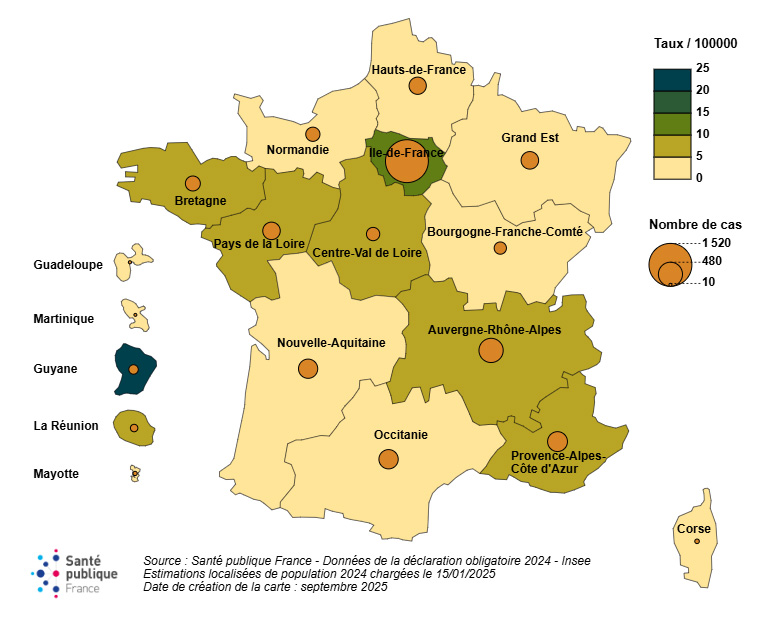
Analysis of Tuberculosis Cases Based on Mandatory Reporting Data
This analysis is presented as a slideshow:
Tables
Table 2: Number of reported tuberculosis cases by new regions, all of France, 2015–2024 (xls 28.1 KB)
Table 3: Number of reported tuberculosis cases by department, all of France, 2004–2024 (xls 41.1 KB)
Table 4: Number of reported cases of active tuberculosis by age group, France, 2004–2024 (xls 29.2 KB)
Table 6: Tuberculosis case reporting rate by department (rate per 100,000), France, 2004–2024 (xls 50.7 KB)
Table 8: Number of reported tuberculosis cases by disease location, France, 2002–2024 (xls 27.1 KB)
Table 13: Tuberculosis incidence rate per 100,000 inhabitants by country, 2010–2023 (xls 44.7 KB)
See also
Guthmann JP, Fraisse P, Bonnet I, Robert J. Active tuberculosis screening among the displaced population fleeing Ukraine, France, February to October 2022. Euro Surveill. 2023;28(12):pii=2300155.
Guthmann JP, Haas W. Tuberculosis in the European Union/European Economic Area: much progress, still many challenges. Eurosurveillance, 2019, vol. 24, no. 12, pp. 1–3.
Guthmann JP, Léon L, Antoine D, Lévy-Bruhl D. Tuberculosis treatment outcomes of notified cases: trends and determinants of potential unfavorable outcome, France, 2008 to 2014. Eurosurveillance, 2020, vol. 25, no. 4, pp. 1–11.
In relation to

Vaccination
thematic dossier
Contagious diseases most often affect children at a very young age. Because children are particularly vulnerable, they are a priority target for vaccination programs.











