




The disease
Tetanus: a disease that has become rare but is still present in France
Tetanus is an acute infection caused by exotoxins produced by a Gram-positive anaerobic bacterium, Clostridium tetani.
Due to the widespread use of tetanus vaccination, the disease has become rare in industrialized countries, but has not completely disappeared. To achieve this, a rigorous vaccination policy with a well-managed booster schedule is required.
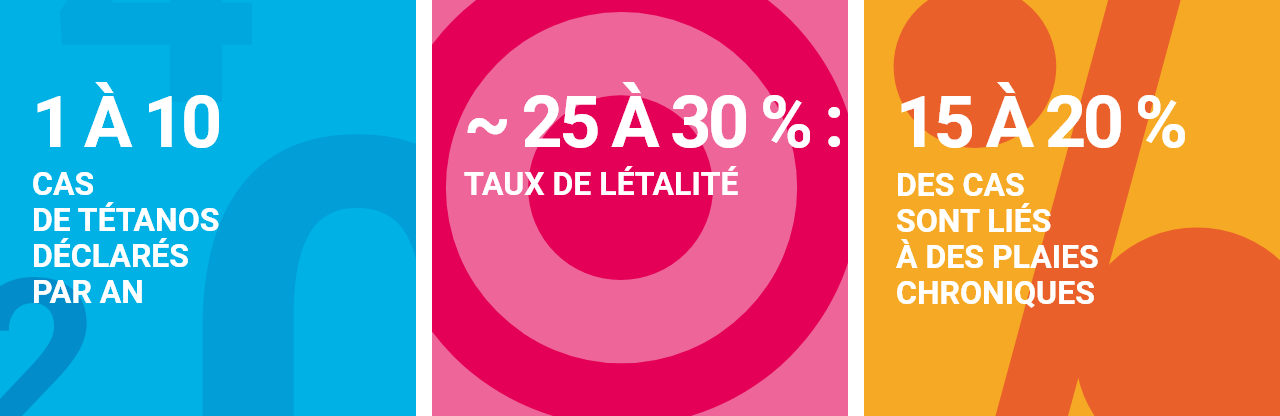
In France, even though the annual number of tetanus cases remains low (between 1 and 10 cases reported each year from 2012 to 2021, representing an average annual incidence of between 0.02 and 0.15 cases per million inhabitants over the past 10 years), all of these cases could have been prevented. This infection is a serious disease, leading to prolonged hospitalization in intensive care, which may be accompanied by long-term complications and a high fatality rate (on average, 25 to 30% of cases result in death). It primarily affects elderly individuals who are unvaccinated or have incomplete vaccination, but can affect anyone whose vaccinations are not up to date.
Thus, during the same period, 3 cases were reported in children aged 3 to 8 at the time of illness, who had not been vaccinated, even though they were born in France, a country where primary vaccination has been mandatory since 1940.
Key statistics on tetanus
Transmission through skin wounds
This bacterium is ubiquitous and lives as a commensal in the digestive tract of animals. It persists in animal feces and in the soil in a spore form, which is extremely resistant. It enters the body through a skin wound.
For tetanus to develop, several conditions must be met:
No or incomplete tetanus vaccination
The entry of spores into the body
Anaerobic conditions (absence of oxygen), allowing the spores to germinate at the wound site and the bacillus to produce toxins. This process is further facilitated by the presence of foreign bodies or necrotic tissue.
Tetanus is not transmitted from person to person, and patients with tetanus do not develop immunity following infection.
Vaccine Prevention
To prevent this disease, a vaccine with near-perfect efficacy and safety has been available for over 70 years. In France, it has been part of the mandatory infant vaccination schedule since 1940.
The cases and deaths that persist could be very easily prevented through better vaccination of adults with tetanus toxoid, improved implementation of the booster policy, and, in the event of a wound, through vaccination and the administration of specific human immunoglobulins.
Vaccination Recommendations
For infants and children, the vaccination schedule calls for a primary series consisting of two doses of the combined vaccine given two months apart, administered at 2 and 4 months of age, followed by a booster dose at 11 months of age. This primary series is mandatory for children. Subsequent boosters should be given at age 6 and then between ages 11 and 13.
In adulthood, boosters are administered at ages 25, 45, and 65, and then every 10 years (at ages 75, 85, 95, etc.) to account for immunosenescence.
For unvaccinated adults, the primary vaccination series consists of two doses administered two months apart, followed by a booster 8 to 12 months later, and then resumption of the vaccination schedule according to age, maintaining a minimum interval of 5 years from the last dose administered.
Since tetanus is not a disease transmitted from person to person, high vaccination coverage in the population does not protect unvaccinated or inadequately vaccinated individuals. Only a complete individual vaccination series (including boosters) protects against infection.
Neuromuscular symptoms
Once dispersed throughout the bloodstream, the toxins produced interfere with neurotransmitters and, after an incubation period of 4 to 21 days, cause neuromuscular damage characterized by muscle contractions, spasms, and convulsions
The disease can present in three forms:
Generalized (the most common and severe: 80% of cases)
Localized (anatomical region near the wound)
Cephalic, involving the cranial nerves.
The neonatal form is generalized tetanus occurring in newborns; while it has virtually disappeared from industrialized countries with high vaccination coverage, it still claims a very high number of victims in developing countries.
Reference materials
Opinion of the High Council for Public Health dated May 24, 2013, regarding tetanus vaccination boosters in the context of wound care.
Circular of February 10, 2003, regarding the new system for anonymous reporting of notifiable infectious diseases. Bull Epidemiol Hebd 2003;12-13:69-76
In relation to

Vaccination
thematic dossier
Contagious diseases most often affect children at a very young age. Because children are particularly vulnerable, they are a priority target for vaccination programs.











