



ESPA Survey, November 13, Phase 2
In November 2020, Santé publique France launched the second phase of the ESPA 13 November survey to assess, five years after the attacks, how the psychological impact has evolved and how support services are being utilized.
Background
Following the attacks of November 13, 2015, Santé publique France launched the first phase of a major epidemiological survey in 2016: the Post-Attack Public Health Survey of November 2015 (ESPA November 13). Nearly 1,400 people participated. The results show a significant impact on the mental health of those involved and offer valuable insights for improving support for victims, as well as for the professionals and volunteers who responded in the aftermath of these events*.
Five years later, it is important to understand how this impact has evolved. Indeed, until now, post-attack research has primarily consisted of cross-sectional studies, which unfortunately do not allow us to understand changes over time or potential causal links. It was therefore essential to conduct a longitudinal study.
That is why Santé publique France launched the second phase of the survey between November 16, 2020, and April 6, 2021, in collaboration with the University of Paris 13. This project is part of the 13-November Program, a large-scale, 12-year transdisciplinary program (2016–2028) funded primarily by the Investments for the Future initiative via the ANR and scientifically led by the CNRS and Inserm.

Survey Objectives
To assess the psychological impact five years after the November 13, 2015, attacks, as well as how this impact has evolved between Phase 1 and Phase 2
To describe and compare the use of care services since the attacks
For individuals who agree to provide their Social Security number, track their health data from the health insurance system 5 years prior to the attacks and 10 years afterward
Study Population
The ESPA November 13 study was aimed at individuals directly affected by the November 2015 attacks and falling into the categories listed below:
You were at or near the sites of the attacks carried out in Saint-Denis and Paris on November 13, 2015, and you were injured, directly threatened, or a direct witness to the events
You witnessed the assault on the building where the terrorists were hiding in Saint-Denis on November 18, 2015
You have lost a loved one who died in the attacks
A loved one of yours was physically injured or was directly threatened by the terrorists
Due to your profession or role, as a member of emergency services, law enforcement, associations, municipal services, or healthcare services, you responded on the night of November 13, or in the days or three weeks that followed, to secure the scene, provide aid and assistance to victims, investigate, restore the site, etc.
Because of your profession or your involvement, as a member of emergency services, organizations, the City of Saint-Denis, or healthcare services, you responded on November 18, 2015, or in the days or three weeks that followed to provide aid and assistance to victims, investigate, restore the sites, etc.
Survey Process
The survey was conducted via an online questionnaire in two stages:
1. Inclusion questionnaire
Upon your first login, a questionnaire was used to verify that you met the criteria for our study population and to obtain your consent to participate.
You were then asked to:
enter your Social Security number so we could obtain your healthcare history and utilization data from the National Health Data System (SNDS) through your health insurance provider. However, this information is not required to complete the questionnaire;
provide your cell phone number to receive a secure access code for the epidemiological questionnaire via text message.
2. Epidemiological Questionnaire
The data collected in the epidemiological questionnaire focused on sociodemographic characteristics (age, gender), experiences of the attacks and their consequences, the psychological and traumatic impact, and the care arrangements adopted. The estimated time to complete the questionnaire was between 25 and 60 minutes. A dedicated hotline allowed participants to reach a psychologist from 10 a.m. to 10 p.m., 6 days a week, for assistance with completing the questionnaire or if psychological support was needed.
Information Regarding Data Processing
Your email address is subject to the processing of personal data under the responsibility of Santé publique France, based on a public interest. It will be processed only by Santé publique France staff involved in the ESPA study to notify you of the study’s start and will be deleted no later than two months after the study begins. You may exercise your rights to object, access, rectify, erase, and restrict the processing of your data by contacting: espa13novembre@santepubliquefrance.fr and indicating “reminder of launch.”
To learn more about the processing of your data: dpo@santepubliquefrance.fr. If you believe your data rights are not being respected, you may file a complaint with the French Data Protection Authority (CNIL): https://www.cnil.fr/fr/plaintes.
Why participate in the ESPA Phase 2 survey?
Partners and funders of the survey speak out to explain why it is important to participate.
Four professionals working alongside victims share their insights in a short one-minute audio clip on the importance of responding to the survey:
Bastien Brul, Lead Psychologist at the France Victimes Federation
Carole Damiani, Doctor of Clinical Psychology and Director of the “Paris aide aux victimes” association
Denis Peschanski, Research Director at the CNRS and Co-Scientific Director of the November 13 Program
Professor Thierry Baubet, Head of the Psychopathology Department at Avicenne Hospital (Bobigny) and Scientific Co-Director of the CN2R
Espa2 Survey: Listen to the audio spots

Témoignage de Bastien BRUL

Témoignage de Carole DAMIANI
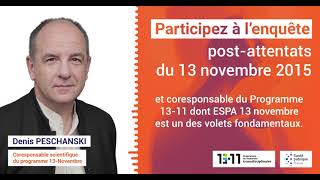
Témoignage de Denis PESCHANSKI

Témoignage de Thierry BAUBET
Results of Participation in Phase 2 of the Survey
445 civilians and 494 first responders who were heavily exposed to the attacks provided valuable information on the psychosocial impact of the attacks and on the use of healthcare services 5 years after the events. Among them, 268 civilians and 324 first responders had already participated in the first phase of the survey.
What will the results be used for?
The results of the ESPA survey will make it possible to:
better understand the factors associated with the persistence of psychological symptoms, as well as those associated with improvement or, conversely, deterioration;
analyze data on healthcare utilization covered by social security for the subgroup of participants who agreed to provide their social security number.
These analyses, which are strictly aggregate and do not allow for the identification of any individual, will enable us to observe changes in healthcare utilization before and after the attack. In particular, we will analyze indicators of mental health as well as indicators of various conditions that may arise or worsen following exposure to such an event.
The hundreds of responses provided by participants to the open-ended questions on the questionnaire are currently being analyzed. The analysis of the question regarding the effects of the attacks on relationships with children was the subject of a medical thesis defended on October 20, 2021.
Acknowledgments
We would like to thank 13onze15: Fraternité et Vérité, Life for Paris, the AFVT, Fenvac, France Victimes, Paris Aide aux Victimes, the CUMPs, the Osé Association, the APHP, the 13-Novembre Program, the Guarantee and Compensation Fund for Acts of Terrorism and Other Offenses, the Paris Fire Brigade, the Armed Forces Health Service, the National Police, the Paris Police Prefecture, the Red Cross, Paris Civil Protection, and the city halls of Paris and Saint-Denis, which helped us disseminate information about the survey’s launch to those affected.
We would also like to thank the many participants whose responses will advance our understanding of the impact of the attacks as well as the care provided to those affected by them.
Data Confidentiality
Specific measures have been taken to ensure the IT security of the data collected. The data collected will remain strictly confidential and will be shared only with authorized Santé publique France staff responsible for this survey. Bound by professional confidentiality, they will analyze the information provided in your responses collectively, without using your direct identifying information (last name, first name, contact details), which will be stored in a separate, secure database. Under no circumstances will results be released that could identify you directly or indirectly. Santé publique France has received authorization from the CNIL (CNIL Decision DR-2020-031 of January 28, 2020, regarding Authorization Request No. 919215) and a favorable opinion from the Committee for the Protection of Persons (CPP SUD-EST I, Decision 2019-41) for the implementation of its data processing.
You will find all additional information regarding the protection of your personal data and the preservation of your individual freedoms in the newsletter available here.
Fire Department Study: Operation 11/13/15 Impact and Resilience (ESPOIR)
The Paris Fire Brigade (BSPP) and Santé publique France sought to collaborate to improve the quality of their respective research by matching data from the November 13 ESPA surveys (Phases 1 and 2) concerning the Paris firefighters with data from interviews conducted by the BSPP with military personnel who responded to the events. The goal of ESPOIR is to better understand the potential repercussions of the November 2015 attacks, identify factors of vulnerability and protection among Paris firefighters, and assess the effectiveness of the prevention and care program initiated by the BSPP.
You can find all additional information about ESPOIR in the newsletter available here and in the post-traumatic stress section.
More information on health data
You will be asked to provide your Social Security number so that your medical care usage data can be analyzed by the Health Insurance Agency. If you agree to provide your Individual Registration Number (NIR), this will allow Santé publique France to obtain information about your healthcare usage. This information is centralized in a secure national database, managed by the National Health Insurance Fund (CNAM), known as the National Health Data System (SNDS).
The various health insurance schemes transmit data on healthcare utilization (medical consultations, medication use, medical devices, etc.) and sick leave for their insured individuals to the National Inter-Scheme Health Insurance Information System (SNIIRAM), which is overseen by the CNAM, in a manner that protects the privacy of those insured. In addition, hospitals also report data on hospitalizations and procedures performed for each patient to a database known as the Medical Information Systems Program (PMSI), which is managed by the Technical Agency for Hospital Informatization (ATIH).
Data from the PMSI and SNIIRAM databases are now consolidated within the SNDS, for which the CNAM is responsible. The information collected in this database is linked using each person’s Social Security number, which is encrypted beforehand according to an anonymization procedure developed by the CNAM, thereby protecting individuals’ identities (no directly identifying data such as last name, first name, or contact information is recorded there).
To learn more about the SNDS: https://www.snds.gouv.fr/SNDS/Qu-est-ce-que-le-SNDS
The NIR entered on the questionnaire is immediately routed to a secure database separate from other data, where it is assigned a unique anonymous ESPA identifier. A single trusted third party, external to the survey, will be the only entity authorized to export the NIR to initiate the “SAFE” protocol with the CNAM. This protocol ensures the anonymization of SNDS data before it is made available to Santé publique France on the CNAM’s SNDS Portal. Personal data from the SNDS made available to Santé publique France in this manner will be analyzed solely within the portal and by authorized personnel. Thus, Santé publique France staff and the external trusted third party will never have access to the NIR or other data.
Participation is voluntary. Those who agree to provide their Social Security number will contribute valuable information that will help us better understand healthcare pathways and utilization.
For each participant, the data collected from the SNDS includes gender, month and year of birth, municipality and department of residence, long-term conditions (ALD), reimbursed outpatient care, inpatient care, and sick leave.
This data will be analyzed over time (between 2010 and 2025). It will then be possible to track medical visits, medication use, and hospitalizations before and after the attacks; this will provide a picture of how the health status of this population exposed to these events has evolved and allow for comparison with that of an equivalent unexposed population.
*References:
BEH No. 38-39 (2018). The 2015 attacks in France: measuring their impact on public health to better prepare the response.
Motreff, Y., Baubet, T., Pirard, P., Rabet, G., Petitclerc, M., Stene, L. E., Vuillermoz, C., Chauvin, P., & Vandentorren, S. (2020). Factors associated with PTSD and partial PTSD among first responders following the Paris terror attacks in November 2015. Journal of Psychiatric Research, 121, 143–150.
Pirard, P., Baubet T., Motreff Y., Rabet G., Marillier M., Vandentorren S., Vuillermoz C., Stene L.E., Messiah A. Use of mental-health supports by civilians exposed to the November 2015 Terrorist Attacks in Paris. BMC Health Services Research (Manuscript Number: BHSR-D-20-01191R2, under review).












