Download





Starting in May 2023, Santé publique France will begin conducting an epidemiological follow-up of employees who may have been exposed to the industrial fire that occurred on September 26, 2019, at the Lubrizol and NL Logistique sites in Rouen.
Everything you need to know about the industrial fire on September 26, 2019, in Rouen and the response by Santé publique France
On September 26, 2019, an industrial fire broke out in the warehouses of Lubrizol and NL Logistique, located in the Rouen port area. Workers present at their workplaces, near the fire, or within the smoke plume may have been exposed to the emissions or their effects (stress, soot deposits, odors, etc.). Numerous companies and firefighters also responded to the fire site on the same day and remained there until the end of the cleanup operation.
Santé publique France was commissioned by the Directorate General for Health to assess the impact on the physical and mental health of individuals who may have been exposed to one or more of these health risk factors. The description and analysis of their perceptions of the event, their exposures, and the symptoms they experienced, along with the measurement and monitoring of indicators of the population’s health status, will enable public authorities to implement public health measures if necessary and to better adapt the management of other industrial accidents.
In this context, a series of epidemiological studies is being conducted to assess the health impact of the fire: the “Post-Fire Health-76” initiative. This initiative includes a component on worker health, drawing on the multidisciplinary expertise of the Normandy Occupational Health Alert Group (GAST) Normandy, whose recent work has recommended the implementation of epidemiological surveillance of workers exposed to the fire or its aftermath, similar to that established for the general population using the National Health Data System (SNDS) and career data from pension funds.
Describe the health status of workers exposed to the fire or its aftermath (deposits, odors, etc.),
and compare it to that of a reference group of workers to identify a potential increase in health issues.
This monitoring will, if there is a significant variation in various health indicators, inform public decision-making regarding the implementation of medical care measures for the affected populations, prevention efforts, and the adaptation of management protocols for other industrial accidents.
Three groups of workers of interest are being monitored as part of this study, defined according to the following inclusion criteria:
workers who were on site between September 26, 2019, and September 30, 2020 (end of the remediation project) at the Lubrizol and NL Logistique fire sites,
employees who worked between September 26, 2019, and October 7, 2019, at a facility located in one of the 119 municipalities within the overall study area,
employees who worked between September 26, 2019, and October 7, 2019 (end of smoldering fire) at a facility located within the plume modeled by the EQRS and 1.2 km from the fire sites (proximity zone).
The study also includes three reference groups of workers, which will allow for comparisons. They will be compared to the workers of interest based on several criteria, such as age, gender, the employer’s business activity, and the department where the employer is located.
The overall study area comprises 119 municipalities in Seine-Maritime.
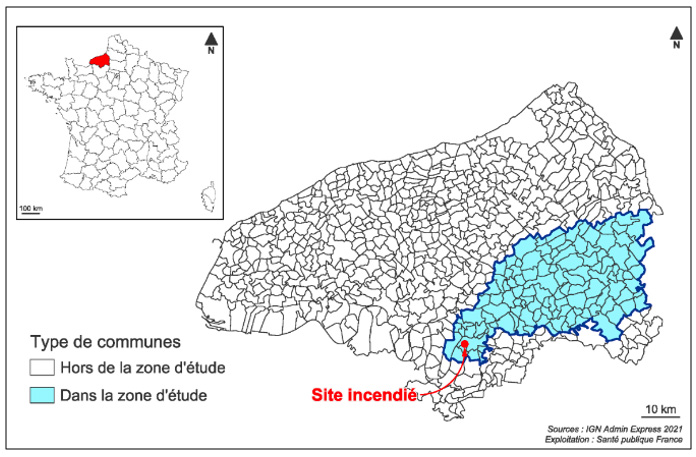
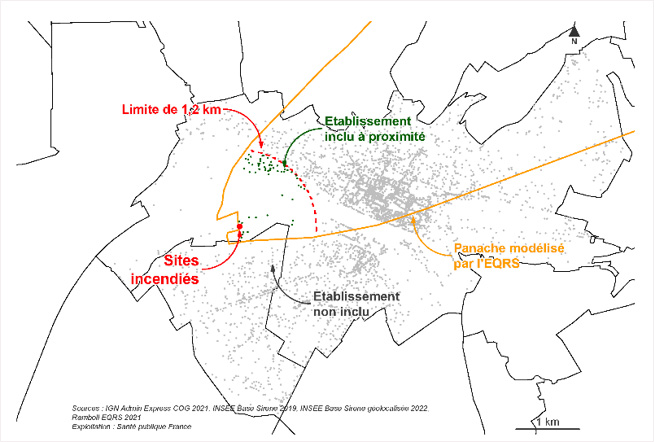
For groups of workers who responded to the fire sites and workers from companies located in the surrounding area: Ipsos will contact the companies to securely obtain a list of their employees who meet the inclusion criteria (see above).
For the group of workers from other companies located within the overall study area: workers will be identified using pension fund databases (the National Old-Age Insurance Fund (Cnav) and the National Pension Fund for Local Government Employees (CNRACL)).
For the reference groups of workers: the pension funds will randomly select workers from among those meeting the matching criteria described above.
The various lists of workers will then be consolidated by the Cnav.
The Cnav and the CNARCL, for the workers and reference groups under their responsibility, will securely transmit the list of individuals along with their relevant career data to the National Health Insurance Fund (Cnam), which manages the National Health Data System (SNDS). Career and healthcare reimbursement data will then be pseudonymized¹ before being transmitted to Santé publique France via a secure portal. This data will also be used to develop various indicators of respiratory and cardiovascular health, as well as cancer incidence.
The SNDS is a medical-administrative database that centralizes data on hospitalizations and healthcare services (doctor visits, prescriptions, etc.) that have been reimbursed by the national health insurance system, regardless of the specific health insurance plan. It also centralizes information on long-term conditions and medical causes of death.
1 Pseudonymization is a process that involves replacing directly identifying data (last name, first name, etc.) in a dataset with indirectly identifying data (alias, sequential number, etc.). This allows for the processing of individuals’ data without being able to identify them (learn more on the CNIL website).
The monitoring period begins on the date of the fire, September 26, 2019. Three end dates for monitoring are defined based on the health events to be studied:
three weeks after the end of the smoldering fire on October 7, 2019, i.e., between September 26, 2019, and October 28, 2019 (referred to as the short term),
one year after the end of the smoldering fire, i.e., between October 29, 2019, and October 7, 2020 (referred to as the medium term),
more than one year after the fire, i.e., between October 8, 2020, and October 7, 2039 (long-term) (with several intermediate analyses at 5, 10, and 20 years).
The initial health assessments are scheduled to be completed and released one and a half years after obtaining the necessary authorizations, followed by long-term monitoring beginning with a 5-year follow-up after the fire.
All results of this study will be published on the Santé publique France website. The results will be shared with local stakeholders. These results may also be featured in scientific articles.
Specific measures have been taken to ensure the confidentiality and IT security of the data collected throughout the study. The collected data will remain strictly confidential and will be shared only with authorized Santé publique France staff responsible for this study. Under no circumstances will results be released that could directly or indirectly identify study participants.
Workers in the categories “workers who responded to the fire sites” and “workers from companies located in the surrounding area” will receive an informational letter from their employers detailing the data processing procedures as well as participants’ rights. This information is also available in the note below.
For other categories of affected workers, the data processing procedures, as well as the data rights and how affected workers may exercise these rights, are detailed in the note below.
Download
The protocol for this study received a favorable opinion from the Ethics and Scientific Committee for Research, Studies, and Evaluations in the Health Sector (CESREES) on July 12, 2022, and authorization from the National Commission on Informatics and Civil Liberties (CNIL) on January 26, 2023 (authorization request No. 922234). These approvals specifically address the scientific quality of the project and its ethical relevance, and ensure that appropriate measures are in place to guarantee the security and confidentiality of personal data processed as part of this study.
Learn more

rapport/synthèse
30 June 2023
Several organizations are involved in conducting this monitoring:
the companies that own the sites affected by the fires (Lubrizol and NL Logistique) to identify the organizations that were present at the fire sites during the period defined in the methodology,
the data collection agency (Ipsos) to contact the organizations that operated on-site or were located nearby in order to explain the purpose of the study and securely collect the list of employees identified as exposed,
the pension funds (Cnav and CNRACL) responsible, for their respective populations of beneficiaries:
identifying beneficiaries defined as exposed within the study area as a whole,
to identify matched references as defined in the methods,
to compile and securely transmit the list of individuals (exposed individuals and reference individuals) to the National Health Insurance Fund (Cnam);
collecting occupational information on the exposed individuals and controls,
to transmit, without identifying information, the occupational information to the CNAM.
The CNAM, as the central operator of the SNDS, to:
directly match the data transmitted by the Cnav and the CNRACL with SNDS data,
provide Santé publique France with a secure space containing the pseudo-anonymized data from the SNDS and the professional data transmitted by the Cnav and the CNRACL.
This monitoring is funded through self-financing by Santé publique France.
The study is supported by an independent thematic advisory committee titled: “Assessment of the Impact of the Lubrizol and NL Logistique Fires on Public Health,” established to support Santé publique France under the SPI76 framework. It is composed of qualified individuals from outside Santé publique France.












