


Emergency contraception: Young people are unaware of the time limits—an information campaign to address this
CP-Contraception-durgence.pdf
Download (PDF - 406.84 KB)
Choosing a birth control method
The pill, condoms, or an IUD? The Choisirsacontraception website provides information on the various methods of contraception available and helps you find the one that best suits your...
Missing a birth control pill, a broken condom, or unprotected sex: various circumstances can put you at risk of an unintended pregnancy. In these situations, emergency contraception (EC) serves as a backup option to reduce the risk of an unintended pregnancy.
However, according to data from the 2016 Santé publique France Public Health Barometer released today, a large majority of people under 30 are unaware of the time limits for use. In light of this finding, the Ministry of Solidarity and Health and Santé publique France are launching a digital communication campaign on emergency contraception aimed at informing young people that, in case of doubt, they have the means to take action.
Emergency contraception: available without a prescription, anonymously, and free of charge
In recent years, access to emergency contraception and its time limits for use have changed. Emergency contraception is now available without a prescription and is provided anonymously and free of charge to minors. It can be obtained at a pharmacy, a family planning and education center (CPEF), a free center for information, screening, and diagnosis of human immunodeficiency virus (HIV), hepatitis, and sexually transmitted infections (CeGIDD), as well as from the school nurse or the university preventive medicine and health promotion service (SUMPPS) if you are a student.
Emergency contraception should be taken within twelve hours of unprotected or inadequately protected sex, if possible, but it can be taken within 3 or 5 days depending on the medication used.
Emergency contraception is not a regular method of birth control. It is a backup method of contraception that, when used correctly, provides an effective solution to address a one-time risk of pregnancy.
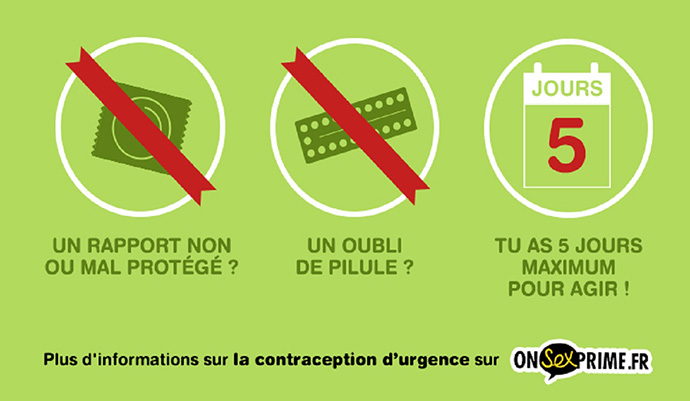
Lack of awareness regarding the time frame for using emergency contraception persists
The results of the 2016 Health Barometer show that 83% of people under 30 are aware that emergency contraception is free for minors, and 82% know that it is possible to purchase emergency contraception without a prescription directly at a pharmacy.
Nevertheless, the level of information among 15- to 30-year-olds regarding the actual time limits for use remains insufficient:
only 1% of those under 30 know the maximum timeframe a woman has after sexual intercourse to prevent an unwanted pregnancy: 5 days;
17% of those under 30 believe that emergency contraception must be taken within 3 days,
and about 40% believe that emergency contraception is effective only if taken within 24 hours of unprotected or inadequately protected sex.
Although women’s knowledge is generally better than men’s, it remains insufficient to ensure the proper use of emergency contraception.
An awareness campaign to remind people of the timeframes for EC effectiveness
This communication with young people about the timeframes for using EC is essential to ensure they enter into sexual activity under the best possible conditions. And although girls are the primary recipients of information regarding contraception and emergency contraception, it is important that this message is also heard and understood by boys so that they are involved in this issue, which concerns couples and not just young girls
This campaign by the Ministry of Solidarity and Health and Santé publique France aims to inform young people—and particularly those aged 18–25—that, in case of doubt, emergency contraception is available after unprotected or inadequately protected sexual intercourse.
The digital campaign will run online and on social media (Facebook, Snapchat, and Instagram) from July 1 to July 21, 2019.
All campaign materials will link to Onsexprime.fr, a trusted resource for young people on sexuality, which answers all questions about emergency contraception: How does it work? Where and how can you get it? Who should you contact?
Our latest news

news
Seniors, pregnant women, and nursing home staff: What is the status of their...

news
Winter Illnesses: A Dynamic and Accessible Way to Track the Spread of...

news












