


Are people living near vineyards more exposed to pesticides than the rest of the population?
CP-pestiriv-281019.pdf
Download (PDF - 375.87 KB)
Press Contacts
presse@santepubliquefrance.fr
Vanessa Lemoine: 01 55 12 53 36
Stéphanie Champion: 01 41 79 67 48
Cynthia Bessarion: 01 71 80 15 66
Launch of the first phase of the PestiRiv study in two wine-growing regions
The goal of the PestiRiv study, conducted by ANSES and Santé publique France, is to better understand pesticide exposure among people living in wine-growing regions, in response to the expectations of the public and government authorities. This national survey begins with a first phase launched today by Santé publique France in two wine-growing regions: Nouvelle-Aquitaine and Grand Est. This first phase will assess the operational and logistical feasibility among 60 households living near vineyards prior to the survey’s nationwide rollout in 2021.
A large-scale study on pesticide exposure among residents living near vineyards in France
France is one of the leading agricultural countries in the European Union in terms of usable agricultural area (approximately 50% of the territory). It is also among the world’s largest users of plant protection products.
Little data is available on pesticide exposure among residents living near vineyards and the impacts on their health. While this issue is a major concern for the French public and government authorities, the PestiRiv study is the first nationwide effort in mainland France to assess pesticide exposure among residents living near vineyards, taking into account all sources of exposure: air, water, food, occupational activities, and household uses.
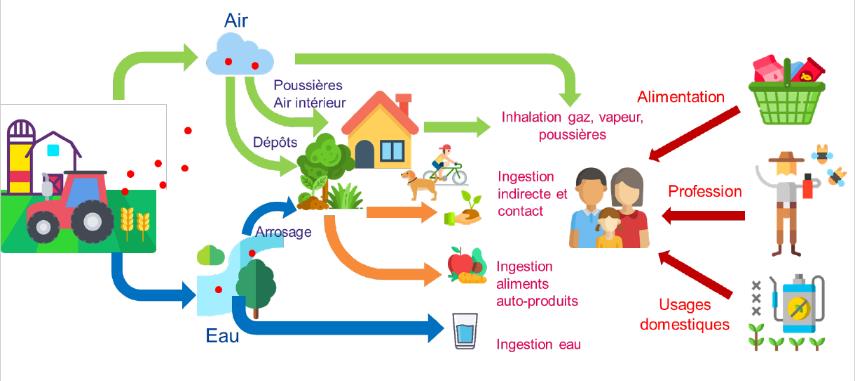
The findings will determine whether people living in wine-growing regions are more exposed to pesticides than the rest of the population and, if so, will provide recommendations for limiting this exposure.
Developing a robust methodology that is acceptable to participants
For the national study to be a success, it is essential that all stakeholders—residents, winemakers, farmers, local elected officials, and wine industry associations—be involved. The first phase of the study will allow us to gather feedback on the ground and adjust our methodology as needed. This feedback is essential to successfully carry out this groundbreaking study, which requires strong participant involvement and whose results are highly anticipated.
The first phase of the study allows us to test the methodology and gauge the support of local residents and stakeholders for a study intended to expand to a larger area. The Nouvelle-Aquitaine and Grand Est regions were chosen because they exhibit clear differences in terms of farming practices, meteorology, and local context. Municipalities with a predominantly viticultural character and a sufficiently large population were selected and agreed to participate in this first phase of the study: Segonzac and Pugnac in Nouvelle-Aquitaine, Verzenay and Blancs-Coteaux in Grand Est.
In the spirit of openness and transparency, Santé publique France has already presented the principles of this study to professional wine-growing organizations as well as to elected officials in the municipalities concerned. Doctors have also been informed of the initiative by mail.
In practice, on the ground…
The first phase of the study is being conducted among a total of 60 households residing within 500 meters of vineyard plots in the two regions. The study involves adults over 18 and children aged 3 and older, selected at random from within the households. It begins on October 28 and is expected to last 6 weeks, involving several home visits to participants and significant involvement on their part.
The study includes:
The collection of information via questionnaires on the characteristics of their homes, their use of pesticides at home, their occupational exposures, their dietary intake, and their lifestyle habits. These factors can influence pesticide exposure.
Environmental and biological samples will be collected. Urine tests will help determine whether individuals have been exposed to pesticides. These tests are conducted to assess their feasibility and identify potential obstacles they may present. The results will be sent to the participant, though at this stage, a comparison with the rest of the population will not be possible.
The participation of the selected individuals is essential, as it will help improve the conduct of the large-scale study.
Our latest news

news
Shamonda Virus: First Human Case Detected in France—What Do We Know?

news
Call for Nominations for the Renewal of the Scientific Advisory Board of the...

news












