



Data
Exposure to pesticides is widespread among the general French population, but the extent of exposure remains unclear for certain subgroups of the population
In France, the levels of pesticide exposure among the general population remain poorly understood, including among children and residents living near agricultural fields. Since 2006, Santé publique France has been conducting biomonitoring studies aimed at estimating the exposure of the French population to environmental pollutants, including certain pesticides.
The results of the ENNS study (National Nutrition and Health Survey) provided the first estimate in mainland France of exposure to certain pesticides among 400 adults aged 18 to 74 in 2006–2007.
Results from the ELFE cohort (Longitudinal Study from Childhood) provided an initial snapshot of pesticide exposure among pregnant French women in mainland France in 2011. In this study, pesticide levels were measured in urine samples from more than 1,000 pregnant women.
The results of these studies show that:
The general population is exposed to pesticides, whether for domestic or agricultural use (chemicals such as pyrethroids were detected in all pregnant women, and organophosphate pesticides were quantified in nearly the entire general population).
Exposure levels increase with domestic pesticide use (insecticides, lice treatments, and flea treatments), as well as with tobacco, alcohol, and fish consumption.
The presence of certain agricultural crops near the place of residence appears to be associated with increased exposure levels. However, in the absence of measurements of pesticide concentrations in the air (indoor or outdoor) and in household dust, these results need to be confirmed by further studies.
There is currently no national data on pesticide exposure among children. The results of the Esteban study, conducted by Santé publique France, will provide initial exposure data for this vulnerable population in mainland France.

rapport/synthèse
9 December 2023
Exposure of the French population to environmental chemicals. Volume 2 - Polychlorinated biphenyls (PCBs-NDL). Pesticides
rapport/synthèse
9 December 2023
Exposure of Pregnant Women to Environmental Pollutants in France in 2011. Perinatal Component of the National Biomonitoring Program Conducted Within the ELFE Cohort - Volume 1: Organic Pollutants
The prevalence of pesticide exposure is high among agricultural workers
By constructing a vineyard-arsenic pesticide exposure matrix (EM), the Matphyto project assessed the use of arsenic-based pesticides in viticulture in mainland France and determined their prevalence of use from 1945 to 2001, the year they were banned. This prevalence of use made it possible to estimate the prevalence of exposure to arsenic-based pesticides, which ranges from 20% to 35% among individuals working on professional vineyards. Cross-referencing this dataset with the agricultural censuses of 1979, 1988, and 2000 provided the number of vineyard workers exposed to arsenic-based pesticides for each census year, as well as a description (age, sex, working hours, etc.) of this population.
This research estimates that, over the periods studied (1979, 1988, and 2000), between 60,000 and 100,000 people worked on farms using arsenic-based pesticides for vine treatment. These individuals worked on vineyards where, according to the vineyard-arsenic pesticide MCE, nearly 15 kg of arsenic were used in 1979, 18.4 kg in 1988, and 26.8 kg in 2000. These figures represent average amounts of arsenic used per farm; the increase in these amounts is not due to an increase in the dose per hectare but to an increase in the average vineyard area per farm: 4.2 ha in 1979, 5.3 ha in 1988, and 7.6 ha in 2000.
Such data enable the implementation of secondary and tertiary prevention targeted at the identified population, particularly to prevent the development or progression of certain cancers induced by arsenic derivatives, by intervening at the earliest possible stage. The occurrence of any condition listed in Table 10 of the agricultural scheme should prompt patients and the medical community to investigate a possible occupational cause for the disease and to consider potential compensation under the recognition of occupational disease.
Exposure to Chlordecone in Martinique and Guadeloupe
Since 1973, Guadeloupe and Martinique have faced a problem of environmental pollution caused by chlordecone, an organochlorine insecticide used until 1993 to control the banana weevil.
In this context, Santé publique France is helping to improve understanding of the exposure of the general population and agricultural workers to chlordecone. In 2018, Santé publique France published findings regarding:
Exposure of the Caribbean population to chlordecone and other pesticides;
Prostate cancer surveillance indicators.
Chlordecone contamination
The Kannari study, “Health, Nutrition, and Exposure to Chlordecone in the French West Indies,” coordinated by Santé publique France, provides the first data on body burden levels of chlordecone and other organochlorine pesticides (lindane, DDT, etc.) in the general population of the French West Indies. The results of this study indicate that:
Chlordecone exposure among adults is widespread in the French West Indies: this pesticide is detected in more than 90% of individuals;
Exposure levels vary widely within the study population: 5% of participants have exposure levels at least ten times higher than the average;
Since 2003, a decrease in chlordecone exposure has been observed for the majority of the population, but the levels among the most exposed individuals have not decreased.
Exposure of Banana Farm Workers
The Matphyto DOM study, conducted by Santé publique France and partially funded by the Écophyto plan, assessed occupational exposure to pesticides used by banana workers, including chlordecone. According to this study, the vast majority of agricultural workers in Caribbean banana plantations were exposed to chlordecone during the period when this pesticide was in use (77% in 1989). Furthermore, banana workers in the Caribbean are still exposed today to other pesticides that also have potentially harmful health effects.
Santé publique France and Inserm have reconstructed the cohort of banana workers using archival records and recent data. This cohort, now comprising more than 13,000 workers, enables the study of the health status of this population highly exposed to various pesticides.
Epidemiological Surveillance of Prostate Cancer in the French West Indies
Chlordecone is suspected of being a carcinogen and of increasing the risk of prostate cancer.
Santé publique France conducted a study on epidemiological surveillance indicators for prostate cancer in the French West Indies in partnership with the National Cancer Institute, the Hospices Civils de Lyon, and the French cancer registry network Francim (of which the cancer registries of Guadeloupe and Martinique are members).
This study showed that prostate cancer incidence rates in Guadeloupe and Martinique are among the highest in the world. This finding is comparable to the situation on other Caribbean islands and among African-American and Black British populations. However, spatial analysis of the distribution of prostate cancer cases in Martinique does not show an excess in areas contaminated with chlordecone. The role of other risk factors explaining this high rate of prostate cancer remains to be studied.
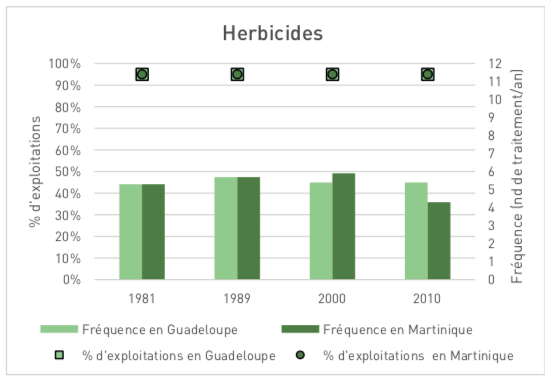
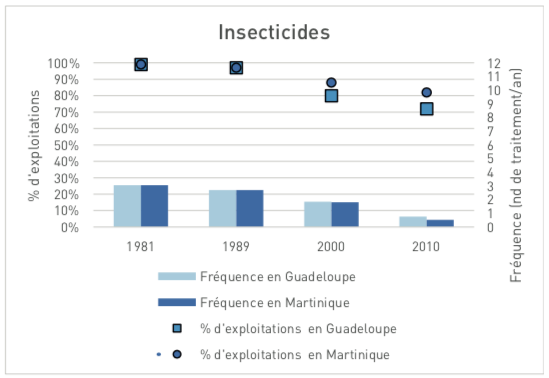
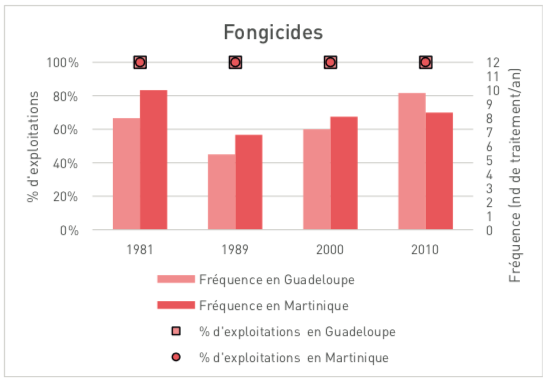
Trends in banana pesticide use in Guadeloupe and Martinique in 1981, 1989, 2000, and 2010
In relation to

thematic dossier
Cancers
Les cancers représentent en France la première cause de décès chez l’homme et la deuxième chez la femme. Santé Publique France copilote la surveillance épidémiologique et participe à leur prévention.

thematic dossier
Neurodegenerative diseases
Les maladies neurodégénératives sont des maladies chroniques progressives qui touchent le système nerveux central. Santé publique France en assure la surveillance épidémiologique.












