


Cluster of cases of hemolytic uremic syndrome (HUS) and bloody diarrhea in the Southwest, June 2012. Update as of July 18, 2012
On June 21, the French Institute for Public Health Surveillance (InVS) was notified by Bordeaux University Hospital of four cases of hemolytic uremic syndrome (HUS) that occurred between June 14 and 20, 2012, in children residing in the departments of Pyrénées-Atlantiques (2 children) and Gironde (2 children).
Investigations and Control Measures
The close temporal and geographical proximity of several cases of this rare condition (approximately 100 pediatric HUS cases are reported annually by the national HUS surveillance network) suggested a common source of contamination.
An investigation, coordinated by the InVS (Department of Infectious Diseases and CIRE Aquitaine) in collaboration with the relevant Regional Health Agencies (ARS), the Directorate General for Food, and the relevant Departmental Directorates for Population Protection, was immediately launched to identify the source of contamination and implement appropriate control measures.
The investigation of the cases that triggered the alert identified that, in the days preceding the onset of symptoms, three of the four children had consumed fresh Jean Rozé brand ground beef purchased at Intermarché stores. The traceability investigation conducted on the ground beef consumed by the three children identified a common manufacturer in Lot-et-Garonne (47). The batches of ground beef suspected of causing these human cases were identified based on the purchase dates provided by the families of the patients. The ground beef with best-by dates ranging from May 28 to June 15 was thus recalled by the manufacturer.
A press release was issued on June 23 by the processed meat company in Estillac (47) to inform consumers who may have kept these ground beef patties in their freezers that they should not consume them and should return them to the store where they were purchased
The batches affected by the recall were as follows: Modified atmosphere
packaging (MAP) trays under the JEAN ROZE, NETTO, and TOP BUDGET brands
Product codes: fresh ground beef 15% fat / fresh ground beef 20% fat
Best-by date: May 28 to June 15, 2012
Bearing the veterinary identification number: FR – 47.091.002 - CE
Sold in the self-service fresh food section from May 22 to June 15 at Intermarché and Netto stores located in the following departments of the Southwest region: 12, 16, 17, 19, 24, 31, 32, 33, 40, 46, 47, 64, 65, 81, 82, 87.
A press release providing an update on the situation was issued on June 25, 2012, by the Aquitaine Regional Health Agency (ARS), and information on the procedures to follow for diagnosing HUS of infectious origin, potentially caused by E. coli, was distributed in Aquitaine and Poitou-Charentes to emergency departments, emergency medical services (Samu), and Poison Control Centers (CAP).
Update as of July 18, 2012
In total, 9 cases of HUS and 6 cases of bloody diarrhea have been reported in Aquitaine and Charente-Maritime since May 28. No new cases have been reported since July 11, and the outbreak appears to be over.
The 9 cases of HUS were aged 2 to 14 years. The cases of bloody diarrhea involved 3 children (aged 2.5 to 10 years) and 3 adults (aged 19 to 42 years). Of the 15 reported cases, 14 resided in Aquitaine (10 in Gironde, 3 in Pyrénées-Atlantiques, and 1 in Landes) and 1 in Charente-Maritime.
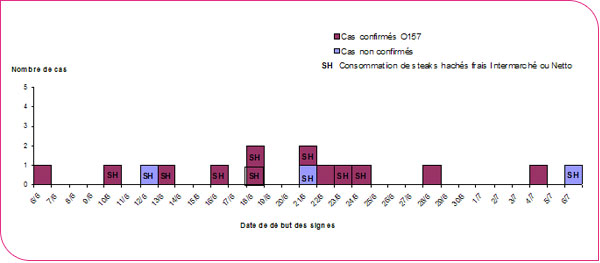
The onset dates of the diarrhea episode for the 15 cases ranged from June 6 to July 6 (Figure). Infection with E. coli O157 was confirmed by stool culture or serology in 12 cases (9 cases of HUS and 3 cases of bloody diarrhea). The infection was not confirmed for the other 3 cases of bloody diarrhea.
Among the 12 cases with confirmed E. coli O157 infection, 8 reported consuming fresh ground beef purchased at Intermarché/Netto with a purchase date between May 28 and June 17. Consumption of the ground beef occurred prior to the product recall for all confirmed cases.
Figure 1
Distribution of HUS and bloody diarrhea cases reported in Aquitaine and Charente-Maritime by date of onset of diarrhea, June 2012
Hemolytic Uremic Syndrome (HUS) and Shiga Toxin-Producing Escherichia coli (STEC)
HUS is a disease most commonly caused in children by a bacterium belonging to the Escherichia coli (E. coli) family, certain strains of which are more virulent and produce toxins called “shigatoxins” (STEC: shigatoxin-producing E. coli). Contamination can occur through the ingestion of contaminated food (undercooked meat, raw milk products, raw vegetables and fruits), through soiled hands after touching animals carrying the bacteria or their environment, or through contact with an infected person who excretes the bacteria in their stool.
STEC infections initially present with diarrhea (often bloody), abdominal pain, and sometimes vomiting. In 5 to 8% of cases (after about a week), these symptoms can progress to HUS. The child then exhibits signs of severe fatigue, pallor, decreased urine output that becomes darker in color, and sometimes seizures.












