




The disease
Mumps, a typically mild illness
Mumps is caused by a paramyxovirus, an RNA virus of the Paramyxoviridae family whose reservoir is strictly human. The disease is usually mild, but it can be accompanied by complications, some of which may require hospitalization. The challenge is therefore to ensure adequate vaccine coverage among the population. Surveillance has been conducted by the Sentinelles network since 1986.
Key facts about mumps
Airborne transmission
The virus is transmitted through the air:
Through inhalation of saliva droplets emitted by an infected person,
Through direct contact with saliva.
Vaccination prevention
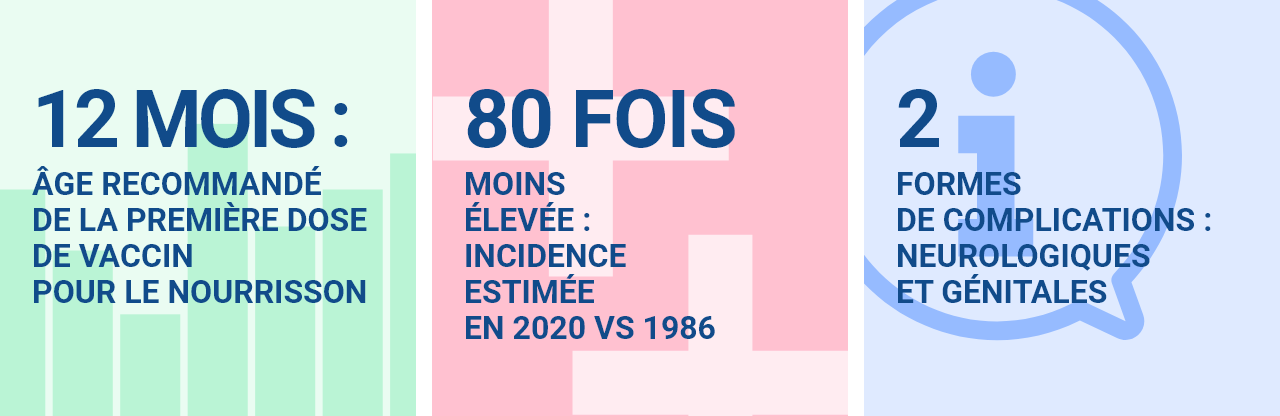
In France, since 1986, routine vaccination against mumps has been recommended in the infant immunization schedule starting at 12 months of age, using the combined measles-rubella-mumps (MMR) vaccine. A second dose of the MMR vaccine was introduced in 1996 for children aged 11–13 years; however, based on modeling studies of measles, the age for this second dose was lowered the following year to 3–6 years. As part of the national plan to eliminate measles and rubella, the vaccination strategy using trivalent vaccines was revised in 2005. While mumps is not specifically targeted by this plan, it nevertheless benefits from the measures implemented for measles and rubella.
The current vaccination schedule now consists of a first dose of MMR vaccine at 12 months and a second dose between 16 and 18 months. A catch-up schedule with two doses is also recommended for individuals born in or after 1980. Note that no monovalent vaccine is available in France.
When a case is reported in a community setting, exclusion of the case is not required. However, attendance at the community setting during the acute phase of the infectious disease is not advisable. There are no specific measures to take, other than to emphasize strict adherence to hygiene measures. Staff and parents must be informed of the presence of cases in the community, and care must be taken to ensure that the vaccination status of those attending the community is up to date (current vaccination schedule).
Specific symptoms
The incubation period averages 21 days.
The most common clinical presentation is painful swelling of the salivary glands, following an episode of fatigue, low-grade fever, and vague pharyngeal or retroauricular pain. The salivary gland most commonly affected is the parotid gland, bilaterally in the majority of cases, sometimes associated with involvement of the submandibular and/or sublingual glands. The enlargement of the parotid glands is accentuated by the constant presence of cervical lymph nodes. However, the infection is asymptomatic in 30 to 40% of cases.
The virus can be isolated in saliva 7 days before and 9 days after the onset of parotitis and in urine 6 days before and 15 days after. The infected individual, even if asymptomatic, is most contagious two days before to four days after parotid involvement. Generally, recovery occurs spontaneously within 8 to 10 days (symptomatic treatment).
Complicated forms fall into two categories:
Neurological involvement, primarily lymphocytic meningitis; mumps encephalitis is much rarer and generally has a good prognosis
Genital involvement, occurring after puberty, such as orchitis and/or epididymitis in men or oophoritis in women.
When a pregnant woman is infected, there is a risk of spontaneous abortion if infection occurs during the first trimester of pregnancy. Permanent sequelae are very rare, primarily involving unilateral hearing loss. Post-mumps infertility is exceptional.
A diagnosis that is often obvious
The diagnosis is most often based on clinical presentation alone; involvement of two salivary glands simultaneously or sequentially confirms the diagnosis of mumps. The differential diagnosis in cases of isolated involvement includes other viral parotitis (CMV, EBV, Coxsackie A, echovirus, parainfluenza virus infections) or bacterial infections (staphylococcus, streptococcus), as well as drug-induced or toxic causes.
Laboratory confirmation is primarily performed in cases of unilateral involvement or diagnostic uncertainty. Typically, the diagnosis is confirmed by serology (detection of IgM and a rise in IgG). However, the sensitivity and specificity of the IgM ELISA tests used by laboratories vary widely depending on the kits employed. Furthermore, laboratory confirmation of cases has become complex.
In individuals with no history of vaccination, serology for IgM is positive in 67% to 100% of cases; however, in individuals vaccinated with a single dose of vaccine, this proportion decreases to between 5% and 76%, and in those vaccinated with two doses of vaccine, to between 4% and 24%.
The test of choice relies on RT-PCR techniques to detect the virus using samples from blood, throat swabs, saliva, or cerebrospinal fluid (CSF). This test is not covered by insurance. However, in the event of an outbreak, it is possible to use the measles diagnostic kits provided by Santé publique France. These kits are available free of charge at Regional Health Agencies (ARS). The analysis is performed by the National Reference Center (CNR) for measles, mumps, and rubella in Caen, where the samples must be sent.
In relation to

Vaccination
thematic dossier
Contagious diseases most often affect children at a very young age. Because children are particularly vulnerable, they are a priority target for vaccination programs.

Measles
thematic dossier
Measles is one of the most contagious infections, with potentially serious complications, and it can be eradicated worldwide. High vaccination coverage is essential to interrupt the spread of the...

Rubella
thematic dossier
Rubella is a viral infection that is usually mild but can, during pregnancy, lead to fetal death or congenital rubella syndrome. A vaccine is available to prevent infection.











