



The syndrome
Sudden infant death syndrome (SIDS) is the leading cause of death among infants under the age of 1. Santé publique France contributes to the surveillance of SIDS in France.
Sudden Infant Death Syndrome: Definition
“Sudden infant death” (SID) is defined as “the sudden death of a previously healthy child aged 1 month to 1 year, when nothing in the child’s known medical history or the circumstances surrounding the event could have predicted it” [1]. Death most often occurs during sleep. Following a comprehensive etiological evaluation (medical history, examination of the scene of death, clinical examination, laboratory tests, imaging, autopsy) [1], this SIDS may be attributed to an infectious, genetic, cardiac, metabolic, traumatic, accidental, or other cause. In the absence of an explanation (approximately 50% of cases), the condition is referred to as sudden infant death (SIDS) [2].
What is the difference between unexpected infant death and sudden infant death syndrome?
Unexpected deaths include those explained by a natural or violent cause and those that remain unexplained despite a thorough investigation, including an autopsy. Deaths that remain unexplained are grouped under the term sudden infant death (SID). Unexplained infant death is therefore a circumstance of death, not a cause. Only after a thorough investigation can an unexplained infant death be classified as SID.
Key statistics on sudden infant death in France
Sudden Infant Death in France
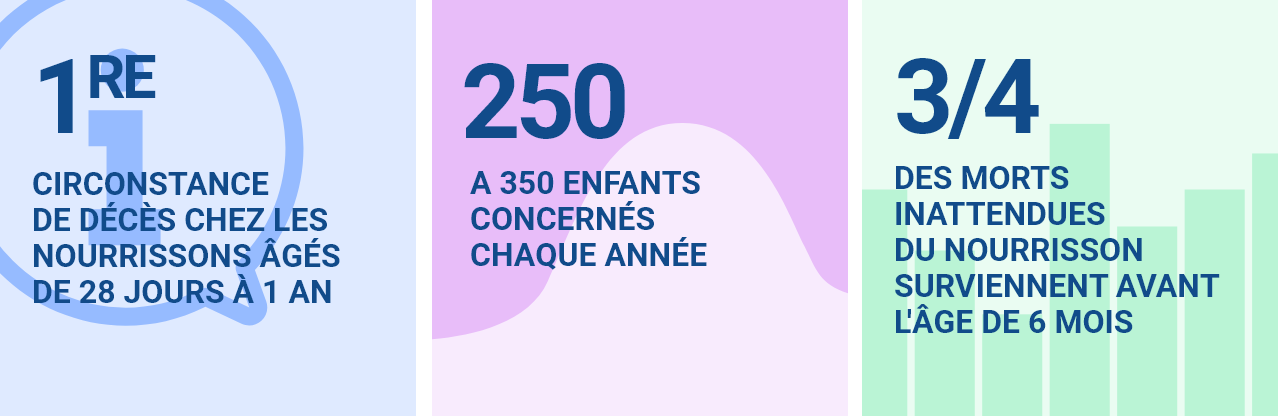
In France, between 250 and 350 babies die each year from sudden infant death syndrome. France is one of the European countries with the highest prevalence [3]. Despite a decrease of more than 75% in the number of deaths following the national “I sleep on my back” campaigns and prevention advice regarding sleeping arrangements in the 1990s, the number of deaths has remained stable since the 2000s. It is currently estimated that 50% of sudden infant death syndrome cases could still be prevented by following recommended preventive measures, particularly regarding the sleeping environment and sleeping positions [4].
Causes and Risk Factors for Sudden Infant Death
For several years, sudden infant death has been considered to have multifactorial causes according to the “triple risk” model [5], namely:
a child who is vulnerable due to their medical history (premature birth, low birth weight, etc.);
a critical period in the child’s neurological, respiratory, and cardiac development (1 to 4 months—75% of deaths occur before the child is 6 months old);
exposure to environmental “stress” factors (prone or side-sleeping, secondhand smoke, sleeping on an unsuitable surface, objects in the crib, infections, etc.).
These three factors combined thus constitute a major risk situation for the child [5].
While intrinsic risk factors have been identified—including male sex (sex ratio of 1.86), extreme prematurity, and low birth weight—numerous studies have identified several extrinsic risk factors for sudden infant death syndrome (SIDS), particularly environmental ones. Among these, sleeping in the prone or side position represents the major risk factor for SIDS [1], linked to the risk of mechanical obstruction of the upper airways; similarly, the presence of objects in the crib (blankets, comforters, pillows, stuffed animals, bedding, etc.) or sleeping on a soft mattress, a sofa, etc. [6-7] increase the risk of the child’s face becoming buried or confined.
Co-sleeping is also an independent risk factor, increasing the risk of SIDS by a factor of 5 in infants under 3 months of age [8]; sharing a room with parents, however, is beneficial and reduces the risk of SIDS by 50%, likely by facilitating monitoring of the child, improving accessibility, and making it easier to reposition the child in the crib during breastfeeding [4].
It is estimated that one-third of sudden infant deaths (SID) could be prevented if mothers did not smoke during pregnancy [9,10]. Exposure to tobacco during pregnancy, considered the second leading risk factor for sudden infant death, exposes the fetus not only to:
several toxic substances produced by tobacco combustion, such as carbon monoxide (CO), which are responsible for impaired brain development,
but also to nicotine poisoning, which alters certain structures of the fetal brain.
What causes sudden infant death?
Certain factors (particularly the sleeping environment) during a child’s sleep increase the risk of sudden infant death. Following the most comprehensive etiological assessment possible, the most common causes of SIDS are:
sudden infant death, suffocation, and asphyxia primarily;
followed by viral or bacterial infections (respiratory, sepsis), cardiac causes, and environmental causes (accidents due to an unsuitable sleeping environment) [2,12];
traumatic causes account for less than 10% of unexpected infant deaths, according to studies.
Other avenues must be explored: genetic, metabolic, neurological, and physiological factors, even though it is possibly the combination of several of these that may lead to the baby’s death [11,12].
Prevention and Recommendations
Prevention remains the most effective way to reduce the number of deaths. The recommendations of the American Academy of Pediatrics (AAP) [4], updated in October 2016, are based on evidence-based medicine and aim to inform healthcare professionals and parents about preventive measures to create a safer sleep environment.
AAP Recommendations
The AAP recommends:
that infants be placed strictly on their backs to sleep, in a sleep sack appropriate for their size and the season, on a firm mattress, and in a crib with no pillows, sheets, comforters, extra mattresses, baby wedges, crib bumpers, or other objects (security blankets, stuffed animals, etc.) that could cover, suffocate, or confine the child;
that the room should not be overheated (between 18 and 20°C) and air should circulate;
to have the child sleep in the parents’ room for at least the first 6 months (the critical age for SIDS) or even the first year;
to breastfeed for the first 6 months due to the beneficial effects of breastfeeding, with the protective effect being greater in cases of exclusive breastfeeding and prolonged duration.
Studies report a protective effect of the pacifier when it is offered at bedtime and not attached to the child (risk of strangulation, etc.). Except for specific medical indications, long-term follow-up at home of parents, siblings, family members, and caregivers of a deceased infant is no longer recommended as it was in the past, nor is the routine use of self-monitoring devices or mattresses designed to detect apnea and bradycardia (learn more on the HAS website).
Regarding cribs attached to the bed, there are no studies to support (or advise against) this practice; however, it is essential to follow standard sleeping guidelines.
Vaccination and Sudden Infant Death
The controversy over a possible causal link between vaccination and the occurrence of SIDS emerged in the 1970s following the introduction, in 1966, of the first tetravalent vaccine (diphtheria, tetanus, polio, and pertussis). Numerous studies have since shown that the sharp increase in the number of SIDS cases beginning in the 1970s was in fact linked to the adoption, at that time, of the prone position for sleeping, which was later recognized as a major risk factor for SIDS.
Among the recommendations made by the AAP, analyses of the U.S. Vaccine Adverse Event Reporting System found no link between vaccines and sudden infant death syndrome (SIDS). In contrast, several large-scale case-control studies have consistently shown that vaccines have a protective effect against SIDS [13].
Recent misinformation and a lack of understanding of infant motor development have wrongly blamed supine positioning for positional cranial deformities (PCD). From a mechanistic standpoint, the observed increase in POS or “plagiocephaly” is secondary not to supine positioning, but to the widespread immobilization of infants due to the use of restraint devices (car seats, etc.) outside of vehicles and certain baby care products (head supports, baby wedges, anti-flat-head cushions, swaddles, positioning cushions, memory foam mattresses, crib inserts, baby bouncers, baby swings, hammocks, etc.) that restrict the infant’s spontaneous movement. Guidelines for strict back-sleeping without physical restraint do not contradict SIDS prevention advice, which is based on allowing free movement, alternating the infant’s head position in the crib, and using play mats with floor toys and parental carrying to broaden the infant’s field of vision when awake [14].
Management of Unexpected Infant Deaths
An interministerial circular dated March 14, 1986, defined the missions of the MIN Reference Centers (CRMIN) to provide care in a specialized hospital setting for children under 2 years of age who have died of sudden infant death syndrome and to conduct postmortem diagnostic investigations.
These reference centers are also tasked with supporting families, developing research initiatives aimed at improving understanding of this condition, and participating in prevention efforts and the training of healthcare professionals and families. In 2013, the French CRMINs joined together to form the National Association of Reference Centers for Sudden Infant Death (ANCReMIN) to support research and better disseminate clinical, physiological, and scientific information, as well as to support prevention and public health initiatives related to sudden infant death, unexplained late fetal deaths, and deaths in the delivery room.
Management protocols
The protocols for managing SIDS are based on the recommendations of the French National Authority for Health (HAS) published in 2007, namely:
pre-hospital care at the scene of death, where the SMUR team collects:
the circumstances of death,
clinical and environmental data regarding the child and their family (complete clinical examination of the child, interviews with those present, examination of the scene of death, collection of the health record, etc.) with a transcription of the data onto the nationally standardized “intervention form” and made available to the CR MINs;
hospital care at the CRMIN, provided by a referring pediatrician who conducts an interview with the family, a complete clinical examination of the deceased child, and biological, bacteriological, virological, metabolic, genetic, and toxicological tests (fundus examination, radiological examinations: chest X-ray, full-body skeletal X-rays, brain imaging or even whole-body imaging, samples for preservation purposes), and requests an autopsy;
post-hospital care in the weeks following the death, with regular follow-up for families organized by the referral team, in order to communicate and explain all the results to the parents, but also to offer them, as well as the siblings, psychological support, referrals to parent support groups, and medical, preventive, and psychological support in the event of a subsequent pregnancy.
Learn more: www.has-sante.fr
[1] Blair PS, Byard RW, Fleming PJ. Sudden unexpected death in infancy (SUDI): suggested classification and applications to facilitate research activity. Forensic Science, Medicine, and Pathology. September 2012;8(3):312-5. doi: 10.1007/s12024-011-9294-x
[2] Krous HF, Beckwith JB, Byard RW, Rognum TO, Bajanowski T, Corey T, Cutz E, Hanzlick R, Keens TG, Mitchell EA. Sudden infant death syndrome and unclassified sudden infant deaths: a definitional and diagnostic approach. Pediatrics. 2004 Jul;114(1):234-8. doi: 10.1542/peds.114.1.234
[3] de Visme S, Chalumeau M, Levieux K, Patural H, Harrewijn I, Briand-Huchet E, Rey G, Morgand C, Blondel B, Gras-Le Guen C, Hanf M. National Variations in Recent Trends of Sudden Unexpected Infant Death Rate in Western Europe. J Pediatr. 2020 Nov;226:179-185.e4. doi: 10.1016/j.jpeds.2020.06.052
[4] Moon RY. Task Force on Sudden Infant Death Syndrome. SIDS and other sleep-related infant deaths: evidence base for 2016 updated recommendations for a safe infant sleeping environment. Pediatrics 2016;138(5).
[5] Guntheroth WG, Spiers PS. The triple risk hypotheses in sudden infant death syndrome. Pediatrics. 2002 Nov;110(5):e64. doi: 10.1542/peds.110.5.e64
[6] Blair PS, Sidebotham P, Pease A, Fleming PJ. Bed-sharing in the absence of hazardous circumstances: is there a risk of sudden infant death syndrome? An analysis from two case-control studies conducted in the UK. PLoS One 2014;9(9), e107799.
[7] Blair PS, Mitchell EA, Heckstall-Smith EM, Fleming PJ. Head covering: a major modifiable risk factor for sudden infant death syndrome: a systematic review. Arch Dis Child 2008;93(9):778–83.
[8] Carpenter R, McGarvey C, Mitchell EA, Tappin DM, Vennemann MM, Smuk M, et al. Bed sharing when parents do not smoke: is there a risk of SIDS? An individual-level analysis of five major case-control studies. BMJ Open 2013;3.
[9] Mitchell EA, Thompson JM, Zuccollo J, MacFarlane M, Taylor B, Elder D, et al. The combination of bed sharing and maternal smoking leads to a greatly increased risk of sudden unexpected death in infancy: the New Zealand SUDI Nationwide case-control study. N Z Med J 2017;130:52–64.
[10] Horne RSC. Autonomic cardiorespiratory physiology and arousal of the fetus and infant. In: Duncan JR, Byard RW, editors. SIDS Sudden Infant and Early Childhood Death: The Past, the Present and the Future. Adelaide: University of Adelaide Press; 2018.
[11] Aishah A, Hinton T, Waters KA, Machaalani R. The α3 and α4 nicotinic acetylcholine receptor (nAChR) subunits in the brainstem medulla of sudden infant death syndrome (SIDS). Neurobiol Dis 2019;125:23–30.
[12] Goldstein RD, Holm IA, Keywan C, Poduri AH. Genetic factors underlying sudden infant death syndrome. Appl Clin Genet 2021 Feb 15;14:61-76.
[13] Deschanvres C, Gras le Guen C, Levieux K, de Visme S, Launay E, Hanf M, Omin. Influence of vaccination status on the occurrence of sudden infant death. Médecine et Maladies Infectieuses 2018;48:S26; https://doi.org/10.1016/j.medmal.2018.04.075
[14] Goldwater PN. The neglected paradigm in SIDS research. Arch Dis Child 2017;102:7677.












