


Gaining a better understanding of the risk factors for musculoskeletal disorders among employees in the human health and social services sectors, in order to better address them. Sumer Study 2016–2017.
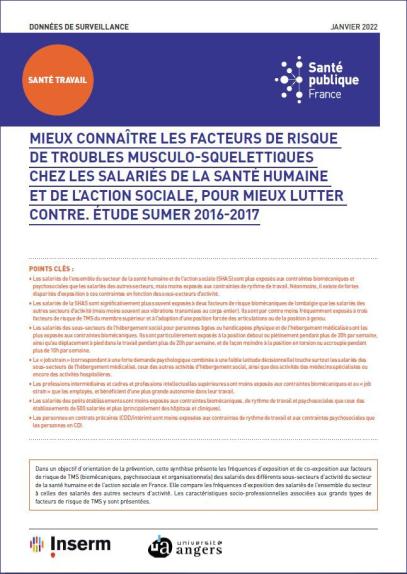
With the aim of guiding prevention efforts, this summary presents the rates of exposure and co-exposure to MSD risk factors (biomechanical, psychosocial, and organizational) among employees in the various subsectors of the human health and social work sector in France. It compares the exposure rates of employees across the entire sector with those of employees in other sectors. The socio-professional characteristics associated with the major types of MSD risk factors are presented here. Employees across the entire human health and social services sector (SHAS) are more exposed to biomechanical and psychosocial stressors than employees in other sectors, but less exposed to work pace stressors. Nevertheless, there are significant disparities in exposure to these stresses depending on the subsector of activity. SHAS employees are significantly more frequently exposed to two biomechanical risk factors for low back pain than employees in other sectors (but less frequently to whole-body vibrations). They are, however, less frequently exposed to three risk factors for upper limb MSDs and to forced joint positions or kneeling. Employees in the subsectors of social housing for the elderly or physically disabled and medical care facilities are the most exposed to biomechanical stressors. They are particularly exposed to standing or walking for more than 20 hours per week, as well as to walking on the job for more than 20 hours per week, and to a lesser extent to twisting or squatting for more than 10 hours per week. "Job strain" (corresponding to high psychological demands combined with low decision-making autonomy) primarily affects employees in the medical care facilities subsector, those in other social care activities, as well as activities involving medical specialists or hospital-based work. Intermediate and managerial professions and higher intellectual professions are less exposed to biomechanical stressors and "job strain" than employees, and enjoy greater autonomy in their work. Employees at small facilities are less exposed to biomechanical, work pace, and psychosocial stressors than those at facilities with 500 or more employees (primarily hospitals and clinics). Individuals on precarious contracts (fixed-term/temporary) are less exposed to work pace and psychosocial stressors than those on permanent contracts.
Author(s): Lloyd Anna, Dugas Julien, Fouquet Natacha, Geoffroy Clara, Robert Maëlle, Roquelaure Yves, Chazelle Émilie
Publishing year: 2022
Pages: 28 p.
Collection: Monitoring data
In relation to
Our latest news

news
Growing Up with Screens. A special report in *La Santé en action* No. 474,...

news
Seniors, pregnant women, and nursing home staff: What is the status of their...

news












