


Prevalence of motor neuron diseases (including amyotrophic lateral sclerosis) and regional disparities in France. Data from 2010 to 2021
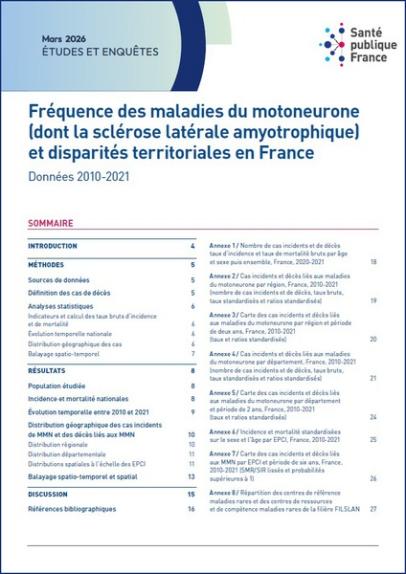
Motor neuron diseases (MNDs), of which amyotrophic lateral sclerosis (ALS, or Charcot’s disease) accounts for 90% of cases, have a major health and social impact. They are notably addressed in the 4th National Plan for Rare Diseases 2025–2030 and the National Strategy for Neurodegenerative Diseases (ND) 2025–2030. For several years, Santé publique France has been conducting epidemiological surveillance of these conditions, providing regional incidence and mortality indicators that are useful for scaling regional information, care, and support services; responding to reports of suspected spatio-temporal clusters; and guiding basic research into possible etiologies. These new results, calculated using medical-administrative data from the National Health Data System, update the estimates previously available through 2015—at the national, regional, and departmental levels—for mainland France and the DROMs (excluding Mayotte) through 2021, and enable a more refined analysis of the geographic distribution of cases at the EPCI (public intermunicipal cooperation establishments). They include an investigation of geographic areas with potential excess incidence or excess mortality. The standardized incidence of MMN is 3.0 to 3.5 cases per 100,000 inhabitants per year, comparable to European data. It is higher among men than among women and increases with age, also consistent with international observations. The standardized mortality rate (2.7 to 3.0 per 100,000), similar to the incidence rate, reflects the high case-fatality rate of these conditions and the short interval between diagnosis and death. No significant temporal trends in the evolution of incidence or mortality were observed between 2010 and 2021 after standardization by age and sex (the observed increase in crude rates may be attributable to population aging), with the exception of a decline in the number of cases in 2020, which could be linked to diagnostic delays during the COVID-19 pandemic. Spatial analysis reveals a heterogeneous geographic distribution of cases across regions, departments, and EPCIs, with areas of excess incidence and excess mortality relative to the national average, confirmed by the results of spatio-temporal scans, although no robust recurring spatial patterns were formally identified at the EPCI level, except potentially in Brittany (incidence and mortality), in Auvergne-Rhône-Alpes (incidence or mortality), and on the border between Occitanie and PACA (incidence only).
Author(s): Torres Marion, Goria Sarah, Guldner Laurence, Moisan Frédéric, Prouvost Hélène, Vernay Michel
Publishing year: 2026
Pages: 28 p.
Collection: Studies and Surveys
In relation to
Our latest news

news
Shamonda Virus: First Human Case Detected in France—What Do We Know?

news
Call for Nominations for the Renewal of the Scientific Advisory Board of the...

news












