



The disease
Disabling neurodegenerative diseases
The severity of motor neuron diseases depends on the extent of the damage and the type of neurons affected.
Amyotrophic lateral sclerosis (ALS), also known in French-speaking countries as Charcot’s disease, is a rare and severe neurodegenerative disease associated with damage to motor neurons in the cerebral cortex and those located in the spinal cord and brainstem. It is the most common motor neuron disease. Generally rapidly progressive, it is characterized by:
a decrease in muscle strength leading to paralysis of the limbs and trunk, affecting the respiratory muscles,
muscle wasting (muscle atrophy),
spasticity.
Approximately 50% of patients die within 30 months of symptom onset.
Depending on the location of the damage, rarer conditions can also be distinguished, such as primary lateral sclerosis, progressive muscular atrophy, or progressive bulbar palsy.
In this context, Santé publique France’s priorities are:
to ensure the epidemiological surveillance of motor neuron diseases;
to study their potential link to certain environmental or occupational exposures;
to generate data to assist public health authorities and healthcare professionals.
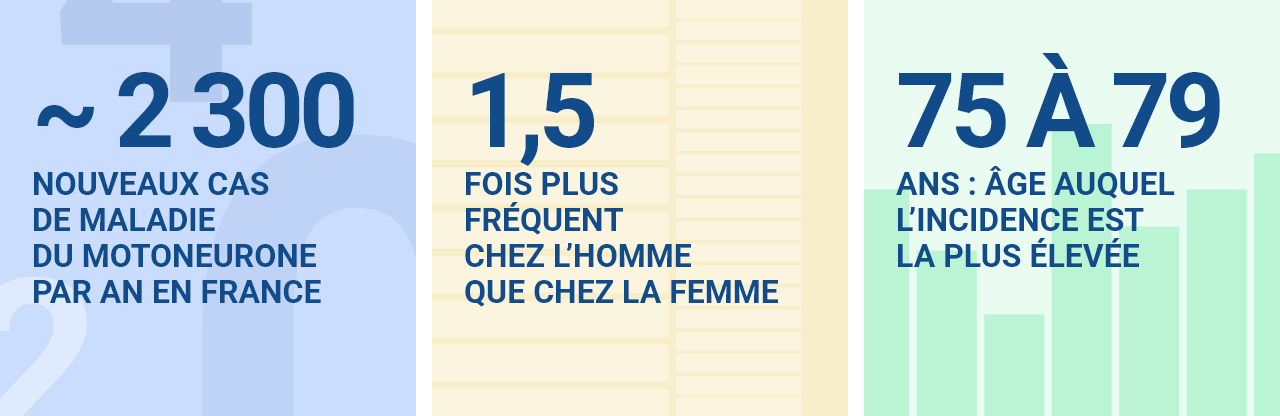
Key statistics on motor neuron diseases
Genetic and environmental risk factors
The etiology of motor neuron diseases is poorly understood. Amyotrophic lateral sclerosis has been the most studied of these diseases; its cause is multifactorial, involving both:
Genetic factors:
There are rare families in which amyotrophic lateral sclerosis is linked to the transmission of a genetic mutation across generations.
Genetic sequencing studies have shown that genetic susceptibility also plays a role in sporadic cases.
Environmental factors that are currently poorly understood and difficult to identify:
Several studies have highlighted the role of occupational exposure to lead.
Other exposures, such as those to pesticides in agriculture¹ or military service², have been suggested, but available studies are few and often rely on small sample sizes with frequently conflicting results. Further studies are needed to better understand the environmental factors that influence the risk of amyotrophic lateral sclerosis.
Multidisciplinary care
To date, there is no cure for motor neuron diseases.
Care relies on human and technical support: physical therapy, environmental adaptations, psychological support, assistance with eating and communication, and non-invasive respiratory ventilation.
Riluzole is the only medication currently available. It can extend survival by a few months.
A significant burden for the patient and their loved ones
Most often, motor neuron diseases progress toward a gradual worsening of symptoms, leading to disability and a loss of independence.
The rate of disease progression, which varies from person to person, is unpredictable. These diseases have dramatic consequences for patients and their loved ones.
Kang H, Cha ES, Choi GJ, Lee WJ. Amyotrophic lateral sclerosis and agricultural environments: a systematic review. J Korean Med Sci. 2014 Dec;29(12):1610-7.
Tai H, Cui L, Shen D, Li D, Cui B, Fang J. Military service and the risk of amyotrophic lateral sclerosis: A meta-analysis. J Clin Neurosci. 2017 Nov;45:337-342.
Links
View the list of our partners' websites












