




The disease
Ebola is a viral disease transmitted to humans, which is often fatal. It is a notifiable disease.
An acute, contagious, and often fatal disease
Ebola virus disease (formerly known as Ebola hemorrhagic fever) is an acute, severe, and often fatal viral disease in humans. It occurs naturally in the forests of tropical Africa.
First identified in 1976 in Sudan, the Ebola virus belongs to the Filoviridae family (filoviruses) and has five distinct subtypes of Ebolavirus:
the Bundibugyo virus,
the Taï Forest virus (Ivory Coast),
the Reston virus,
the Sudan virus,
and the Zaire virus, which are responsible for epidemics.
The Ebola virus is transmitted to humans after contact with infected wild animals found in Africa and can then spread among populations through human-to-human transmission.
Outbreaks most often occur when human-to-human transmission increases during care provided by family members, during funeral rites and care, or in hospital settings.
Key Facts About Ebola
Transmission through close physical contact
Fruit-eating bats of the family Pteropodidae are believed to be the natural hosts of the Ebola virus. The natural range of Ebola viruses responsible for human disease largely overlaps with the distribution range of Pteropodidae.
The virus enters the human population following direct contact with bats, or when handling the carcasses of infected wild animals (mammals, primarily primates).
It then spreads among humans through direct contact with the blood, tissues, or bodily fluids of infected individuals, or through surfaces and inanimate objects contaminated by these bodily fluids (syringes, needles, surgical equipment, etc.).
Low in the early stages of the disease, the risk of human-to-human transmission increases as the disease worsens.
Transmission of the Ebola virus requires close contact with an infected person who is showing symptoms, such as during a medical examination, for example. The risk is higher if that person exhibits more severe symptoms such as vomiting, diarrhea, or bleeding.
Even after recovery, transmission of the Ebola virus remains possible. Sexual transmission of the virus (from man to woman) has been reported more than a year after the source case recovered.
People at particularly high risk
The situations posing the highest risk of Ebola virus disease are unprotected contact with the blood or bodily fluids of an infected person exhibiting severe symptoms of the disease, or with their body in the event of death.
These high-risk situations primarily involve:
the care of patients infected with the virus by healthcare workers and their families,
working in a laboratory containing Ebola virus strains or samples containing the Ebola virus,
participation in funeral rites and care.
The vast majority of people infected during Ebola virus disease outbreaks are members of the patients’ households or their healthcare teams.
Severe symptoms
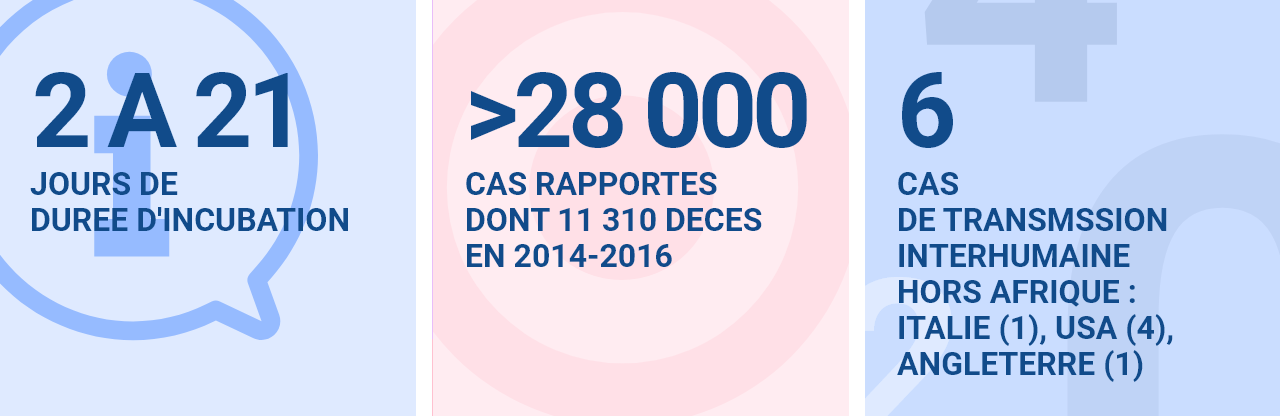
After an incubation period of 2 to 21 days (on average 8 to 10 days), Ebola virus disease is characterized by:
a sudden onset of fever accompanied by fatigue, myalgia (muscle pain), headaches, and sore throat,
followed by diarrhea, vomiting, skin rashes, and kidney and liver failure,
internal and external bleeding may then occur. This bleeding can be localized (conjunctival hemorrhages) or profuse: hematemesis and melena.
The case fatality rate for Ebola virus disease ranges from 25% to 90%, depending on the viral subtype involved and the context in which the outbreaks occur.
Diagnosis performed in a high-security laboratory
Currently in France, the National Reference Center for Viral Hemorrhagic Fevers is the only laboratory capable of performing the main diagnostic techniques for Ebola virus disease under Biosafety Level 4 containment:
detection of anti-Ebola virus IgG and IgM antibodies by serology
detection of viral genetic material via molecular biology (RT-PCR).
The conditions for collecting and shipping diagnostic samples to the National Reference Center for Viral Hemorrhagic Fevers are described here.
Molecular diagnosis of Ebola and Marburg filoviruses using commercial kits can be performed in specialized laboratories with high biosafety levels.
Treatment and Vaccine
There is currently no approved specific treatment for Ebola virus disease, but supportive rehydration via oral or intravenous routes and symptomatic treatment improve survival rates. Several treatments (blood products, immune-stimulating therapies, or medications) are under investigation.
Prevention relies on:
Strict hygiene protocols: wearing gloves and appropriate protective clothing
Early identification and specialized care of patients.
Several vaccines are currently being evaluated. The results are encouraging for one of them, the rVSV-ZEBOV vaccine.
In France, through a decree published on August 31 in the “Journal Officiel,” the Directorate General of Health has authorized, on an exceptional basis, the administration of the rVSV-ZEBOV vaccine to “all healthcare professionals traveling to an epidemic zone as well as healthcare professionals at designated healthcare facilities, listed by the Director General of Health, posted on the website of the Ministry of Solidarity and Health and the Armed Forces Training Hospitals, particularly when these professionals are required to be in direct contact with patients.”











