thematic dossier
Sexually transmitted infections
Les infections sexuellement transmissibles (IST) se transmettent principalement lors des rapports sexuels. Il existe de nombreux virus ou bactéries transmissibles de cette manière.



To mark World AIDS Day on December 1, 2020, Santé publique France is releasing updated data on HIV/AIDS as well as data on bacterial STIs.
thematic dossier
Les infections sexuellement transmissibles (IST) se transmettent principalement lors des rapports sexuels. Il existe de nombreux virus ou bactéries transmissibles de cette manière.
The following information is available on the website:
demographic characteristics of individuals who learned of their HIV-positive status between January 2019 and September 2020. The number of new HIV diagnoses for 2019 could not yet be estimated due to a higher rate of underreporting than in previous years;
updated 2019 data on bacterial sexually transmitted infections (STIs);
an issue of the BEH and an issue of the public health bulletin dedicated to new research, surveillance data, and the impact of COVID-19 on HIV and bacterial STI testing, as well as regional bulletins.
These publications serve as a reminder of the importance of scaling up HIV and other STI testing to reduce incidence and diagnosis rates among both the general population and the most at-risk groups.
The data show that the increase in HIV and bacterial STI testing activity, observed over the past several years, continued in 2019. This is a positive development toward the goal of reducing the number of people unaware of their infection. Indeed, the individual benefit of early therapeutic care also constitutes a collective benefit by preventing transmission to sexual partners. However, in the context of the SARS-CoV-2 pandemic, where reduced use of testing was observed in 2020, it is essential to continue encouraging the population to utilize the healthcare system and, in particular, testing services. Other prevention measures (condoms, TasP, PrEP, TPE, etc.) also remain crucial to ultimately reduce the number of diagnoses observed each year.
Medical laboratories performed 6.2 million HIV serology tests, a number that has been rising since 2014 and increased more sharply in 2019 (+6% between 2018 and 2019).
Men who have sex with men and heterosexuals born abroad remain the two most affected groups, accounting for 43% and 37%, respectively, of HIV-positive diagnoses reported between January 2019 and September 2020.
Heterosexuals born in France account for 14% of all HIV diagnoses, people who inject drugs account for 2%, and transgender people infected through sexual contact account for 2%.
One-quarter of HIV diagnoses (26%) reported between January 2019 and September 2020 were made at an advanced stage of infection.
The number of screenings for bacterial sexually transmitted infections (STIs) (syphilis, gonorrhea, or Chlamydia trachomatis) continued to rise in 2019.
The number of diagnoses of gonococcal or Chlamydia trachomatis infections also continued to rise in 2019, while the number of diagnoses of recent syphilis declined for the first time.
The SARS-CoV-2 pandemic had a significant impact on HIV and bacterial STI testing in 2020. A nearly 60% decrease in the number of tests was observed between February and April 2020.
Download
bulletin national
1 December 2020
This issue features several articles on testing, based on the “Au labo sans ordo” conducted in Paris and the Alpes-Maritimes, data on CeGIDD clients in 2018, and HIV testing activity in 2019 and 2020, taking into account the impact of the COVID-19 pandemic. Regarding this pandemic, an article will focus on its perceived impact on men who have sex with men.
Learn more

magazines/revues
12 July 2024
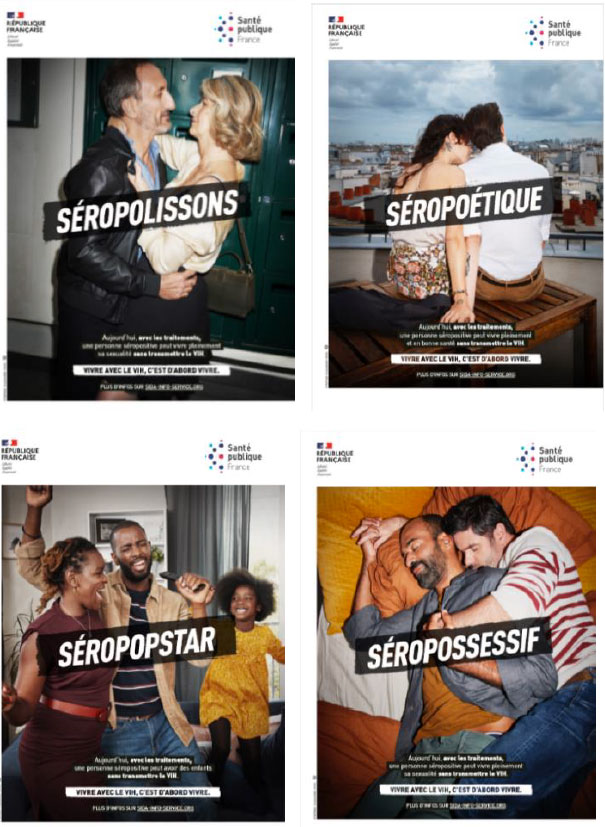
December 1 is an opportunity to say, “Living with HIV means living first and foremost.” With this slogan, Santé publique France’s new campaign addresses a critical issue: reminding people that today, with treatment, an HIV-positive person can live a healthy life, enjoy a fulfilling sex life, and have children.
Visible on billboards and online from November 26 through December 28, 2020, the campaign features five visuals depicting couples and families in private settings and during joyful moments. The photos were candid shots to better capture the daily lives and intimacy of these couples in their private spaces.
The campaign highlights a wide variety of couples—same-sex and opposite-sex, young and older—who are representative of French society. It thus reaches a broad audience, with a particular focus on the populations most affected by HIV (men who have sex with men and migrants from sub-Saharan Africa), as well as people living with HIV.