


Outbreak of tick-borne encephalitis linked to the consumption of raw-milk goat cheese in the Ain department. Update as of June 19, 2020.
Santé publique France has issued an update following the occurrence of several cases of tick-borne encephalitis linked to the consumption of raw-milk cheese in the Ain department between April and May 2020.

Tick-borne encephalitis
thematic dossier
Tick-borne encephalitis is transmitted to humans through the bite of a tick carrying the virus. The primary preventive measure involves protecting oneself against tick bites. In addition, vaccines...
Background
The Oyonnax and Bourg-en-Bresse hospitals reported that, starting on May 10, 2020, they had treated several patients presenting with lymphocytic meningitis of viral appearance but with no initially identified cause. The main bacterial and viral causes of neuro-meningeal infection had in fact been ruled out. An investigation was immediately launched involving physicians from both hospitals, biologists from the Hospices Civils de Lyon and the National Reference Center for Arboviruses in Marseille, the Regional Health Agency, the French Agency for Food, Environmental and Occupational Health & Safety (ANSES), the Departmental Directorate for Population Protection (DDPP), the General Directorate for Food (DGAL), and Santé publique France to determine the cause.
Epidemiological situation in the Ain department as of June 19, 2020
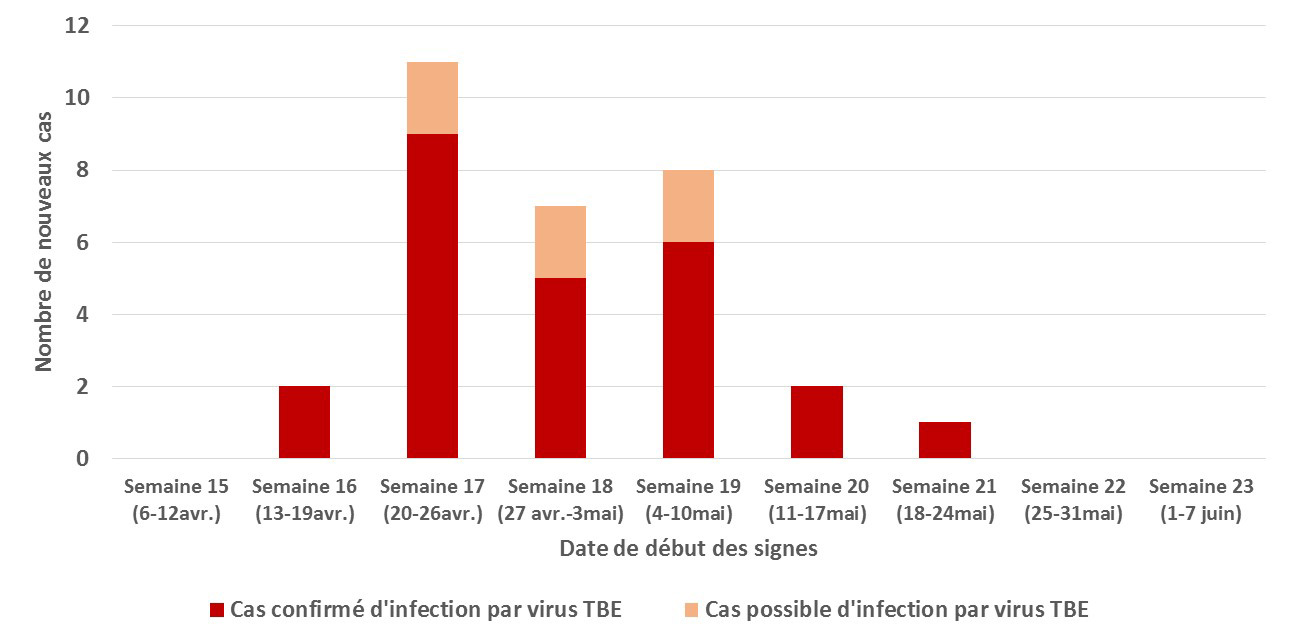
42 cases of lymphocytic meningitis, encephalitis, and infectious syndromes have been identified in a limited area of the Ain department among people living in the Oyonnax area, within a radius of approximately 30 km. Two additional similar cases involve residents of Loire-Atlantique and Jura who consumed raw-milk goat cheese, the source of the cases. The cases occurred between Week 16 (April 13–19) and Week 21 (May 18–24), with an epidemic peak in Week 17 (April 20–26).
Epidemic curve of tick-borne encephalitis cases linked to the consumption of raw-milk goat cheese, Ain, April–May 2020. Updated as of June 19, 2020.
Results of the Initial Investigations
On May 27, 2020, the National Reference Center for Arboviruses confirmed a diagnosis of TBE (Tick-Borne Encephalitis) virus infection—the causative agent of tick-borne encephalitis—in 33 of the 44 cases identified in total. The remaining 11 cases are currently under investigation, and laboratory tests are being conducted to confirm or rule out the diagnosis of tick-borne encephalitis.
Among the confirmed cases, the median age is 49 years (min: 11 months, max: 86 years), and 45% are women. Thirty confirmed cases were hospitalized or visited the emergency room, two of whom were admitted to the intensive care unit.
Forty-one of the 43 cases (95%) reported having consumed, starting in mid-April, goat cheese or goat faisselle made from raw milk from the same cheese producer located in the Ain department. The foodborne cause of these infections was confirmed on June 2, 2020, by the National Reference Center for Arboviruses. Indeed, the TBE virus genome was identified in a goat cheese from the producer in question. As a precautionary measure, a recall of this producer’s dairy products had been carried out even before this result was known.
This cluster of tick-borne encephalitis cases is the first identified in France linked to the consumption of raw milk products. However, the occurrence of sporadic cases of tick-borne encephalitis is not new in the Auvergne-Rhône-Alpes region. In fact, a few rare cases have been identified each year in the Annecy region since 2003 and more recently in the Livradois-Forez massif, with the detection of three cases in the Loire and Haute-Loire departments during the summers of 2017 and 2018. Another case of tick-borne encephalitis was identified in late May 2020 in the Ain department in a person who had been bitten by ticks several times but had not consumed the at-risk cheese.
Control measures and product recall
Control measures were implemented under the auspices of the DGAl and the DDPP01. To ensure the safety of its products, the producer has implemented pasteurization of goat’s milk prior to processing. A recall of products on the market at the time of the alert was decided on May 27, 2020. ANSES dispatched a team to the Ain department to conduct additional environmental studies on ticks and the TBE virus in the affected geographic area.
In addition, an informational message was sent to physicians in the region to raise awareness about the circulation of the virus and to improve the diagnosis of the infection. The French Blood Establishment (EFS) suspended the distribution of potentially at-risk blood products and interviewed donors about their consumption of goat cheese and any tick bites they may have had.












