


Outbreak of pediatric hemolytic uremic syndrome caused by Escherichia coli O26 in mainland France linked to the consumption of Reblochon cheese: update as of May 31, 2018
Between February and May 2018, several children with hemolytic uremic syndrome (HUS), infected with Escherichia coli (E. coli) O26 bacteria sharing the same characteristics, were identified by the National E. coli Reference Center and its associated laboratories (Institut Pasteur, Paris, and the Microbiology Laboratory at Robert Debré Hospital, Paris). Investigations conducted by Santé publique France confirmed an epidemiological link between these cases and the consumption of raw-milk Reblochons produced at the Chabert company’s facility in Cruseilles (Haute-Savoie).
Epidemiological Update as of May 31
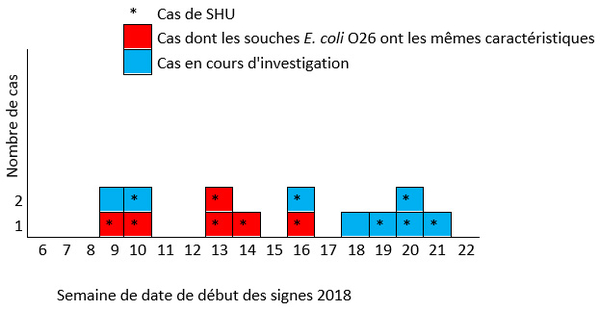
As of May 31, 2018, 14 children aged one to five years are included in the investigation of this outbreak:
6 children with HUS were infected by the same strain of E. coli O26, and their consumption of the implicated Reblochon cheese has been documented. These six children reside in several regions of mainland France (Centre–Val de Loire, PACA, Île-de-France, Auvergne-Rhône-Alpes, Pays-de-la-Loire);
Investigations are ongoing for 8 other children. Among them, two presented with signs of gastroenteritis and six presented with HUS. One of the children with HUS has died; the investigation into this case is ongoing. To date, it is neither possible to rule out nor confirm that these cases of HUS are linked to the consumption of Reblochon: the strain has not been isolated and characterized, and consumption of the implicated Reblochon has not yet been documented.
The ongoing investigations have two components: an epidemiological component, which involves interviewing parents about their children’s dietary intake and, where applicable, tracing the origin of the Reblochon consumed. A microbiological component, on the other hand, which aims through analyses to identify the strain that infected the child and to determine whether it exhibits characteristics similar to those of the epidemic strain. These investigations are a long and complex process, and in some cases the strain responsible for the infection cannot be identified.
Figure - Distribution of E. coli O26 (epidemic strain) infection cases and cases under investigation, by date of symptom onset, France, February–May 2018
Surveillance of pediatric hemolytic uremic syndrome in France
HUS is a rare disease in France: between 100 and 160 cases are reported through the surveillance system each year. It is a serious disease, as it is the leading cause of acute kidney failure in children aged 1 month to 3 years. In the international literature, the mortality rate ranges from 3% to 5% (1% according to French surveillance data). This disease is most often caused by a bacterium belonging to the Escherichia coli family, some strains of which are more virulent and produce toxins called "shigatoxins."
Contamination occurs:
by ingesting contaminated food consumed raw or undercooked: unpasteurized milk or dairy products, undercooked beef (especially ground beef), contaminated raw vegetables, contaminated drinking water;
by touching the mouth with dirty hands after touching animals carrying the bacteria or their contaminated environment;
through contact with an infected person who excretes the bacteria in their stool.
In France, surveillance of hemolytic uremic syndrome and infections caused by Shiga toxin-producing Escherichia coli relies on several surveillance systems that identify the vast majority of cases:
HUS surveillance in children under 15 years of age: since 1996, a network of volunteer pediatric nephrology departments has been reporting cases to Santé publique France;
the National Reference Center for E. coli;
mandatory reporting of foodborne outbreaks.
Each year, Santé publique France produces a report on HUS surveillance in children under 15 years of age. In 2017, 164 cases of pediatric HUS were reported to Santé publique France, and no outbreaks were identified.












