


Making cities heat-resilient: a necessity for reducing the health impacts of extreme heat
What is the link between urban planning, heat, and mortality? Santé publique France and the Institut Paris Région have published the results of a study conducted in 2019–2020 across 1,300 municipalities in the Île-de-France region.

Climate change
thematic dossier
Climate change is rapidly and profoundly altering the environment. The health impacts of climate change are numerous and varied.
Preventing health risks associated with heat waves requires not only appropriate individual behavior but also environmental measures to reduce urban heat: greening buildings, selecting suitable building materials, reducing land sealing by promoting soil porosity and restoring water retention, addressing the layout and density of housing in real estate projects, etc.
What is a heat island?
A heat island (HI) refers to a microclimate generated by the concentration of human activities, resulting in higher temperatures in urban areas compared to neighboring rural areas.
What was the focus of the study and what was its scope?
Santé publique France and the Institut Paris Région (formerly the Institut d'aménagement et d'urbanisme de la région d'Île-de-France) studied the influence of certain urban characteristics conducive to the formation of heat islands on the relationship between temperature and mortality between 1990 and 2015.
The analysis focused on the Île-de-France region, given the prevalence of heat islands there, the size of the exposed population, and the resulting statistical power. The region also benefits from extensive research on identifying urban characteristics likely to lead to these heat islands. It features a highly built-up environment with high-rise buildings, recent apartment complexes, or historic centers with limited vegetation, green spaces of varying sizes, and both apartment complexes and single-family homes…
We compared the relationship between mortality and temperature in the municipalities of Île-de-France, taking into account urban characteristics conducive to the formation of heat islands (non-vegetated artificial surface area, non-wooded surface area, soil imperviousness rate, and the proportion of the population living in an area with moderate or high potential for nocturnal urban heat islands). Socioeconomic factors were also included in the analysis.
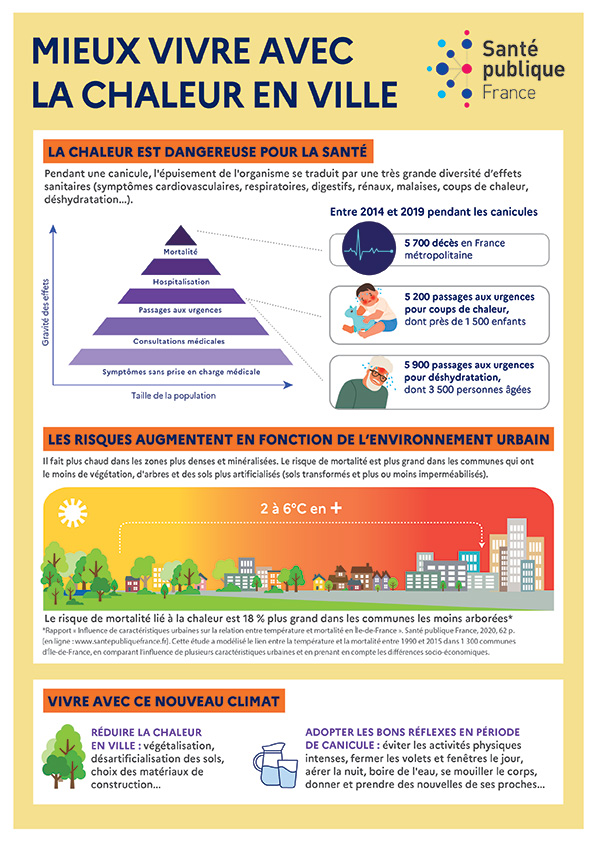
In Paris, the risk of heat-related mortality is 18% higher in municipalities with the fewest trees
The study published today, “Influence of Urban Characteristics on the Relationship Between Temperature and Mortality in Île-de-France,” shows that the risk of heat-related mortality is lower in municipalities with the most vegetation, the most trees, and less paved surfaces. In Paris and the inner suburbs, the risk of dying from extreme heat is 18% higher in municipalities with the fewest trees than in those with the most.
Interventions, particularly regarding greening and soil permeability, could therefore help reduce the health impacts of extreme heat. These must be combined with other measures to prevent the effects of heat. Taking action on the urban environment thus helps protect residents’ health and adapt to climate change.
Download

enquêtes/études
17 May 2022
The Impact of Urban Characteristics on the Relationship Between Temperature and Mortality in the Île-de-France Region
Infographic: Coping with the Heat in the City
3 Questions for Mathilde Pascal, Climate Project Manager in the Occupational Health and Environment Division
Heat waves, as defined by the National Heat Wave Plan, caused nearly 38,000 deaths between 1973 and 2019 in metropolitan France (detailed data is available on the Géodes app). With climate change, they are becoming increasingly frequent and intense. Between 1974 and 1983, there were an average of 17 heat waves per year at the departmental level; between 2004 and 2013, that number rose to 40.
The 2003 heat wave remains the deadliest, with 15,000 excess deaths. No other heat wave is comparable to 2003 in terms of duration and geographic extent. Since 2015, temperatures equivalent to or higher than those observed in 2003 have been regularly recorded, but over much shorter periods and in more limited geographic areas. These events have a significant impact on public health. Despite prevention efforts since 2004 (implementation of heatwave plans), there were already more heatwave-related deaths between 2014 and 2019 (5,500 deaths in five years) than between 2004 and 2013 (2,200 deaths in ten years).
The use of green and permeable surfaces to mitigate extreme heat is well established and is an approach that is gaining increasing traction. From a public health perspective, it offers numerous benefits, as vegetation helps regulate heat, but also reduces air pollution and noise, encourages physical activity, and fosters social connections… Numerous studies highlight better health outcomes among populations living in areas with more vegetation. However, this greening must be designed to account for certain potential negative effects (such as avoiding allergenic plant species) and to reduce social health inequalities.
Regarding the urban heat island effect, greening is not the only option. There is a range of possible, complementary interventions that must be selected based on the local context.
Finally, in the face of extreme heat, actions targeting the urban environment must be combined with other preventive measures (such as improving thermal comfort in buildings), public information campaigns, the identification of vulnerable individuals, and the adoption of appropriate individual behaviors.
Our study examined the influence of certain urban characteristics conducive to the formation of urban heat islands on the relationship between temperature and mortality in municipalities across the Île-de-France region.
The urban heat island (UHI), which leads to overexposure of city dwellers to heat, results from the combination of specific meteorological conditions and certain urban characteristics. UHI refers to a microclimate generated by the concentration of human activities, resulting in higher temperatures in urban areas compared to neighboring rural areas. It depends on the physical properties of the city (e.g., land use, building materials, urban morphology, human activity, etc.) and favorable meteorological conditions, characterized in particular by light winds and clear skies.
The main factors influencing the UHI are:
water (it stores heat drawn from the ambient air and allows it to be released, leading to localized cooling);
vegetation (it removes heat through evapotranspiration and creates shade, leading to localized cooling);
building and cladding materials;
human activities (including air conditioning) that generate additional heat;
transportation traffic (which heats the ambient air and emits pollutants that create an additional greenhouse effect, reducing nocturnal radiative cooling);
sealing, which prevents surface water and vegetation—which cool the air through evaporation and evapotranspiration—from forming.
Combating the Urban Heat Island (UHI) effect is one of the priority areas of France’s second climate change adaptation plan (Pnacc-2). Actions to reduce the UHI effect will seek to modify controllable urban variables, and thus those related to urban planning and material choices.
Useful Links
Heat in the City (report by the Paris Region Institute)
Resource Center for Climate Change Adaptation (Ministry of Ecological Transition)












