Increase in Mycoplasma pneumoniae infections in France
Santé publique France has released an update as of November 30, 2023, following the rise in Mycoplasma pneumoniae infections in France, and is reminding the public of the preventive measures to follow.
Stay informed
To stay up to date with our news, subscribe to our newsletters by filling out the form below
Mycoplasma pneumoniae is a bacterium primarily responsible for infections of the upper respiratory tract (tonsillitis, pharyngitis, etc.) or lower respiratory tract. After pneumococcus, it is the bacterial agent most frequently implicated in community-acquired pneumonia (CAP), accounting for 30 to 50% of these infections in children. In most cases, symptoms are mild. Complications, such as asthma exacerbation or rare manifestations—particularly skin or neurological symptoms—may require hospitalization.
Human-to-human transmission occurs via respiratory droplets, and the incubation period is generally 1 to 3 weeks [1]. Infections occur throughout the year but may be more frequent in summer and fall. Clusters of cases have been reported, particularly in childcare settings but also among adults. Epidemic peaks occur cyclically every 3 to 7 years. In Europe, several countries experienced epidemics during the 2015–2017 period [2;3].
Update
In 2023, unusual increases in Mycoplasma pneumoniae respiratory infections were reported in France during week 47, both in urban areas—where clusters of suspected community cases were identified in schools—and in several regions, where confirmed cases were reported in hospital intensive care units.
In France, there is no national reporting or surveillance system dedicated to Mycoplasma pneumoniae infections. As part of the investigation into this report, Santé publique France is analyzing the situation by mobilizing, in collaboration with its partners, several data sources (clinical, microbiological, and epidemiological; in urban areas and in hospitals).
Investigations conducted in France to date suggest an increase in cases of Mycoplasma pneumoniae respiratory infections since the end of summer, which has been more pronounced since October 2023, notably with an increased occurrence of CAP attributed to this pathogen.
The evidence supporting this increase is as follows:
Emergency department visits (OSCOUR® Network) related to pneumonia (all types combined) have been increasing since early October, and more markedly since early November [4], particularly among 6- to 15-year-olds as well as 16- to 49-year-olds (Figure 1). The levels reached in these age groups are significantly higher than those in 2019 and 2022. This increase is also observed in analyses restricted to bacterial pneumonia, which could corroborate the reports received to date, even though the proportion attributable to Mycoplasma pneumoniae cannot be precisely estimated from this data source. Furthermore, the trend in medical procedures for pneumonia in the SOS Médecins network is comparable to that observed in emergency departments [5], with a more pronounced increase among those under 15 and those aged 15–44.
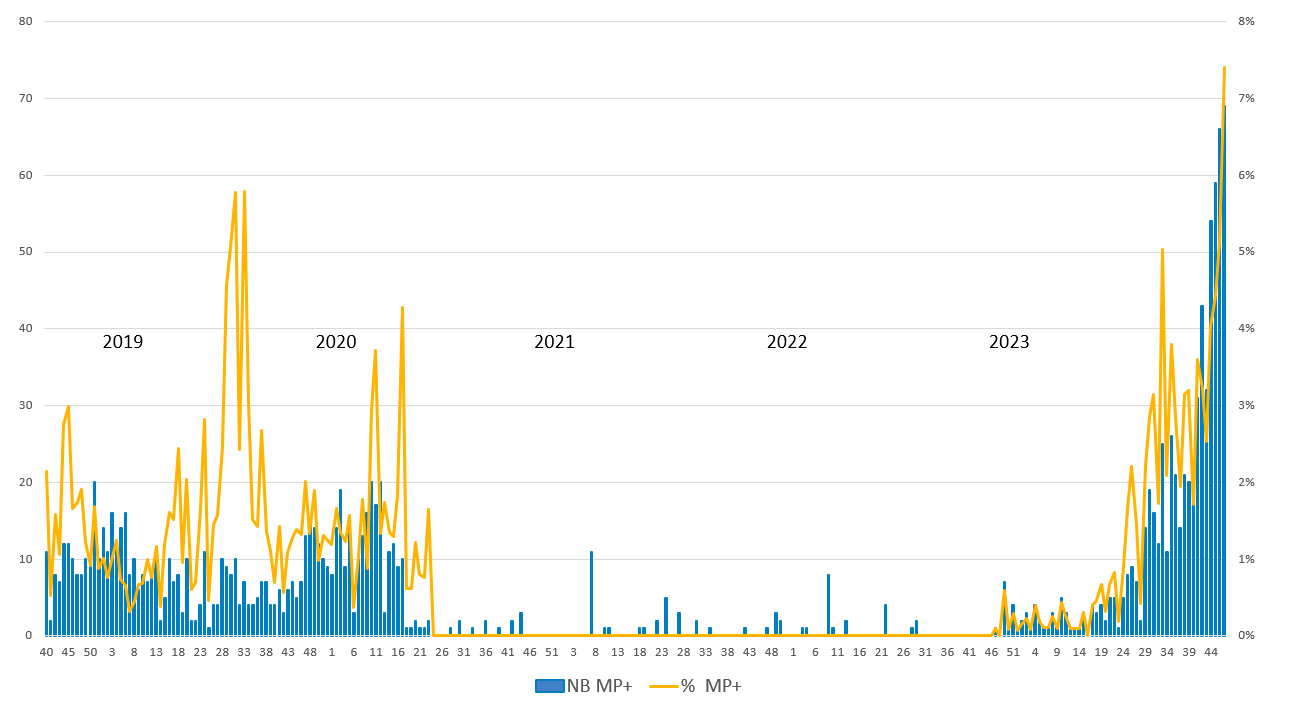
The RENAL hospital laboratory network notes that the number of PCR-detected cases of Mycoplasma pneumoniae across all age groups increased markedly starting in October 2023, reaching levels in week 47 that were significantly higher than those in 2019 (Figure 2). The number of PCR detections tripled between weeks 40 and 46 of 2023, with the increase continuing into week 47.
Geographically, several regions in mainland France as well as Réunion reported consistent findings, particularly from hospitals. Furthermore, several other European countries have also recently reported increases in Mycoplasma pneumoniae infections (e.g., Sweden, the Netherlands, Norway, Ireland).
All data collected to date indicate increased circulation of this bacterium in France since the beginning of autumn, with a higher number of cases than in 2019 and 2022 during the same period, reflecting an epidemic situation. While hospital microbiological data showed that the circulation of this bacterium in France during the pandemic was at a very low level, the increase currently observed could be linked to the lifting of control measures implemented during the pandemic, as has already been observed for other pathogens.
The Ministry of Health has conducted an awareness campaign for private and hospital-based healthcare professionals regarding diagnosis and management.
Figure 1 - Weekly rate of emergency department visits for pneumonia per 100,000 emergency department visits by age group, weeks 23 through 47, 2019, 2022, and 2023, OSCOUR® network
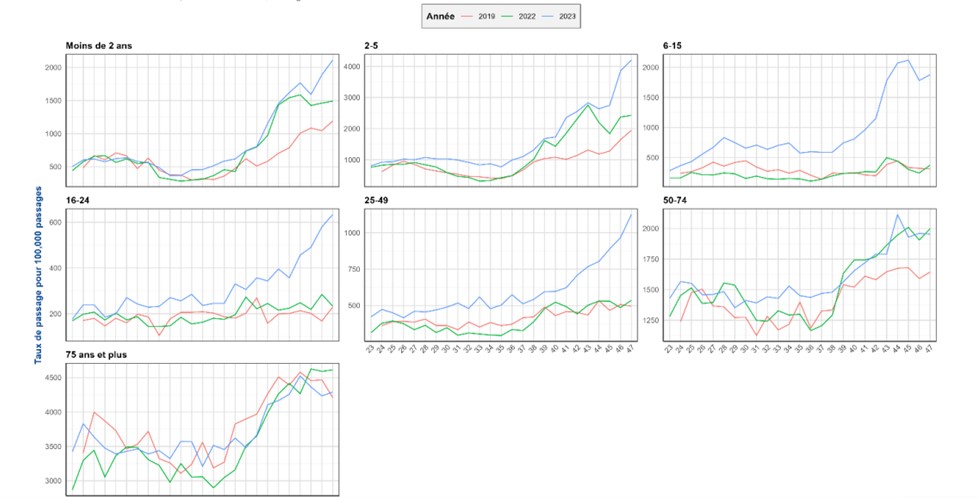
Figure 2 - Number and weekly detection rate of Mycoplasma pneumoniae by PCR, weeks 40/2019 to 47/2023, RENAL hospital laboratory network
[1] Parrott, G. L., Kinjo, T., & Fujita, J. A. Compendium for Mycoplasma pneumoniae. Front. Microbiol. 2016; 7.
[2] Beeton M L, Zhang X, Uldum S A et al., the ESCMID Study Group for Mycoplasma and Chlamydia Infections (ESGMAC) Mycoplasma pneumoniae subgroup. Mycoplasma pneumoniae infections, 11 countries in Europe and Israel, 2011 to 2016. Euro Surveill. 2020;25(2).
[3] Meyer Sauteur P M, Beeton M L, Uldum S A, et al., ESGMAC–MyCOVID Study Team. Mycoplasma pneumoniae detections before and during the COVID-19 pandemic: results of a global survey, 2017 to 2021. Euro Surveill. 2022;27(19).
[4] SurSaUD® syndromic surveillance. OSCOUR® Network Bulletin / Public Health France. Weekly update No. 972 of 11/28/2023.
[5] SurSaUD® syndromic surveillance. SOS Médecins® Network Bulletin / Public Health France. Weekly update No. 828 of 11/27/2023.
Simple precautions to take
To reduce the risk of infection, Santé publique France recommends a few simple preventive measures:
Wear a mask if you have symptoms (cold, fever, sore throat, or cough), in crowded places, and around vulnerable people
Wash your hands frequently with soap and water or with hand sanitizer
Ventilate your home regularly
Sneeze into your elbow (rather than into your hands)
Use a disposable tissue
Download
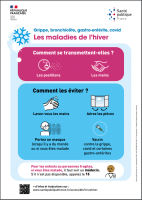
Flu, bronchiolitis, gastroenteritis, COVID-19: winter illnesses—how can you avoid them?