


Hurricane Irma in the Caribbean: More Than 100 Reservists on the Ground
Following Hurricane Irma’s passage through the Caribbean and at the request of the Ministry of Health, Santé publique France’s medical reserve has been mobilized. Several teams are taking turns to provide on-site medical and logistical support. To date, more than 100 reservists are on site.
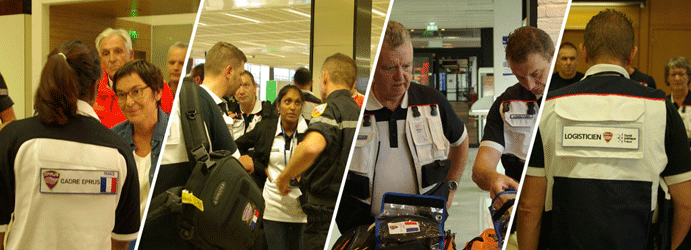
On Wednesday, September 6, 2017, a team of 20 reservists from various specialties was assembled to provide medical support and assess needs on the ground. The team departed for Guadeloupe that evening alongside Annick Girardin, Minister for Overseas Territories, as well as members of the civil security forces, firefighters, and Red Cross personnel. During its 7-day reinforcement mission, the Medical Reserve team is tasked with analyzing the situation on the ground and assessing future needs.
Since then, several teams of reservists have been regularly deployed to the area. On Monday evening, a hospital engineer and a national consultant psychiatrist joined Agnès Buzyn, Minister of Health, and Emmanuel Macron aboard the presidential plane, bringing the total number of reservists on the ground to over a hundred.
Operational teams of reservists deployed in Guadeloupe and Saint Martin
Led by one or more coordinators, the teams rotate through different affected areas and provide specific assistance based on the needs identified by the initial reconnaissance team.The deployed personnel are thus divided among: doctors (emergency physicians, anesthesiologists, general practitioners), medical dispatchers, surgeons, nurses, logisticians, a telecommunications specialist, a psychiatrist, psychologists, pharmacists, pharmacy technicians, etc.
Additional human and material reinforcements
The Cire Antilles (Regional Intervention Unit) of Santé publique France will also be reinforced by two reserve epidemiologists.
In light of the evolving health situation and the needs of healthcare facilities, local authorities may request adjustments to the staffing levels and specialties of the medical reinforcements. For this reason, additional teams are already preparing to depart for the Antilles.
Material reinforcements are accompanying the first responders to address the exceptional health situation on the ground. As such, mobile medical stations have already been delivered by the pharmaceutical division, enabling frontline medical care and the treatment of 200 victims and 75 critical emergencies (100 crates of supplies, medical products, and medications). In addition, more than two tons of medications have been transported by the pharmaceutical division of Santé publique France via the presidential aircraft. Finally, radio communication equipment has been sent to both islands to facilitate communication among healthcare professionals on site.
Santé publique France is also responsible for managing volunteers from the French West Indies. This is why, among the volunteer reservists, requests from professionals already on site are given priority.
A new call for volunteers has been issued to 10,000 reservists to organize reinforcements for the coming weeks. A wide range of healthcare professionals is being sought.
Learn more about the Health Reserve
Joining the Health Reserve means being ready to step in as reinforcements during an exceptional situation. Healthcare professionals wishing to be notified of alerts and offer their services can register on the website: www.reservesanitaire.fr or visit the Health Reserve’s Facebook page: https://fr-fr.facebook.com/EPRUS.ReserveSanitaire/
Formed and managed by Santé publique France, the national public health agency, the Health Reserve consists of 2,000 healthcare professionals, both active and retired. Health reservists can provide backup during serious health threats or crises to support authorities and healthcare facilities.
It can be mobilized by the Ministry of Health, at the request of other ministries if necessary, as well as by the directors of the Regional Health Agencies. Assignments are generally short-term, in France or abroad. They very often take place in overseas territories.
Any need for additional healthcare professionals during exceptional situations may result in a call upon the Health Reserve, most often for limited durations and with limited personnel. The Health Reserve has thus recently been called upon to carry out missions of the following types:
reinforcement of healthcare facilities during massive influxes of patients and/or staff burnout due to exceptional health situations (the Nice attack, outbreaks of dengue, chikungunya, Zika, etc.) or severe recruitment shortages in overseas territories (reinforcement of the Mamoudzou General Hospital in 2015, 2016, and 2017);
reinforcement and support for medical-psychological emergency units and psychiatric services (Nice, 2016);
reinforcement of services experiencing temporary surcharges due to a health event (reinforcement of biology laboratories and monitoring of pregnant women in French Guiana during the 2016 Zika epidemic) or requiring specific expertise;
reinforcement of call centers for victims (terrorist attacks) or the general public (meningococcal vaccination campaign in Dijon, 2017);
reinforcement of government services responsible for coordination during public health events, vaccination campaigns, large gatherings, and influxes of migrants;
assessment and health and medical-psychological support for French citizens affected by an event abroad (terrorist attacks in Africa in 2016);
support for repatriation or evacuation in exceptional situations (Nepal 2015);
reinforcement of exceptional safety measures during large gatherings (national commemorative ceremonies such as Verdun 2016);
reinforcement of care and transport for highly contagious patients (Ebola epidemic).
In the event of an alert, available reservists volunteer and are then selected by Santé publique France based on the skills required. Reservists receive regular training to ensure they are always operational, and their missions are compensated. In 2016, the Health Reserve carried out 25 operations, representing 286 team rotations. 480 reservists were mobilized, for a total of 7,400 mission days (including 1,800 days dedicated to the Nice attack and 5,300 days in overseas territories).












