


Heat Waves and Health: What Are Local Governments Doing to Better Protect the Public?
Santé publique France has released the results of a survey designed to assess local governments’ practices regarding measures to mitigate the health impacts of heat waves on residents. Several recommendations are proposed to support these efforts.

Extreme heat, heat wave
thematic dossier
Heat waves can have a significant impact on health. It is therefore essential to take proper precautions. Certain measures must be put in place, especially for those most at risk.
Municipalities are on the front lines when it comes to protecting residents from the heat. With the aim of sharing best practices and improving prevention efforts, they were surveyed about their practices, challenges, and needs in this area. As part of this effort, Santé publique France conducted a survey of several municipalities of varying sizes (villages, small and large urban areas) across different regions and climates.
What was the survey about, and how was it conducted?
The survey took place between June and October 2019 via four online questionnaires, developed by Santé publique France with the assistance of the WHO Healthy Cities Network and sent to all municipalities in metropolitan France. The questions asked focused on practices regarding the protection of schoolchildren, the homeless, and vulnerable individuals (via municipal registries that identify elderly and/or disabled people for the purposes of alerting and protecting them), and cities’ adaptation to heat.
Analysis of the results, supported by certain French and international studies and, in some cases, by the opinions of the High Council for Public Health, has led to recommendations for action to improve the measures taken by municipalities. These recommendations are primarily directed at public authorities and local governments. The proposed actions, however, need to be evaluated to promote those deemed effective. Some have been implemented since the survey, particularly those utilizing municipal registries developed during the COVID-19 crisis.
What are the proposed courses of action?
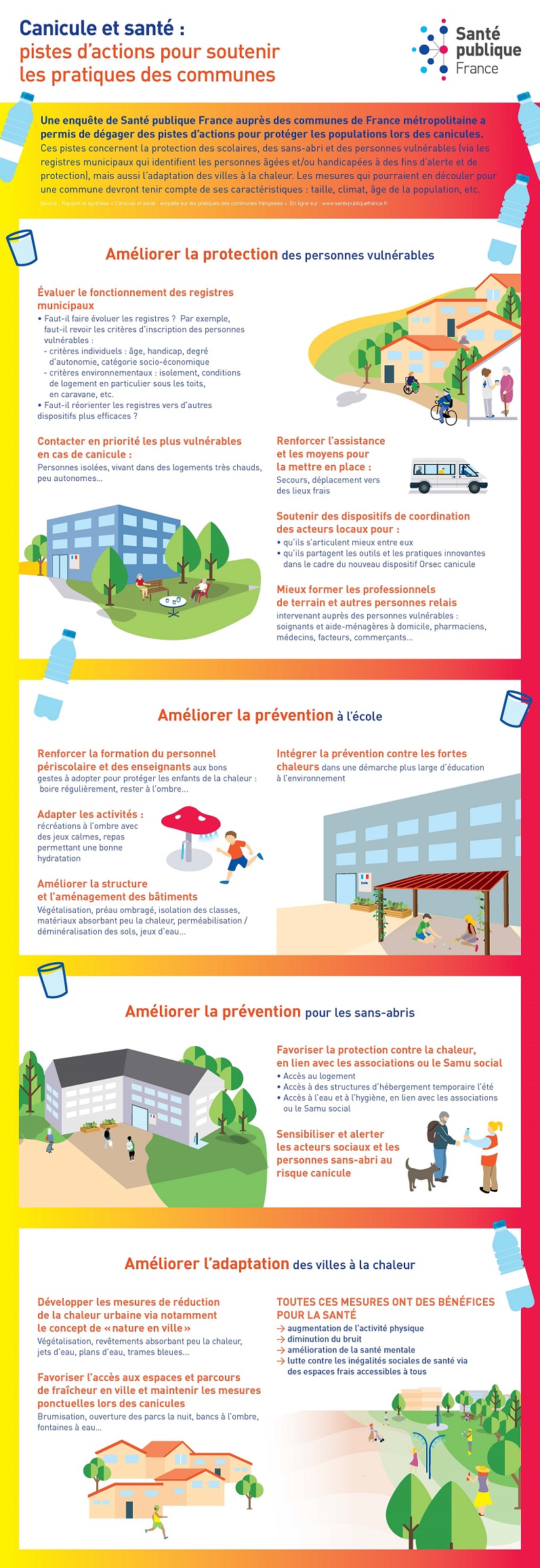
Ways to improve the protection of vulnerable people in municipalities
Assessing the functioning of municipal registries
Strengthen support for individuals
Better coordinate stakeholders
Better train frontline professionals and community liaisons (caregivers and home health aides, pharmacists, doctors, mail carriers, shopkeepers, etc.)
Ways to improve prevention in schools
Strengthen training for after-school staff and teachers on the proper steps to take to protect children from the heat
Adapt activities (recess, meals, schedules, etc.)
Improve the structure and layout of buildings (greenery, shaded courtyards, classroom insulation, blinds, heat-reflective materials, permeable/de-mineralized surfaces, water play areas, etc.)
Integrate heatwave prevention into a broader environmental education approach
Ways to improve protection for the homeless
Promote protection against heat, with the help of organizations or the Samu Social: access to housing/temporary shelters in the summer, access to water and hygiene
Raise awareness and alert social service providers and homeless individuals to the risk of heat waves
Ways to improve cities’ adaptation to heat
Develop measures to reduce urban heat, particularly through the “nature in the city” concept (greening, heat-reflective surfaces, water fountains, bodies of water, blue infrastructure)
Promote access to cool spaces and routes in the city and maintain temporary measures during heat waves (misting, keeping parks open at night, fountains, etc.)
All these measures go beyond the scope of heat waves and offer health benefits: increased physical activity, reduced noise, improved mental health, and the fight against social health inequalities through cool spaces accessible to all.
See also

enquêtes/études
20 September 2022
Survey on Municipal Practices to Mitigate the Health Impacts of Heat Waves
Climate change
thematic dossier
Climate change is rapidly and profoundly altering the environment. The health impacts of climate change are numerous and varied.












