


Getting more exercise: a necessity for the French
The latest data from the Esteban* study conducted by Santé publique France show that physical inactivity and a sedentary lifestyle are on the rise among the French population. Women are the most affected. Over the past 10 years, the proportion of physically active women has fallen by 16%. This is a concerning decline, given that physical inactivity was identified in 2009 as the fourth leading risk factor for noncommunicable diseases, contributing to more than 3 million preventable deaths. Based on this finding, Santé publique France has developed new digital tools for the start of the school year—tools designed to inform and encourage—inviting the French public, and particularly French women, to move more and move better.
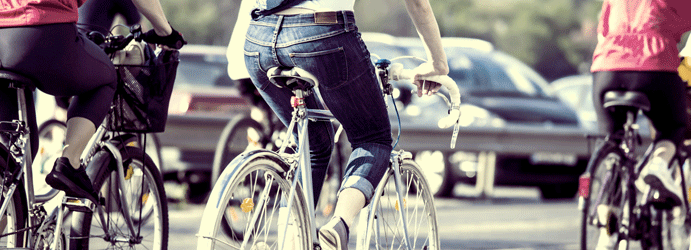
More than one in five women lead sedentary lifestyles and are physically inactive
A high level of sedentary lifestyle combined with low physical activity increases the risk of noncommunicable diseases.
In France, in 2015, 22% of women had both of these risk factors, compared to 17% of men. And only 53% of women meet the World Health Organization’s recommendations for physical activity, compared to 70% of men. Over the past 10 years, the physically active female population has declined by a concerning 16%, a drop that is particularly pronounced among women aged 40–54 (-22%).
Create Your Own Physical Activity Program with Mangerbouger
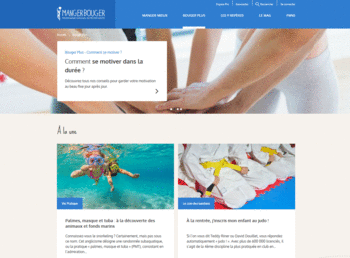
Completely redesigned, the "Move More" section of the www.mangerbouger.fr website aims to help French people increase their physical activity and reduce the time they spend sitting. Enriched with a wealth of content, the "Move More" tab allows visitors to learn about the benefits of physical activity. Visitors can then assess their level of physical activity, exercise at home using the 41 exercise guides provided, find activities that suit them, and create a program to fit into their schedule.
Physical Activity, Sedentary Lifestyle: What Are We Talking About?
Physical activity refers to all movements of the body produced by muscle contraction that result in energy expenditure greater than that of rest. It can be performed as part of work, transportation, household activities (both indoors and outdoors), and leisure (including sports and unsupervised physical exercise). Sports are physical activities in which participants adhere to a common set of rules and where a performance goal is defined (for example: team sports, gymnastics, water aerobics, running, Nordic walking, cycling, cross-country skiing, rowing, swimming).Sedentary behavior refers to situations spent in a sitting or lying position (excluding sleep and mealtimes), in which body movements are reduced to a minimum: watching television, working on a computer, playing video games, reading, talking on the phone, being a passenger in a vehicle, etc.
* Esteban is the Study on Health, Environment, Biomonitoring, Physical Activity, and Nutrition. It was conducted from April 2014 to March 2016 in mainland France on a nationally representative sample of 2,678 adults and 1,182 children aged 6 to 17.












